Weekend Times


Google Workspace

Business News

the end of daily letter deliveries is in sight

  • Written by Paul Alexander, Adjunct Associate Professor of Supply Chain Management, Curtin University
the end of daily letter deliveries is in sight

Australia Post is seeing red. A lot of it.

After posting a razor-thin profit of $23.6 million in the last six months of 2022, it anticipates a loss for the full 2022-23 financial year – only the second time since being corporatised in 1989.

The last loss was in 2014-15, following a $190 million investment in “transformational reform” of Australia Post’s letters business. At the time, it expressed confidence those efficiency improvements[1] would allow it “to maintain a five-day-a-week delivery”. Now it is pessimistic. With the ongoing collapse in demand for letter delivery, it sees only more losses ahead.

That’s a huge problem, because Australia Post has two main obligations, enshrined in federal legislation. It is required to operate on commercial principles – that is, the federal government wants it to deliver a dividend – while also meeting strict community service obligations[2].

Those obligations – established in 1989 and last reviewed in 2019[3] – require delivering letters to 98% of all Australian addresses five days a week, and in more remote areas to 99.7% of addresses at least twice a week, generally within two days of posting.

The Morrison government temporarily relaxed[4] those obligations between May 2020 and June 2021 so Australia Post could divert resources to its parcel delivery services as online shopping boomed during the pandemic. Now the organisation wants those community service obligations reduced permanently.

Read more: COVID hands Australia Post opportunity to end daily delivery[5]

Cost of service obligations

Meeting the obligations cost $348.5 million in 2021-22, says a federal government discussion paper on “postal services modernisation[6]” published this month. It says they “are no longer financially sustainable and are not well targeted at the needs of Australians due to changes brought about by the digitisation of the economy”.

It’s hard to disagree. The numbers are incontrovertible. The hundreds of millions of dollars a year being lost on letter delivery will only get bigger. People just don’t need a daily postal service like they used to.

In the red, and dying

In the 2021-22 financial year, Australia Post made a slim profit of $55 million on revenues of $8.97 billion. That’s a 0.6% profit margin, far below the 8.5% average within the transport services sector[7].

The surplus was due only to its parcel-delivery business, which grew about 12% in 2021-22 after four years of growing at more than 20%. Letters now account for less than 20% of Australia Post’s revenue.

The discussion paper notes letter volumes in Australia is now less than half what they were in 2008. This is not as severe as countries such as New Zealand or Denmark, but worse than Germany, Japan, the United States and the United Kingdom.

Declines in postal organisation letter volumes
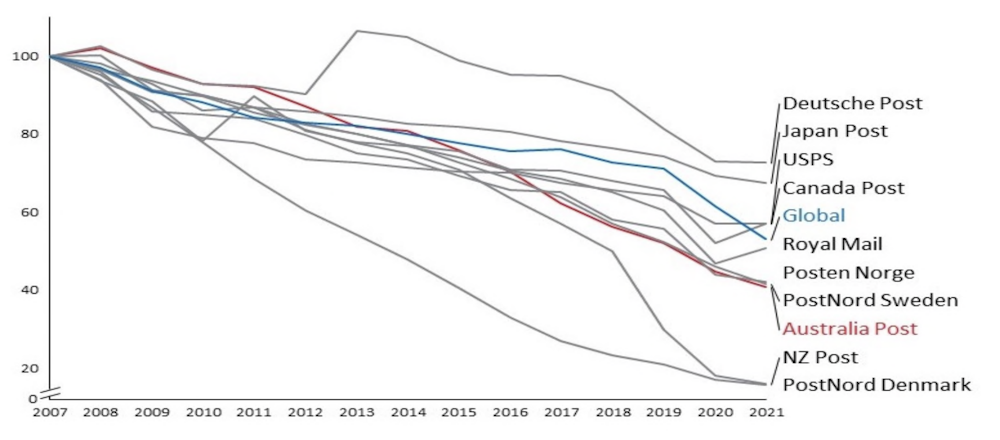
Australian Government, Postal Services Modernisation Discussion Paper, March 2023
Australian Government, Postal Services Modernisation Discussion Paper, March 2023, CC BY[8][9] Government agencies and businesses now account for 97% of mail sent. Overall volume will decline as they move to cheaper, more efficient online methods. Even major postal events like election campaigns are likely to disappear, with postal voting replaced by digital technology[10]. What can be done? The discussion paper flags a range of possible responses. One is to charge higher prices. Britain’s Royal Mail, for example, has raised postage prices by 64% over the past five years[11]. Australia Post increased the rate for standard letter delivery from A$1.10 to A$1.20 in January, which the discussion paper notes is significantly less than the average of $2.08 for OECD countries. Higher prices may boost profit for a year or two, but in the longer term will just accelerate the transition to non-postal methods. Another option is investing in more efficient sorting technology, particularly automation. The French and German postal services are doing this. But Australia Post has already made huge investments in efficiencies, and doing more will cost the federal government money – something it won’t want to do given the budget position. What about local post offices? Another option is to reduce Australia Post’s network of post offices, of which there are more than 4,300. This number is tied to another community service obligation: that no one live further than 2.5km from a post office in a metropolitan area, or 7.5km in a non-metropolitan area. The discussion paper notes Australia has more post offices than supermarkets. They cost $1.3 billion to operate in 2021-22. These provide posting, pickup, banking, transaction and retail services. But their need is diminishing as all things are progressively digitised. An argument could be made that some, at least in metropolitan areas, could be replaced with smart lockers for parcel pick-up. But that’s likely to be politically contentious, with less financial gain, than the most obvious choice – to scrap the community service obligation to deliver post five days a week. New Zealand’s postal service did this in 2013, moving to delivery every other day. Sweden did so in 2020 as a trial, with the intention of making it permanent. Some will miss the daily service. But most of us won’t. As the relaxation to deliveries every second day showed during the COVID period, it is likely most people won’t even notice. References^ efficiency improvements (auspost.com.au)^ community service obligations (auspost.com.au)^ last reviewed in 2019 (www.transparency.gov.au)^ temporarily relaxed (www.legislation.gov.au)^ COVID hands Australia Post opportunity to end daily delivery (theconversation.com)^ postal services modernisation (www.infrastructure.gov.au)^ transport services sector (www.abs.gov.au)^ Australian Government, Postal Services Modernisation Discussion Paper, March 2023 (www.infrastructure.gov.au)^ CC BY (creativecommons.org)^ digital technology (101blockchains.com)^ 64% over the past five years (www.citizensadvice.org.uk)Authors: Paul Alexander, Adjunct Associate Professor of Supply Chain Management, Curtin University

Read more https://theconversation.com/post-apocalypse-the-end-of-daily-letter-deliveries-is-in-sight-201094

The Weekend Times Magazine

The Aussie Man Launches Debut Range of Men’s Grooming Products

Brand new Australian made men’s skincare company The Aussie Man has today announced the launch of their new range of organic skincare.  The Aussie Man uses hero natural ingredients such as...

Prime Minister interview with Karl Stefanovic and Alison Langdon, Today

KARL STEFANOVIC: Joining us now from Kirribilli House in Sydney. PM, good morning to you. Thank you for your time.    PRIME MINISTER: G’day Karl.   STEFANOVIC: The Premiers don't seem to be listening...

The Role of Headless CMS in Modern Digital Architecture

With a constantly evolving digital architecture landscape, firms are continuously searching for novel avenues that guarantee nimbleness, flexibility, and scalability. A headless CMS sits front and center as one of...

Why Car Sharing is dominating Car Renting

Sustainability, budget, urban living, lack of parking – these are just a few of the reasons that many people are choosing not to buy cars in today’s environment. ...

4 Simple Tips To Help You Relax This Weekend

After a long week of hard work, a relaxing weekend is much needed. Often, some people just don't know how to lay back and enjoy their weekend without getting stressed...

Essential Packaging Materials That Support Business Efficiency in Melbourne

Reliable access to packaging materials is a key factor in how smoothly businesses operate across storage, shipping, and distribution processes. Companies that depend on packaging supplies Melbourne understand that packaging is...

Why Lighting Stores Perth Are the Key to Brightening Homes and Businesses

The right lighting can transform a room from dull to dynamic, highlight architectural details, and create an inviting environment for living, working, or entertaining. For those in Western Australia, visiting...

Protecting Properties with Durable Security Fencing

From residential homes to large commercial facilities, strong and reliable fencing provides peace of mind by keeping intruders out and safeguarding what matters most. Among the many options available, security...

Aussies get budget savvy with surge in deferred payment of bills

Deferit co-founders Mat Blas and Jonty Hirsowitz Deferit, a payment platform exclusively focused on helping people pay their bills on time, has released new data on the huge uptake of its...