China's experience with mobile payments highlights the pros and cons of a cashless society
- Written by: Wanglin Ma, Associate Professor of Economics, Lincoln University, New Zealand
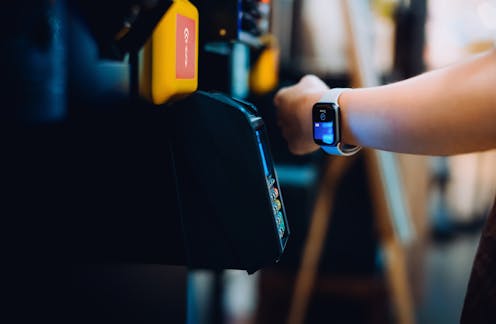
An increasing number of people are using mobile devices – their smartphone, a smartwatch or tablet – to pay for goods and services. Mobile devices allow people to complete transactions without using cash or a traditional bank card, making shopping quicker and easier.
Our recent research[1] on China’s experience with mobile payments even suggests that people who pay with mobile devices are happier than those who do not.
While China’s experience with mobile payments over the past decade highlights some of the benefits of using digital devices to pay for everyday items, it also illustrates how accessibility issues can leave sections of the community behind.
Although mobile payments have been around since the early 2000s, they did not take off until the widespread adoption of smartphones. PayPal launched its first product for mobile phones in 2006[2], allowing customers to pay others via text message. M-PESA[3] was launched soon after in Kenya in 2007. Google launched its digital wallet in 2011[4] and Apple launched[5] its own version of the digital wallet in 2014.
Over the past two decades, China has emerged as the front runner in mobile payment usage. More than 87% of China’s internet users[6] were using mobile payment services in 2021. The high rate of internet usage, a supportive regulatory framework and the government’s push for a cashless society[7] – with COVID-19 as the impetus to introduce the digital yuan to replace physical bank notes – all contributed to the success of mobile payments in China.
Leading mobile payment platforms Alipay and WeChat Pay, which boast over a billion users each[8], are leading the way. Alipay is a mobile payment app and digital wallet that also allows users to order a taxi, apply for a credit card and buy insurance. WeChat Pay is a payment feature integrated within the instant messaging app WeChat. Both apps allow users to leave their physical wallet at home in favour of just their smartphone or smartwatch.
But China is not alone in this digital revolution. New Zealanders are also increasingly embracing mobile payments[9] instead of cash.
More than just convenient
On the surface, the benefits of mobile payments may seem trivial – they allow people to shop without the need for cash.
But mobile payments can help reduce costs on essentials like food bills[10]. In earlier research, we found mobile payment users in China spent 2,347 yuan (roughly NZ$546) less on food each year. These savings stemmed from the fact that people using mobile payments for their shopping were able to take advantage of time-sensitive online promotional offers at the checkout.
Read more: A cashless society and the five forms of mobile payment that will get us there[11]
Mobile payments also helped increase farmers’ resilience to adverse weather events[12] by allowing them to access money from family and friends outside the affected areas. This access to funds that could then be spent via mobile payments allowed the farmers to remain solvent in the aftermath of a natural disaster.
Mobile payments can boost rural household consumption[13] by making shopping easier for communities that may not have access to traditional financial services such as banks. Mobile payments have also been found to create business opportunities[14] by helping small entrepreneurs become more nimble, increasing their appetite for risk and easing credit constraints by allowing them to take advantage of micro-lending services.
And mobile payments can measurably increase a person’s happiness, particularly in rural areas.
Analysing data from the 2017 Chinese General Social Survey and measuring happiness on a five-point scale, we found that using mobile payments was associated with a 0.76 point increase in happiness in rural China. No changes in happiness were observed for city dwellers.
The increased happiness was likely due to the convenience of mobile payments, helping people seamlessly pay for a broad spectrum of goods and services.
In terms of gender, using mobile payments affected women’s happiness more than men’s, regardless of where they lived. In rural China, using mobile payments was associated with a 0.83 point increase in women’s happiness compared to a 0.69 point increase in men’s happiness.
We found education increased the likelihood of someone using mobile payments. And being socially active was also positively associated with mobile payment use. But the data showed that the older the person, the less likely they were able to use mobile payments.
Ensuring accessibility
While there are clear positives to the widespread use of mobile payments, one of the potential stumbling blocks has been the issue of accessibility. As the global pandemic spread in 2020, concerns were raised that China’s older cash-using residents were being excluded by the push towards mobile payment options[15].
Read more: Cash and the coronavirus: COVID-19 is changing our relationship with money[16]
New Zealand could face similar issues. Concerns have already been raised by the reduction of bank branches in favour of online banking[17] and what this means for older people and those with limited access to the internet.
While 95% of New Zealanders have access to the internet – either via landlines or on their phones – 31% of those in social housing and 29% of people with disabilities report not having any access[18].
Considering the documented benefits of mobile payments and their growing usage, service providers should invest in easy-to-use user interfaces for people from all walks of life. If managed well, the growing popularity of mobile payments in New Zealand could positively impact society, promoting financial inclusion, convenience and wellbeing.
References
- ^ Our recent research (link.springer.com)
- ^ first product for mobile phones in 2006 (money.cnn.com)
- ^ M-PESA (www.vodafone.com)
- ^ digital wallet in 2011 (www.theguardian.com)
- ^ Apple launched (www.theguardian.com)
- ^ 87% of China’s internet users (www.statista.com)
- ^ push for a cashless society (www.eyeonasia.gov.sg)
- ^ billion users each (www.csis.org)
- ^ increasingly embracing mobile payments (sba.co.nz)
- ^ food bills (www.tandfonline.com)
- ^ A cashless society and the five forms of mobile payment that will get us there (theconversation.com)
- ^ adverse weather events (doi.org)
- ^ rural household consumption (doi.org)
- ^ create business opportunities (doi.org)
- ^ mobile payment options (www.sixthtone.com)
- ^ Cash and the coronavirus: COVID-19 is changing our relationship with money (theconversation.com)
- ^ bank branches in favour of online banking (www.stuff.co.nz)
- ^ not having any access (www.psa.org.nz)
Authors: Wanglin Ma, Associate Professor of Economics, Lincoln University, New Zealand