how a real-life Cold War defection became a soothing spy story for anxious Australians
- Written by: Melanie Brand, Lecturer in Intelligence Studies, Macquarie University
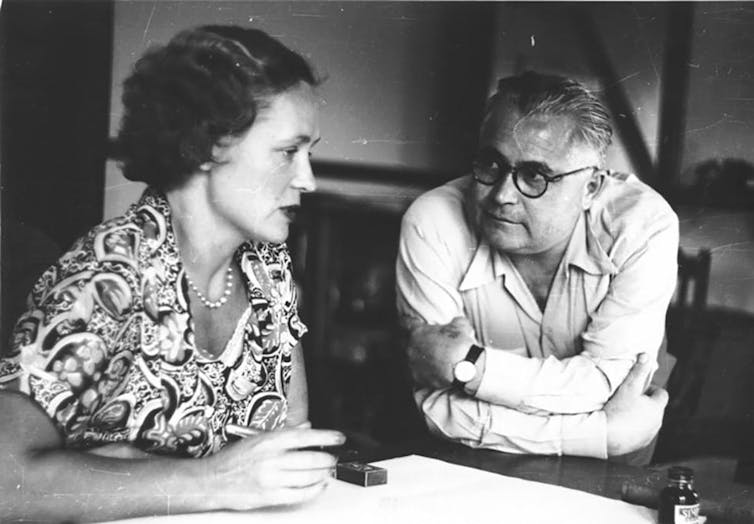
This year marks 70 years since Soviet diplomat Vladimir Petrov sensationally defected to Australia shortly before the 1954 election, beginning what came to be known as the “Petrov affair[1]”. The defection itself is interesting – but what’s equally fascinating is how the Australian media covered the Petrov affair.
The story dominated press coverage for months. With little experience of international spying beyond the narratives of popular culture, the Australian media told the story of the Petrov affair using the familiar formulas of spy fiction and film. This coverage transformed Australia’s unsettling involvement in the world of international espionage into thrilling and sensational entertainment.
This framing – as an exciting but familiar drama – may have helped Australians manage their anxiety about the threat posed by Soviet espionage.
Read more: Chinese 'spy' case may be the greatest challenge to Australian security since Petrov – but caution is needed[2]
Hollywood spy drama come to life
The key plot points of the Petrov affair are straightforward. After a carefully planned Australian Security Intelligence Organisation (ASIO) operation, Vladimir Petrov – a KGB officer based in the Soviet embassy in Canberra – was convinced to defect to Australia in 1954, providing information in exchange for political asylum.
From the beginning, the Australian press portrayed the events of the Petrov affair as entertainment for their eager readers.
As the Bulletin[3] put it at the time, Australians had long read of espionage in Europe and
felt a vicarious thrill of horror as they have read of hairbreadth escapes across borders and of spy rings.
Now their own country was a world in which Hollywood spy drama had come to life.
In media[4] reports Australians were promised the Petrov affair contained
all the elements of a spy thriller – undercover agents, secret service men, a spy ring, secret hiding places and bribery.
And it featured an all-star cast. As one report[5] put it:
the actors of the moment seem larger than life; their actions wilder than in any of the most lurid spy thrillers.
Mrs Petrov defects
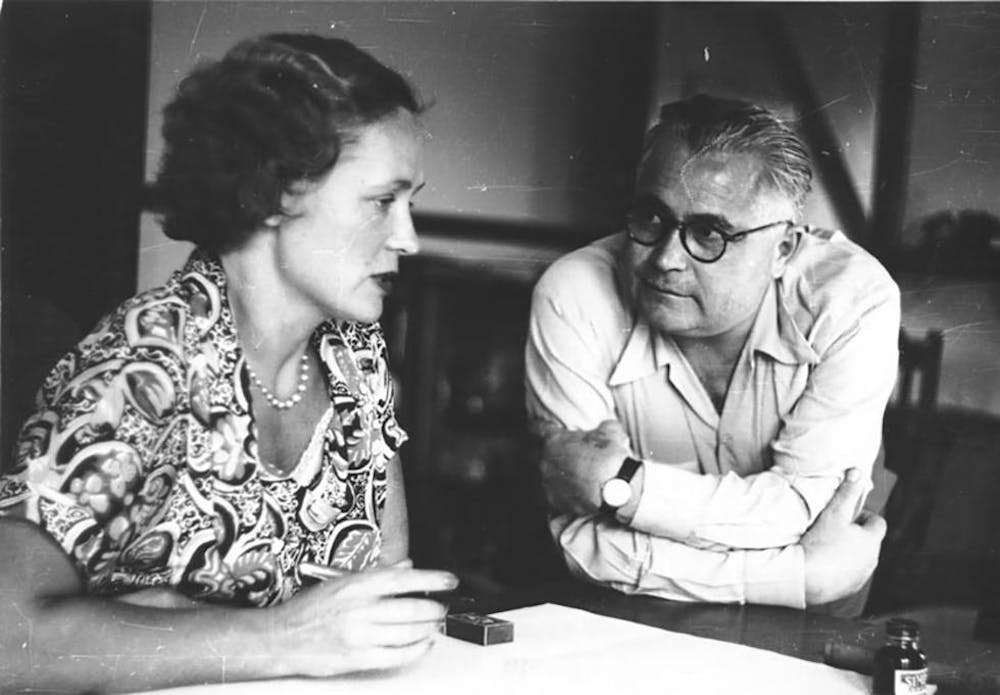
The undoubted “star of our biggest real life spy story”, as one report[7] called her, was Evdokia Petrova, Vladimir’s glamorous[8] wife.
From her first interview[9], given the day after her husband’s defection, Evdokia looked the part of a classic Hollywood damsel in distress.
This effect was only increased days later, when Evdokia appeared to be forcibly dragged on to a plane[10] to the Soviet Union by two armed guards.
Pictures[11] of Evdokia’s distressed face as she was led toward the plane, one shoe lost in the scuffle, were plastered across every newspaper in the country.
When Evdokia herself decided to defect a few hours later, Australia rejoiced[12].
Evdokia, according[13] to Woman’s Day, was
the star of a thriller more tense and terrible than anything Alfred Hitchcock ever brought to the screen.
Indeed, journalists seemed in agreement[14] that for
sheer breathtaking drama, no thriller writer has beaten the true story of how Mrs Petrov escaped the grim clutches of Moscow’s goon squad.
The show begins
Petrov’s claims of a Soviet spy ring in Australia prompted a royal commission[15] soon after his defection.
The first hearings of this inquiry were as heavily anticipated as the opening of a Hollywood blockbuster[16].
Journalists spoke of the “the blood-chilling revelations” on offer, and of “the shadow of Moscow” that seemed to linger over the inquiry[17].
Journalist Hal Richardson set the scene[18] for readers of the Melbourne Argus:
There were figures so shadowy in Albert Hall this week that when you walked out into the open they seemed to disintegrate in the fragile reality of Canberra’s winter sunshine. But they were real […] And you wondered whether it was the cold outside or the shadows inside that sent shivers through you.
The leading man
Although Vladimir Petrov was undeniably a main character in the drama, his appearance at the Royal Commission was something of a let-down.
Rather than the dashing and handsome secret agent the Australian public had expected, “the leading man, Petrov himself” was instead “no matinee idol[19]”.
Those who attended the inquiry “expecting a chapter, or anyway a page or two, out of an Eric Ambler spy novel,” came away disappointed.
“Petrov looked nothing like a spy to me,” admitted one journalist.
Instead, one reporter opined[20], Petrov was “just a podgy man in a dark-blue suit”.
Others[21] observed “Petrov would not fit any fictional portrayal of an international spy”.
That these writers felt they knew what a spy should look like highlights the strong influence of popular culture on public perceptions of the Petrov affair.
The familiarity of formula fiction eases anxiety
The Australian media coverage of these events transformed the country’s brush with the clandestine events of the Cold War into something closer to entertainment.
The Petrov affair was “the spy thriller [that] outdoes fiction” and the Australian public was its audience.
As my research outlines, the Australian press and public leveraged their knowledge of popular culture to interpret events, using the common formulas of espionage fiction to understand the startling revelations stemming from Petrov’s defection.
To some extent, this dynamic continues today and many Australians still view[22] the work of intelligence agencies and their staff[23] through the lens of popular culture.
The secrecy that surrounds intelligence means the representations of intelligence found in popular culture are often the only way that hidden activities can be known and understood[24].
Read more: ASIO history: chasing Russian spies and local communists[25]
References
- ^ Petrov affair (www.nma.gov.au)
- ^ Chinese 'spy' case may be the greatest challenge to Australian security since Petrov – but caution is needed (theconversation.com)
- ^ Bulletin (trove.nla.gov.au)
- ^ media (trove.nla.gov.au)
- ^ report (trove.nla.gov.au)
- ^ National Archives Australia (www.naa.gov.au)
- ^ report (catalogue.nla.gov.au)
- ^ glamorous (trove.nla.gov.au)
- ^ first interview (trove.nla.gov.au)
- ^ forcibly dragged on to a plane (petrov.moadoph.gov.au)
- ^ Pictures (trove.nla.gov.au)
- ^ rejoiced (trove.nla.gov.au)
- ^ according (catalogue.nla.gov.au)
- ^ agreement (trove.nla.gov.au)
- ^ royal commission (www.naa.gov.au)
- ^ Hollywood blockbuster (trove.nla.gov.au)
- ^ inquiry (trove.nla.gov.au)
- ^ set the scene (trove.nla.gov.au)
- ^ no matinee idol (trove.nla.gov.au)
- ^ opined (trove.nla.gov.au)
- ^ Others (trove.nla.gov.au)
- ^ view (theconversation.com)
- ^ staff (www.betootaadvocate.com)
- ^ understood (www.theguardian.com)
- ^ ASIO history: chasing Russian spies and local communists (theconversation.com)
Authors: Melanie Brand, Lecturer in Intelligence Studies, Macquarie University