Australia is on the brink of ending interest rate hikes and an economic first – beating inflation without a recession
- Written by: Peter Martin, Visiting Fellow, Crawford School of Public Policy, Australian National University
What if Reserve Bank Governor Philip Lowe and his successor Michele Bullock were able to achieve something truly remarkable – a steady decline in inflation without further interest rate increases, and without bringing on a recession.
It’s suddenly looking possible. Inflation is now coming down so quickly worldwide there’s probably no need to push it down further.
We couldn’t have said that a week ago. Then, the US inflation rate was 4%[1], well down on the peak of 9.1% a year earlier, but high enough for eminent economists such as former US Treasury Secretary Larry Summers to say the US would need a mountain of unemployment to bring it down further.
Specifically, Summers said that to control inflation[2] the US would need
five years of unemployment above 5% to contain inflation – in other words, we need two years of 7.5% unemployment, or five years of 6% unemployment, or one year of 10% unemployment
That was in late June, when US inflation had slipped from 5% to 4.9% to 4% over three months. Then, it was at least arguable that it wouldn’t fall much further without another push.
No longer. Last week, we learned that US inflation plunged yet again to 3%[3] in June. Although other countries’ results for June aren’t out yet (ours is out next week) it’s now no longer easy to argue that progress isn’t real and continuing.
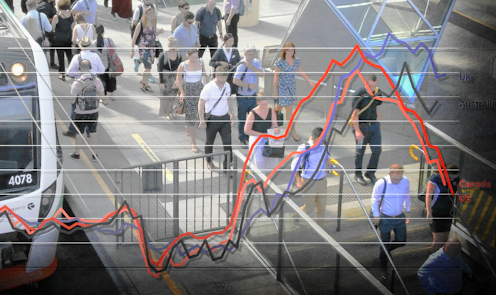
This graph of the latest monthly readings of annual inflation rates shows inflation peaked in the US, the UK, Canada and Australia late last year, and has been coming down fairly steadily since.
Summers and others in the US used to deride those who said ultra-high inflation would go away as “team transitory[4]”. But it is now looking as if that high inflation was indeed transitory, even if the transition took longer than expected.
Driving down inflation has been one of the key forces that drove it up: energy and transport prices, which surged in the wake of Russia’s February 2022 invasion of Ukraine.
US energy prices have fallen 16.7% over the past year, led down by a 26.5%[5] slide in the price of what Australians call petrol. That’s a saving that will push down Australia’s inflation rate and inflation rates worldwide.
Non-energy and non-food inflation fell as well, suggesting that there isn’t (yet) a psychology of expectations holding US inflation up.
Falling inflation expectations
Here, Australians expect falling inflation, if their answers to the Melbourne Insitute’s monthly expectations survey[6] are to be believed. In June, those surveyed expected inflation of 5.2% in the year ahead, down from 6.3% a year earlier.
This makes Australians less likely than they were to bake high inflation into wage negotiations and other decisions, making it less likely inflation will remain high.
And it ought to be noted that the inflation Australians say they expect has traditionally been much more than what’s been delivered[7]. That’s presumably because most of us notice the prices that are going up more than those that aren’t.
A soft landing, without a recession
The much quicker than expected[8] collapse in US inflation has dramatically raised the likelihood of what’s called a “soft landing[9]” in the US. Here in Australia, it’s what our current Reserve Bank Governor has called staying on the “narrow path[10]” of returning inflation to target in a reasonable timeframe, without a recession.
If that happens, finance journalist Alan Kohler[11] says Lowe and his successor Michele Bullock (who takes over in September) will be the first team at the top of the bank to get inflation down from above 7% without delivering a recession.
There was a recession when the bank tried to get inflation down below 7% in the mid-1970s, in the early 1980s, and in the early 1990s.
That we might be able to pull off yet another first ought no longer to surprise us, after all of the firsts during COVID. Enduring Australia’s (brief) 2020 recession without unemployment climbing above 7% was also a first.
The minutes of the Reserve Bank’s June board meeting released on Tuesday show it is prepared to countenance[12] such a first.
The bank’s board members acknowledged that inflation was “now declining, albeit from a high level”, while falling commodity and shipping prices were cutting cost pressures. All this before the full effect[13] of the bank’s 12 rate rises to date has been felt.
Read more: Meet Michele Bullock, the RBA insider tasked with making the Reserve Bank more outward-looking as its next governor[14]
Remember, these are minutes of a meeting that took place before last week’s extraordinarily good news from the US. So those board members’ comments hold open the possibility of Australia keeping the bulk of its gains in employment, while getting inflation back down to controllable levels.
The fact that it has never happened before hasn’t stopped the economics team at the ANZ Bank from predicting[15] it – no further rate rises from here on, a continuing slide in inflation, and only a modest uptrend in unemployment.
Read more: New findings show a direct causal relationship between unemployment and suicide[16]
A ‘Goldilocks’ economy is in sight
The “Goldilocks[17]” outcome – not too hot or too cold, but just right – would be keeping in work most of the Australians who got into work when unemployment fell and getting on top of inflation. If we can manage that, we will have done future Australians an enormous service.
Things get easier when unemployment is low. We get more likely to become more productive, because we’re less resistant to change when unemployment is less of a threat. We get in a better position to help the budget, by taking less in benefits and paying more in tax. And we become more like each other – lessening inequality.
It is looking as if the Reserve Bank has the opportunity to cement low unemployment while controlling inflation. Holding off (and perhaps abandoning) future rate raises will keep it in reach.
Our next official inflation update, due out next Wednesday, will matter a lot.
References
- ^ 4% (tradingeconomics.com)
- ^ control inflation (slate.com)
- ^ 3% (edition.cnn.com)
- ^ team transitory (www.washingtonpost.com)
- ^ 26.5% (www.bls.gov)
- ^ expectations survey (melbourneinstitute.unimelb.edu.au)
- ^ much more than what’s been delivered (tradingeconomics.com)
- ^ quicker than expected (www.forbes.com)
- ^ soft landing (www.nytimes.com)
- ^ narrow path (www.rba.gov.au)
- ^ Alan Kohler (thenewdaily.com.au)
- ^ countenance (www.rba.gov.au)
- ^ full effect (theconversation.com)
- ^ Meet Michele Bullock, the RBA insider tasked with making the Reserve Bank more outward-looking as its next governor (theconversation.com)
- ^ predicting (cdn.theconversation.com)
- ^ New findings show a direct causal relationship between unemployment and suicide (theconversation.com)
- ^ Goldilocks (www.investopedia.com)
Authors: Peter Martin, Visiting Fellow, Crawford School of Public Policy, Australian National University