
Google AI

Weekend Times


The Times

Business News

One year on, El Salvador's Bitcoin experiment has proven a spectacular failure

  • Written by: John Hawkins, Senior Lecturer, Canberra School of Politics, Economics and Society, University of Canberra

One year on, El Salvador's Bitcoin experiment has proven a spectacular failure

A year ago, El Salvador became the first country to make Bitcoin legal tender – alongside the US dollar, which the Central American country adopted in 2001 to replace its own currency, the colón.

President Nayib Bukele, a cryptocurrency enthusiast, promoted the initiative as one that would deliver multiple economic benefits.

Making Bitcoin legal tender, he said[1], would attract foreign investment, generate jobs and help “push humanity at least a tiny bit into the right direction”.

His ambitions extended to building an entire “Bitcoin city” – a tax-free haven funded[2] by issuing US$1 billion in government bonds[3]. The plan was to spend half the bond revenue on the city, and the other half on buying Bitcoin, with assumed profits then being used to repay the bondholders.

El Salvador's President Nayib Bukele announced his plan for 'Bitcoin City' at a conference for cryptocurrency speculators in November 2021.
El Salvador’s President Nayib Bukele announced his plan for ‘Bitcoin City’ at a conference for cryptocurrency speculators in November 2021. Salvador Melendez/AP

Now, a year on, there’s more than enough evidence to conclude Bukele – who has also called himself “the world’s coolest dictator[4]” in response to criticisms of his creeping authoritarianism – had no idea what he was doing.

This bold financial experiment has proven to be an almost complete failure.

Making Bitcoin legal tender

Making Bitcoin legal tender meant much more than allowing Bitcoin to be used for transactions. That was already possible, as it is in most (but far from all[5]) countries.

If a Salvadoran wanted to pay for something in bitcoins, and the recipient was willing to accept them, they could.

But Bukele wanted more. Making bitcoins legal tender meant a payee had to accept them. As the 2021 legislation[6] stated, “every economic agent must accept Bitcoin as payment when offered to him by whoever acquires a good or service”.

Read more: Can Bitcoin be a real currency? What's wrong with El Salvador's plan[7]

To encourage Bitcoin uptake, the government created an app called “Chivo Wallet” (“chivo” is slang for “cool”) to trade bitcoins for dollars without transaction fees. It also came preloaded with US$30 as a bonus (the median weekly income is about US$360[8]).

Yet despite the law and these incentives, Bitcoin has not been embraced.

Greeted with little enthusiasm

A nationally representative survey[9] of 1,800 Salvadoran households in February indicated just 20% of the population was using Chivo Wallet for Bitcoin transactions. More than double that number downloaded the app, but only to claim the US$30.

Among respondents who identified as business owners, just 20% said they were accepting bitcoins as payment. These were typically large companies (among the top 10% of companies by size).

Business acceptance of Bitcoin in El Salvador
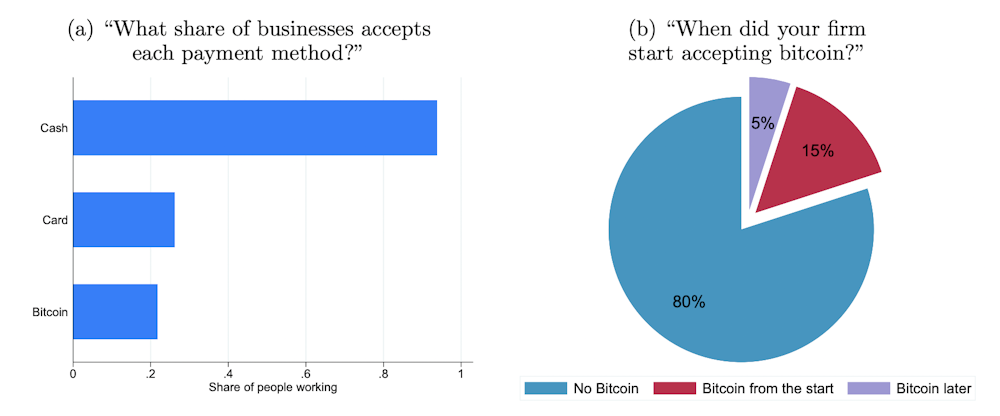
NBER Working Paper 29968, CC BY[10][11] A survey for the El Salvador Chamber of Commerce in March found only 14%[12] of businesses were transacting using Bitcoin. Making huge losses Fortunately for Salvadorans, nothing has come of the US$1 billion Bitcoin bonds scheme. But the Bukele government has still spent more than US$100 million[13] buying bitcoins – which are now worth less than US$50 million. When Bukele announced his plans in July 2021, Bitcoin’s value was about US$35,000. By the time the legislation came into effect, on September 7 2021, it was about US$45,000. Two months later, it peaked at US$64,400. Now it is trading at around US$20,000. Bukele has made self-congratulatory tweets[14] about “buying the dip” but almost all the bitcoins bought by the government have been for more than US$30,000, at an average price of more than US$40,000. A year ago, Bukele was urging his citizens to hold their money in bitcoins. For anyone who did, the losses would be devastating. Flawed analyses Bukele’s misunderstanding of Bitcoin – and economics more generally – has been demonstrated repeatedly. In June 2021 he tweeted[15]: “Bitcoin has a market cap of US$680 billion. If 1% of it is invested in El Salvador, that would increase our GDP by 25%.” This suggests he seemed to think Bitcoin was some sort of investment fund. It also showed he did not understand GDP[16]. Foreign investment is not a component of GDP. There has been no surge in foreign investment nor GDP. In a January 2022 tweet[17] he argued a “gigantic price increase is just a matter of time” because there will only ever be 21 million bitcoins while there are 50 million millionaires in the world. “Imagine when each one of them decides they should own at least ONE #Bitcoin,” he proclaimed. Bitcoin’s value has since halved. The rest of the world is not impressed The Bitcoin plan has adversely affected El Salvador’s credit rating and relations with the International Monetary Fund. With investors more wary of lending to the country, local borrowers have had to offer higher interest rates. In January the IMF urged El Salvador[18] to reverse Bitcoin’s legal lender status because of[19] the “large risks for financial and market integrity, financial stability and consumer protection”. Bitcoin is notorious for its use in scams and other illegal activities, as well as its volatility. Bukele tweeted[20] a dismissive response involving a Simpsons-themed meme. El Salvador’s President Nayib Bukele’s response to the IMF’s warnings about the risk of making Bitcoin legal tender. Twitter, CC BY[21][22] This seems particularly rash, given El Salvador has been seeking a loan[23] of more than $1 billion from the IMF. International credit rating agencies Fitch[24] has downgraded El Salvador’s credit rating this year, citing concerns about its Bitcoin policies. Read more: Cryptocurrencies are great for gambling – but lousy at liberating our money from big central banks[25] No other country with its own currency, not even ones such as Zimbabwe and Venezuela with discredited currencies, has followed suit and made Bitcoin legal tender. Given El Salvador’s record, it is is unikely any ever will. References^ he said (www.abc.net.au)^ funded (www.afr.com)^ government bonds (www.ft.com)^ the world’s coolest dictator (www.theguardian.com)^ but far from all (tile.loc.gov)^ 2021 legislation (twitter.com)^ Can Bitcoin be a real currency? What's wrong with El Salvador's plan (theconversation.com)^ is about US$360 (worldsalaries.com)^ nationally representative survey (www.nber.org)^ NBER Working Paper 29968 (www.nber.org)^ CC BY (creativecommons.org)^ only 14% (www.bloomberg.com)^ more than US$100 million (www.latimes.com)^ self-congratulatory tweets (twitter.com)^ tweeted (twitter.com)^ he did not understand GDP (theconversation.com)^ tweet (twitter.com)^ urged El Salvador (archive.ph)^ because of (www.imf.org)^ tweeted (twitter.com)^ Twitter (twitter.com)^ CC BY (creativecommons.org)^ seeking a loan (www.bloomberg.com)^ Fitch (www.fitchratings.com)^ Cryptocurrencies are great for gambling – but lousy at liberating our money from big central banks (theconversation.com)Authors: John Hawkins, Senior Lecturer, Canberra School of Politics, Economics and Society, University of Canberra

Read more https://theconversation.com/one-year-on-el-salvadors-bitcoin-experiment-has-proven-a-spectacular-failure-190229

The Weekend Times Magazine

Unique and Trendy Christmas Gift Ideas for 2025 - Best Holiday Gifts Guide

?? Discover unique and trendy Christmas gift ideas for 2025! Your ultimate guide to the best holiday gifts is here! ?? The Importance of the Holiday Season The holiday season is a...

Dentists in Sydney: Your Guide to Dental Care

Sydney, Australia is home to the absolute best dental experts in the country. With a different range of services and specialties, dental specialists in Sydney take care of different needs...

Horse Float Maintenance: Keeping Your Investment in Top Shape

Horse floats are equipment that are required for the safe and efficient transportation of horses. Long life and performance are assured with proper maintenance. Safety risks and structural damage may...

When AEC IT breaks, It Rarely Looks Like IT

AEC businesses rarely lose time to one dramatic outage. What hurts more are the small, repeat delays that show up right when pressure is highest. The drawing set stalls, the...

Why Sydney Never Stops Welcoming the World

Every weekend, Australia's harbour city reminds us why international tourism matters. Walk through Circular Quay on a Saturday morning and you'll hear dozens of languages before you've finished your coffee. Families photograph...

All the Things You Need to Know Before Flying to Cairns

Cairns is the gateway to Queensland, offering a tropical climate and a relaxing atmosphere, making it an ideal destination for outdoor activities. The city has iconic destinations, charming cafes, lively...

Should I get a COVID vaccine while I’m pregnant or breastfeeding?

From Monday, Australia’s front-line health workers, quarantine staff, border control officers, and workers and residents in aged-care homes will be offered the Pfizer COVID-19 vaccine. Some of these workers will be...

The Future of the Sales Handoff: From AI SDR to Human Closer

Artificial intelligence is altering the sales process at lightning speed. For many firms, AI is their Sales Development Representative. This class of SDRs completes the initial stage of the sales...

How Much Should a Small Business Actually Budget for a Website in 2026?

Three quotes land in the same inbox. One says $890. One says $4,600. One says $11,000. All three are for a five-page website for the same Sydney plumbing business. All three...

hacklink esim new zealandmarsbahismarsbahismeritkinghacklink panelBetim