the case against death duties just got stronger
- Written by: Richard Holden, Professor of Economics, UNSW

If you are worried about inequality you probably lament the end of death duties[1].
At first in Queensland and then in the rest of the country, Australia became one of the first nations in the world[2] to abolish death duties in the late 1970s.
Surely an inheritance tax (that’s what a death duty is) would cut the size of inheritances, reducing the intergenerational transmission of inequality.
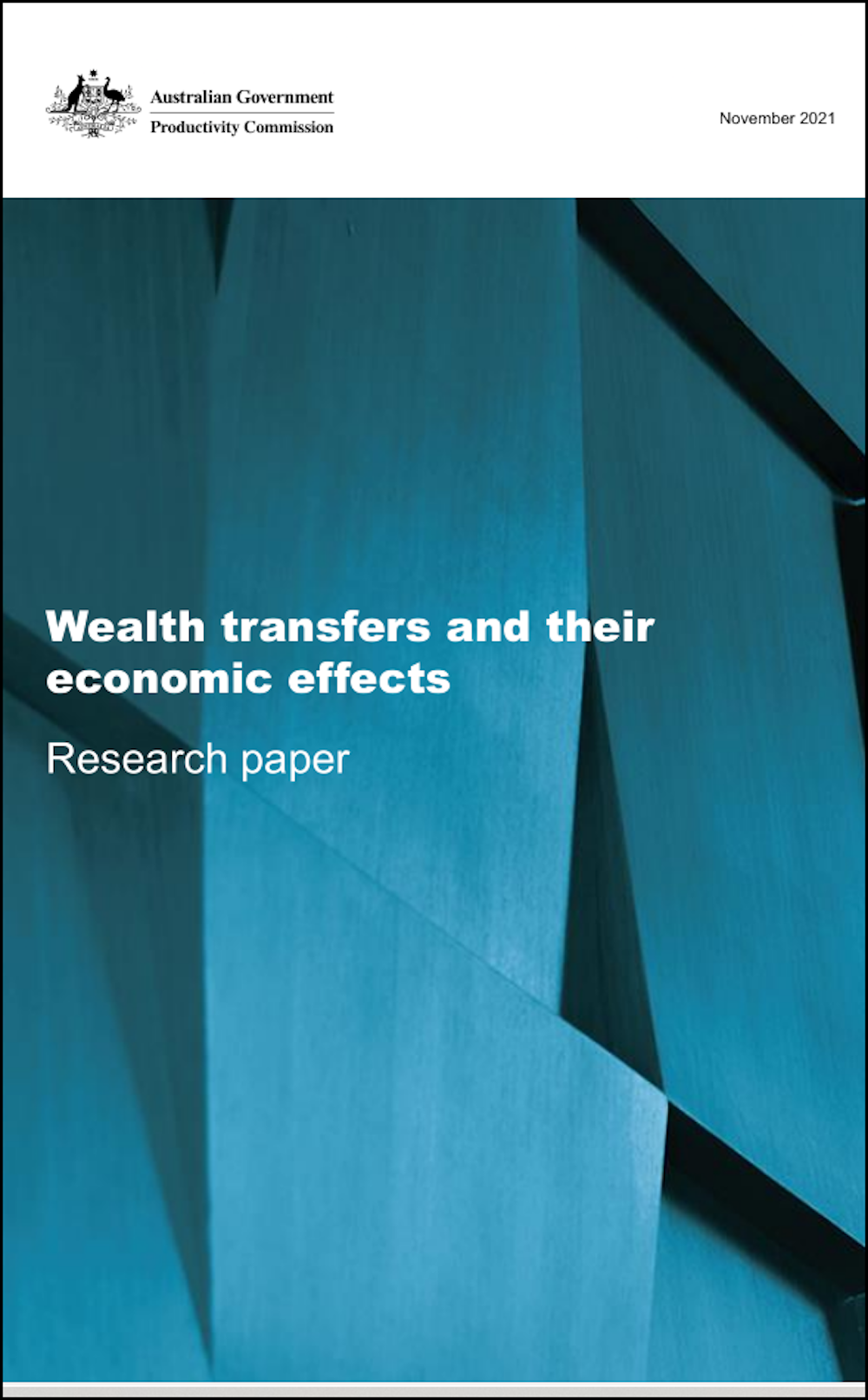
Actually no, according to a groundbreaking study released on Tuesday by the Productivity Commission[3].
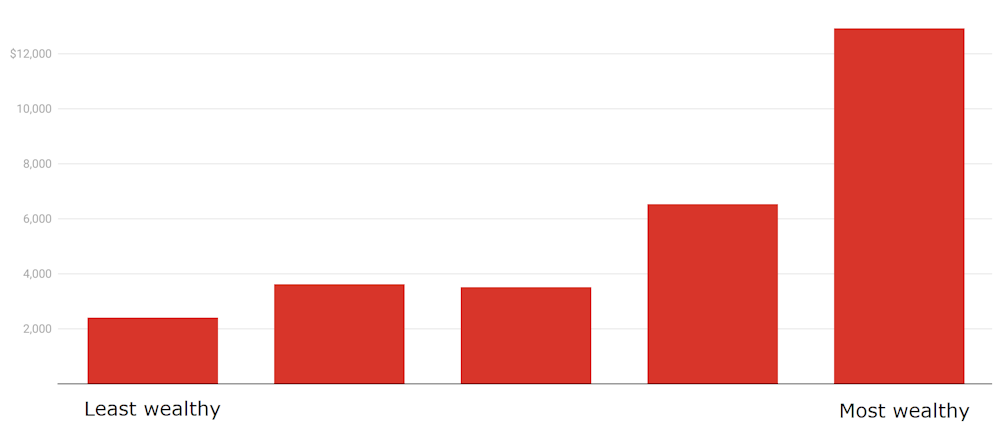 Average equivalised wealth transfer received among all people in a three-year period, by initial equivalised wealth quintile.
Productivity Commission[6]
The extra thing the commission discovered was that as a proportion of the wealth they already have, inheritances lift the wealth of the bottom fifth of the population far, far more than that of people better off.
And this isn’t a peculiarly Australian phenomenon. The commission finds it is true in most advanced economies.
Average wealth transfer as share of initial wealth
Average equivalised wealth transfer received among all people in a three-year period, by initial equivalised wealth quintile.
Productivity Commission[6]
The extra thing the commission discovered was that as a proportion of the wealth they already have, inheritances lift the wealth of the bottom fifth of the population far, far more than that of people better off.
And this isn’t a peculiarly Australian phenomenon. The commission finds it is true in most advanced economies.
Average wealth transfer as share of initial wealth
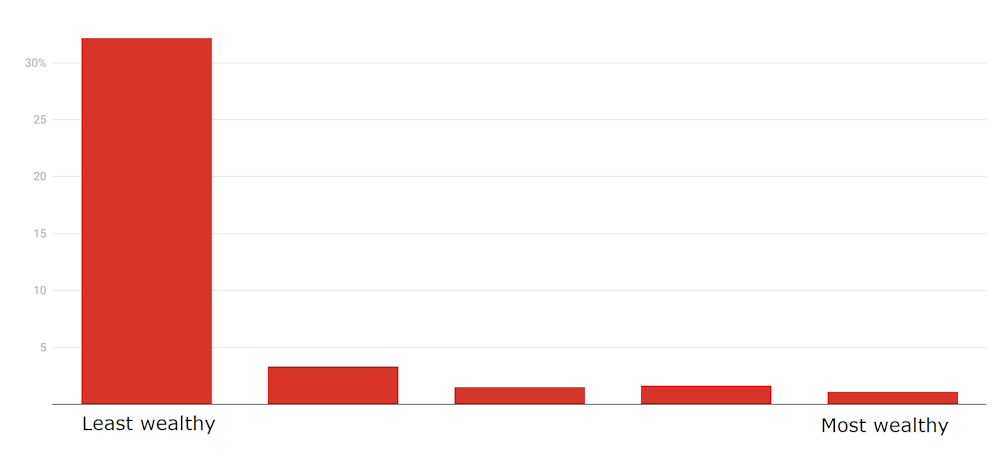 Average equivalised wealth transfer in a three-year period as a share of average initial equivalised wealth by initial wealth quintile.
Productivity Commission[7]
So ought we to make sure inheritance taxes stay dead?
In our forthcoming book “From Free to Fair Markets: Liberalism after COVID[8]”,
Rosalind Dixon and I argue that’s exactly what we should do.
In 2010 the late Emmanuel Farhi and Ivan Werning examined optimal taxation in a setting where society cared about current and future generations.
They found that in such a situation, the best death duty would be negative[9] – that we should subsidise inheritances to stop parents consuming too much and children getting too little.
What about a progressive inheritance tax?
One way to get the benefits of inheritances and still fight inequality would be to exempt from tax modest-size bequests and tax larger bequests even more.
This could be done by making inheritances of up to, say, $100,000 tax-free, and everything over that taxed (increasingly) heavily.
But there would be a big incentive to come in just under the cap.
Just as retirees moved to Queensland[10] to avoid death duties (and appeared to adjust the timing[11] of their deaths) retirees with a lot of wealth would find it worthwhile to give big gifts to their children ahead of their deaths – which would have to be caught by a gift duty.
Read more:
Rethink inheritances. These days they go to the already middle-aged[12]
The gift duty might have to take in deposits for houses and childcare and school fees (and to be equitable, perhaps childcare in kind provided by grandparents!).
And then you would get into really murky territory. People would want to exempt things such as homes, which could lead to even more upward pressure on home prices if more and more wealth got transferred in the form of homes.
It isn’t going to happen
In any event, in Australia, it isn’t going to happen.
Death duties are common around the world. Across the OECD[13], 24 countries have inheritance or estate taxes, among them the US, the UK, Korea and Germany.
Canada, New Zealand and Australia are among the smaller number of countries that had such taxes and then withdrew them.
The mere (incorrect) assertion that Labor would bring them back helped cost it the 2019 election.
Average equivalised wealth transfer in a three-year period as a share of average initial equivalised wealth by initial wealth quintile.
Productivity Commission[7]
So ought we to make sure inheritance taxes stay dead?
In our forthcoming book “From Free to Fair Markets: Liberalism after COVID[8]”,
Rosalind Dixon and I argue that’s exactly what we should do.
In 2010 the late Emmanuel Farhi and Ivan Werning examined optimal taxation in a setting where society cared about current and future generations.
They found that in such a situation, the best death duty would be negative[9] – that we should subsidise inheritances to stop parents consuming too much and children getting too little.
What about a progressive inheritance tax?
One way to get the benefits of inheritances and still fight inequality would be to exempt from tax modest-size bequests and tax larger bequests even more.
This could be done by making inheritances of up to, say, $100,000 tax-free, and everything over that taxed (increasingly) heavily.
But there would be a big incentive to come in just under the cap.
Just as retirees moved to Queensland[10] to avoid death duties (and appeared to adjust the timing[11] of their deaths) retirees with a lot of wealth would find it worthwhile to give big gifts to their children ahead of their deaths – which would have to be caught by a gift duty.
Read more:
Rethink inheritances. These days they go to the already middle-aged[12]
The gift duty might have to take in deposits for houses and childcare and school fees (and to be equitable, perhaps childcare in kind provided by grandparents!).
And then you would get into really murky territory. People would want to exempt things such as homes, which could lead to even more upward pressure on home prices if more and more wealth got transferred in the form of homes.
It isn’t going to happen
In any event, in Australia, it isn’t going to happen.
Death duties are common around the world. Across the OECD[13], 24 countries have inheritance or estate taxes, among them the US, the UK, Korea and Germany.
Canada, New Zealand and Australia are among the smaller number of countries that had such taxes and then withdrew them.
The mere (incorrect) assertion that Labor would bring them back helped cost it the 2019 election.
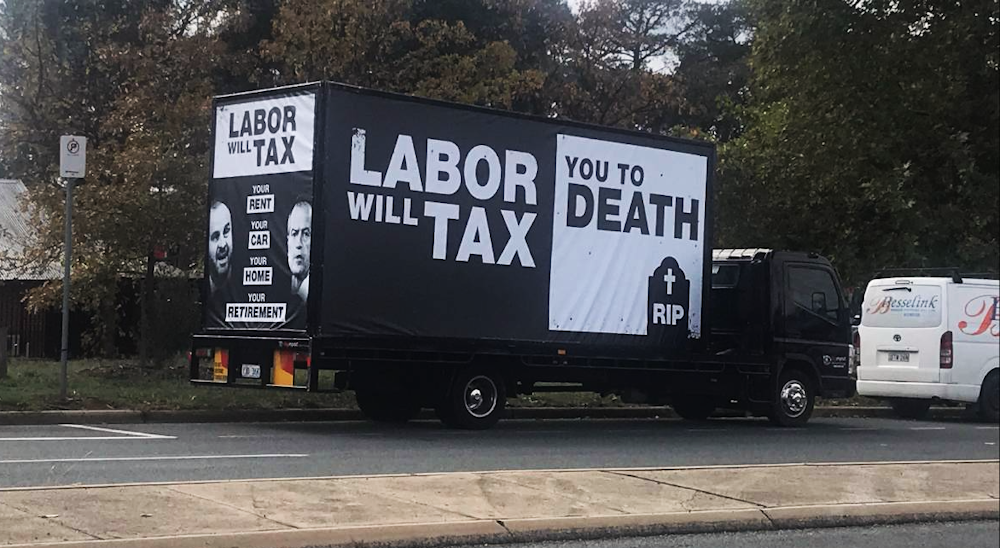 A mobile billboard parked at locations around Canberra during the 2019 election.
Sally Whyte
Labor no longer has the stomach for a tax on emissions[14] that would actually work.
It most certainly doesn’t have the stomach for one that would make it harder for parents to pass on things to their children, probably worsen inequality, and complicate the tax system even further.
References^ death duties (classic.austlii.edu.au)^ first nations in the world (researchbank.swinburne.edu.au)^ Productivity Commission (www.pc.gov.au)^ Productivity Commission (www.pc.gov.au)^ Catherine de Fontenay (www.pc.gov.au)^ Productivity Commission (www.pc.gov.au)^ Productivity Commission (www.pc.gov.au)^ From Free to Fair Markets: Liberalism after COVID (richardholden.org)^ negative (dspace.mit.edu)^ moved to Queensland (www.smh.com.au)^ timing (papers.ssrn.com)^ Rethink inheritances. These days they go to the already middle-aged (theconversation.com)^ OECD (www.oecd.org)^ tax on emissions (thenewdaily.com.au)Authors: Richard Holden, Professor of Economics, UNSW
A mobile billboard parked at locations around Canberra during the 2019 election.
Sally Whyte
Labor no longer has the stomach for a tax on emissions[14] that would actually work.
It most certainly doesn’t have the stomach for one that would make it harder for parents to pass on things to their children, probably worsen inequality, and complicate the tax system even further.
References^ death duties (classic.austlii.edu.au)^ first nations in the world (researchbank.swinburne.edu.au)^ Productivity Commission (www.pc.gov.au)^ Productivity Commission (www.pc.gov.au)^ Catherine de Fontenay (www.pc.gov.au)^ Productivity Commission (www.pc.gov.au)^ Productivity Commission (www.pc.gov.au)^ From Free to Fair Markets: Liberalism after COVID (richardholden.org)^ negative (dspace.mit.edu)^ moved to Queensland (www.smh.com.au)^ timing (papers.ssrn.com)^ Rethink inheritances. These days they go to the already middle-aged (theconversation.com)^ OECD (www.oecd.org)^ tax on emissions (thenewdaily.com.au)Authors: Richard Holden, Professor of Economics, UNSWRead more https://theconversation.com/vital-signs-the-case-against-death-duties-just-got-stronger-173409