how the attention economy helps stoke aggression towards retail workers
- Written by: Nathalie Collins, Senior Lecturer, Edith Cowan University
A Melbourne bookshop worker shoved down an escalator[1]. Another scalded by a cup of hot coffee thrown at them. A trolley thrown at yet another.
These are three of the more shocking incidents in what Australian retailers and unions say is an epidemic of abuse and aggression directed towards retail staff.
The Shop, Distributive and Allied Employees Association says 59% of frontline retail workers[2] have experienced some form of abuse in 2021. The Australian Retailers Association says thousands of incidents[3] reported to it include “many acts of significant violence”.
We shouldn’t assume this is all down to people angry about rules to do with masks, QR codes and vaccination checks. Abuse of retail staff has been a problem for years.
But there have been enough incidents[4] to show resistance to pandemic rules is a big part of it, with the retailers’ association saying aggression has been particularly bad in Victoria, where the government has threatened to exclude the unvaccinated from non-essential shops and other venues till 2023.
But why get angry with low-paid retail workers? They’re not responsible for rules in their stores, much less in their state.
The reasons are likely complex, but two interlocking contributors seem clear.
Angry and even violent rhetoric has been normalised in the echo chambers of online platforms. So too have confrontations with shop staff by “digital soldiers” looking to publicise their cause, and themselves, on social media channels.
For most the rhetoric doesn’t move beyond bluster. But for some it inspires real-world aggression, with retail workers too often copping the brunt of it.
Read more: Anger, grievance, resentment: we need to understand how anti-vaxxers feel to make sense of their actions[5]
Seeking attention
Remember “Bunnings Karen”? She was the woman who in July 2020[6] went viral globally after she filmed herself confronting staff over wearing a mask as a condition of entry.
She threatened to have them “sued personally for discriminating against me as a woman”.
“You’re discriminating against me”: a video filmed and uploaded to the internet by the woman widely dubbed ‘Bunnings Karen’.There have been hundreds of thousands of views of various versions of that video. Although much of the “mainstream” commentary ridiculed her, within anti-lockdown and conspiracy-minded chat groups there was also admiration for her courage – and perhaps even more admiration for how much the attention she gained. There have been plenty of emulators since.
Read more: What to do with anti-maskers? Punishment has its place, but can also entrench resistance[7]
“Look at me! Look at me!”
The idea of the “attention economy” was first formulated by US economist and computer scientist Herbert Simon in a 1971 paper[8] discussing the downsides of an information-rich world.
A wealth of information, Simon said, meant a scarcity of what information consumes – the attention of its recipients:
Hence a wealth of information creates a poverty of attention and a need to allocate that attention efficiently among the overabundance of information sources that might consume it.
That is, time is finite, and when you give your attention to one thing you can’t give it to something else.
While this economic lens is by no means a complete explanation for what drives social media, it is useful for understanding core “selling points” of the very American-sounding “freedom movement”.
If you watch mainstream television and movies, you have less time for social media. So social media activists/influencers have a vested interest in telling you the mainsteam media is lying to you, and telling you you’re special, because you’re “awake”.
Why Karens (and Darrens) get the attention
But how to keep your attention? A lesson easily learned from commercial media is that people are drawn to watch conflict and drama – especially where they aren’t a participant. This is the reason we rubberneck at car accidents, where the drama is obvious.
Drama plus conflict is even more riveting. One way to do this on social media is to stoke an “us against them” mentality, joining an existing battle.
The narrative of a heroic “out group” fighting for freedom against an evil oppresser is a shorthand most of us understand immediately.
In fact, research published in June[9] by University of Cambridge psychologist Steve Rathje and colleagues found
out-group language is the strongest predictor of social media engagement across all relevant predictors measured, suggesting that social media may be creating perverse incentives for content expressing out-group animosity.
Doing their Kardashian
In a sense the social media influencers who are the default leaders of this vaccination “resistance movement” are simply keeping up with Kim Kardashian[10].
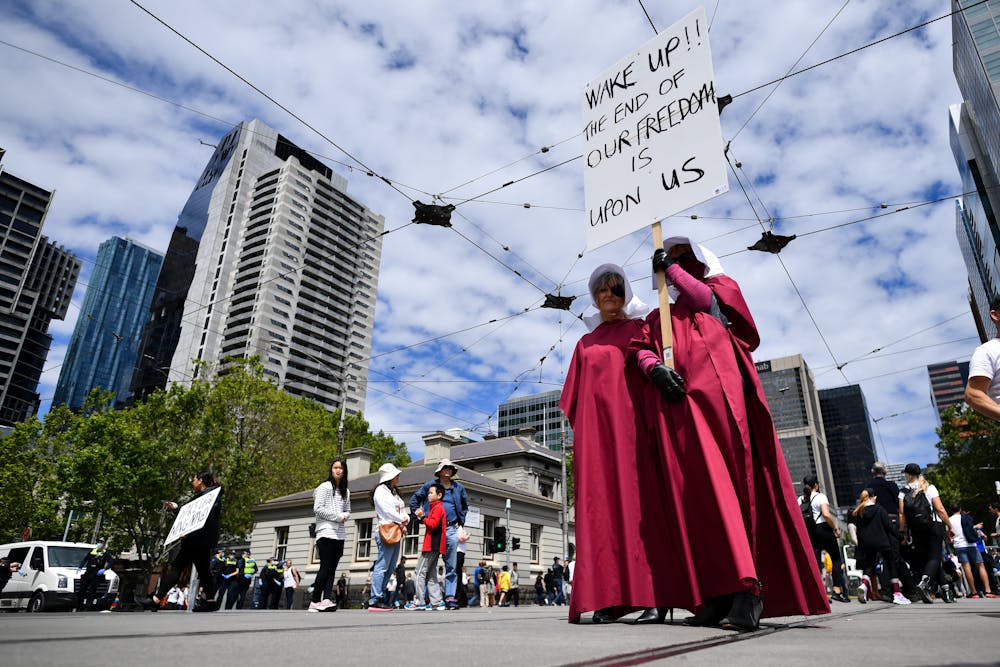
 A popular meme among those opposed to masks, lockdowns, vaccine mandates and government generally.
CC BY[11]
A popular meme among those opposed to masks, lockdowns, vaccine mandates and government generally.
CC BY[11]
Like the Kardashians, they have found a way to make content[12] and attract attention by creating theatre out of their everyday existence. In the case of a minority of anti-vaccination protesters, this includes going to the shops to record a confrontation with staff.
Combined with rhetoric about the majority of people being compliant “sheep[13]” complicit in ushering in tyranny by following the rules, it’s a potent mix.
This anger with their fellow citizens never gets beyond talk for most. But it still normalises the idea that it’s acceptable, indeed heroic, to take online invective into the real world.
Read more: Jacinda Ardern calls for 'ethical algorithms' to combat online extremism. What this means[14]
So what to do about it?
That’s a hard question. We may need specific penalties to deter those who exploit and endanger others for the purpose of attracting online attention.
The one piece of advice I can give you is that you can’t fight ire with ire. Take a cue from the staff who dealt with Bunnings Karen. Be firm, but remain calm and reasonable. De-escalate as much as possible.
Particularly if your harasser is brandishing a mobile phone. The last thing you want to do is help them create content.
References
- ^ down an escalator (www.police.vic.gov.au)
- ^ 59% of frontline retail workers (www.news.com.au)
- ^ thousands of incidents (www.9news.com.au)
- ^ enough incidents (www.theguardian.com)
- ^ Anger, grievance, resentment: we need to understand how anti-vaxxers feel to make sense of their actions (theconversation.com)
- ^ July 2020 (www.abc.net.au)
- ^ What to do with anti-maskers? Punishment has its place, but can also entrench resistance (theconversation.com)
- ^ 1971 paper (digitalcollections.library.cmu.edu)
- ^ published in June (www.pnas.org)
- ^ Kim Kardashian (www.theguardian.com)
- ^ CC BY (creativecommons.org)
- ^ make content (journals.sagepub.com)
- ^ sheep (www.latimes.com)
- ^ Jacinda Ardern calls for 'ethical algorithms' to combat online extremism. What this means (theconversation.com)
Authors: Nathalie Collins, Senior Lecturer, Edith Cowan University