Victoria's privatised quarantine arrangements were destined to fail
- Written by: Richard Holden, Professor of Economics, UNSW
Most people agree there are services government should pay for. Primary and secondary education, a dignified level of health care, emergency services and the military come to mind.
What is less clear is what services government should directly provide, and what it can safely contract out.
Past experiments in privatisation include the running of prisons[1] and detention centres[2], and hiring private military contractors[3] to guard embassies.
We have just witnessed a real-time experiment with the Victoria government’s hotel quarantine debacle.
Read more: Melbourne's hotel quarantine bungle is disappointing but not surprising. It was overseen by a flawed security industry[4]
This week an inquiry headed by former Family Court of Australia judge Jennifer Coates began into failures in Victoria’s hotel quarantine system,[5] believed to be responsible for Melbourne’s second-wave viral outbreaks.
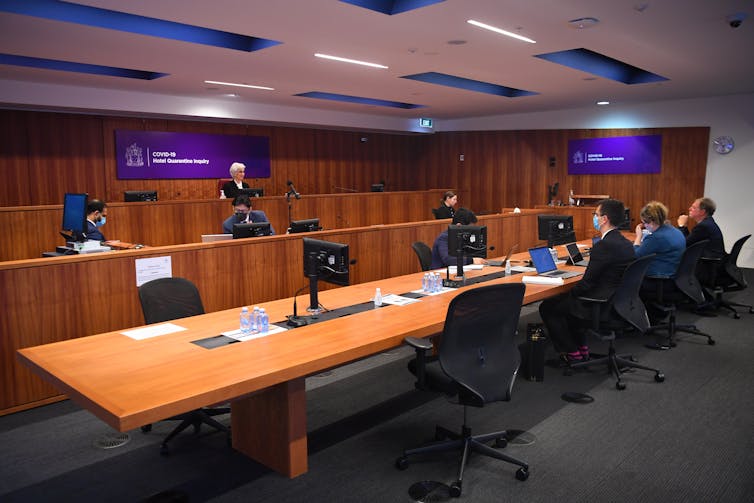 The COVID-19 Hotel Quarantine Inquiry, headed by Jennifer Coate, begins in Melbourne on July 20 2020.
James Ross/AAP
The COVID-19 Hotel Quarantine Inquiry, headed by Jennifer Coate, begins in Melbourne on July 20 2020.
James Ross/AAP
But what can economics tells us about why this happened?
Thanks to the literature on “incomplete contracts” that led to a Nobel Prize for Harvard University economist Oliver Hart, quite a bit.
Using private contractors for hotel quarantine was destined to fail. It all boils down to a trade-off between costs and quality.
Using private providers is a good option when keeping costs low is more important than high quality. This was not such a case.
Incomplete contracts
Hart’s classic 1997 paper on “The Proper Scope of Government[6]” (co-authored with Andrei Shleifer and Robert Vishny) mostly considers privatisation in theoretical terms, with some discussion of prisons, garbage collection, schools, health care, policing and a few other things.
The animating idea behind the “incomplete contracts” approach is that there are some contingencies that contracts, no matter how detailed, can’t cover.
This could be because parties can’t conceive of all future contingencies. Or perhaps they understand what’s at issue but it is hard to codify that in a way a non-specialist court could understand.
For instance, a famous legal case[7] concerned the definition of a chicken, with the judge writing:
The issue is, what is chicken? Plaintiff says ‘chicken’ means a young chicken, suitable for broiling and frying. Defendant says ‘chicken’ means any bird of that genus that meets contract specifications on weight and quality …
Philippe Aghion and I expanded on incomplete contracts and prisons as well as many other applications[8] in the Journal of Economic Perspectives in 2011.
To keep things simple, imagine there are two things someone running a prison can put effort into: reducing costs or improving quality.
Improvements in quality could involve increasing rehabilitation rates, reducing violent incidents and or minimising escape risks. Lower costs lead to lower quality. For example, employing fewer guards might result in more escape attempts or prisoner-on-prisoner violence.
Read more: People have lost faith in privatisation and it's easy to see why[9]
Cost versus quality
When the government owns the prison and employs a warden to run it, it doesn’t have to rely just on an written contract to get what it wants in terms of investment in quality. It can tell the warden what to do, and replace them if they don’t produce the goods.
If it’s serious about quality, though, the government will likely have to provide more resources. Quality costs.
When a prison is privatised, the government’s control over how the operator acts is limited to its contract.
In a perfect contract, the government could stipulate how much the private contractor is allowed to reduce costs and how much it must improve quality.
But these things are difficult to write into contracts. Wherever there are gaps, any contractor providing a fixed-price service will look to cut costs instead of improving quality.
So that’s the trade-off. When low cost is very important, private contracting is best. But when quality is more important, government ownership is optimal.
 Melbourne’s Stamford Plaza Hotel. identified along with Rydges on Swanston, as a source of the city’s coronavirus outbreaks.
James Ross/AAP
Melbourne’s Stamford Plaza Hotel. identified along with Rydges on Swanston, as a source of the city’s coronavirus outbreaks.
James Ross/AAP
The Victorian quarantine
What’s more important in hotel quarantine during a pandemic: cost or quality?
The Hart-Shelifer-Vishny rationale tells us the Melbourne hotels should not have been policed by private security contractors, because the highest possible standards were paramount.
Moreover, even if one could write a complete contract, it doesn’t really matter. There’s no real recourse in this case for a breach of contract. The cost is billions of dollars in damage to the economy already. What good is a contract with a bankrupt contractor?
Read more: Victorian COVID crisis to deliver $3.3 billion hit to nation's growth in September quarter[10]
Of course, police (and other public servants) aren’t always perfect either. But at least there is more training, a code of conduct, a sense of duty and a whole apparatus for disciplining misbehaviour.
The Coate inquiry may uncover valuable details about where and how the quarantine system failed, but economics can already point us to why it was destined to fail.
When high quality matters more than low cost, governments shouldn’t outsource unless absolutely necessary.
The choice for hotel quarantine should have been clear.
References
- ^ prisons (lens.monash.edu)
- ^ detention centres (asiatimes.com)
- ^ private military contractors (www.smh.com.au)
- ^ Melbourne's hotel quarantine bungle is disappointing but not surprising. It was overseen by a flawed security industry (theconversation.com)
- ^ Victoria’s hotel quarantine system, (www.abc.net.au)
- ^ The Proper Scope of Government (scholar.harvard.edu)
- ^ a famous legal case (law.justia.com)
- ^ incomplete contracts and prisons as well as many other applications (pubs.aeaweb.org)
- ^ People have lost faith in privatisation and it's easy to see why (theconversation.com)
- ^ Victorian COVID crisis to deliver $3.3 billion hit to nation's growth in September quarter (theconversation.com)
Authors: Richard Holden, Professor of Economics, UNSW