Cooling Perth Data Centres and Server Rooms: Why Standard Commercial Air Conditioning Is Not Enough
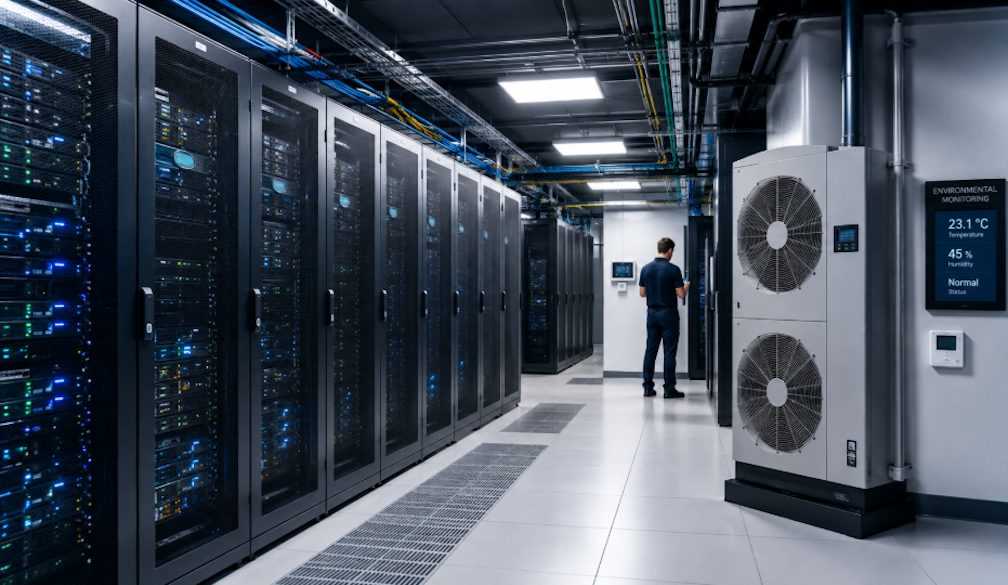
Perth's growing digital economy has produced a corresponding growth in the data centre and server room infrastructure that supports it. From purpose-built wholesale data centres housing the infrastructure of major enterprises and cloud service providers, through to the server rooms and IT equipment rooms in commercial buildings, schools, healthcare facilities, and government offices across the metropolitan area, the need to maintain computing equipment within tight temperature ranges is a widespread and critical facility management challenge.
Standard commercial air conditioning is designed for human thermal comfort: maintaining air temperatures between 22 and 26 degrees Celsius in spaces occupied by people. The cooling requirements of data centre and server room environments are categorically different in their technical demands, their failure consequence profile, and the design approaches required to meet them reliably.
For Perth business owners and IT managers responsible for server rooms within commercial premises, understanding why the standard office split system or ducted unit in the server room corner is typically inadequate, and what appropriate data centre cooling actually looks like, is the foundation for managing one of the most consequential environmental risks to their business technology infrastructure.
Why Server Rooms Have Fundamentally Different Cooling Requirements
The thermal environment that computing equipment requires differs from human comfort conditioning in several ways that drive the need for specialist cooling solutions.
Heat density. A single rack of server equipment can generate 5 to 20 kilowatts of heat from a floor footprint of less than one square metre. The heat density of even a small server room far exceeds that of any human occupancy application. A standard office split system with a 5-kilowatt cooling capacity would need to serve a room with 50 to 100 human occupants to reach the heat density of a single rack of densely packed servers. Standard cooling systems are not sized or designed for this heat density.
Continuous operation requirement. Human comfort cooling operates for business hours and is typically unattended outside these periods. Server room cooling must operate continuously, 24 hours per day, 365 days per year. A standard commercial split system or ducted unit that was designed for the start-stop operational pattern of a comfort cooling application will fail significantly earlier than its rated life when operated continuously at high load.
Temperature and humidity precision. Server equipment is specified to operate within temperature ranges of typically 18 to 27 degrees Celsius and relative humidity ranges of 20 to 80 percent, with specific rates of change that the equipment can tolerate. Deviations outside these ranges cause thermal stress, condensation risk, and accelerated hardware degradation. Standard comfort cooling systems that maintain temperature to within 2 to 3 degrees Celsius of setpoint are typically not precise enough for the tighter ranges that equipment reliability requires.
High sensible heat ratio. The ratio of sensible heat (which changes air temperature) to latent heat (which changes air humidity) in a data centre environment is very high because the heat generated by electronic equipment is almost entirely sensible. Standard comfort cooling systems that are designed for a mixed sensible and latent load over-dehumidify server room air if operating at reduced capacity to meet the sensible heat load. The result is excessively dry air that increases static electricity risk and can cause equipment damage.
The Consequences of Inadequate Server Room Cooling in Perth
Perth's summer climate makes inadequate server room cooling a particularly acute risk. Outdoor temperatures that regularly exceed 40 degrees Celsius in summer create a thermal challenge for any cooling system, and a system that is marginally adequate in winter may completely fail to maintain acceptable server room temperatures on a 42-degree Perth summer day.
The consequences of server room temperature exceedance range from immediate equipment shutdown (which is the thermal protection mechanism built into modern server hardware) to accelerated degradation and premature equipment failure from sustained operation at elevated temperatures.
The Arrhenius equation, which describes the rate of chemical reactions as a function of temperature, is commonly cited in the context of electronics reliability. The general principle it illustrates, that every 10-degree increase in operating temperature approximately halves the operational life of many electronic components, has direct implications for data centre thermal management. Server room temperatures that run 5 to 10 degrees above the equipment specification accelerate the failure rate of hard drives, power supplies, and other components in ways that translate directly into increased downtime, data loss risk, and hardware replacement costs.
For Perth businesses that depend on their server infrastructure for continuous business operations, a server room cooling system failure during a summer heatwave is not simply a facilities inconvenience. It is a business continuity crisis.
Precision Cooling Solutions for Perth Server Rooms and Data Centres
Specialist commercial air conditioning solutions for Perth differ from standard commercial systems in their design, their operating characteristics, and their reliability engineering.
Computer room air conditioning (CRAC) and computer room air handler (CRAH) units are the specialist cooling systems designed for data centre environments. These units are designed for the specific operational requirements of the data centre environment:
- Continuous duty operation rather than the start-stop pattern of comfort cooling
- High sensible heat ratio to manage the predominantly sensible heat load of electronic equipment without over-dehumidifying
- Precision temperature control typically to within 1 degree Celsius of setpoint
- High availability design with redundant fans, redundant compressors, and in some configurations, fully redundant units with automatic failover
In-row cooling. In high-density data centre environments where rack heat density is too high for room-level cooling to manage effectively, in-row cooling units positioned between or at the end of rack rows provide cooling at the heat source rather than conditioning the room air volume. This approach reduces the thermal path from heat source to cooling coil and allows higher rack densities than room-level cooling can manage.
Liquid cooling. For the very highest density applications, liquid cooling solutions that bring coolant directly to the heat sources within the server rack are increasingly used in high-performance computing and AI infrastructure. These systems require specific facility infrastructure including leak detection, appropriate fluid management, and secondary cooling to reject the heat captured by the liquid cooling system.
Redundancy and Reliability for Business-Critical Cooling
The reliability engineering of server room cooling is fundamentally different from comfort cooling applications because the consequence of failure is typically business-critical rather than merely inconvenient.
N+1 redundancy. A standard reliability configuration for a critical server room cooling system is N+1, where N is the number of cooling units required to maintain the room at the design temperature and 1 is the additional unit that provides capacity if one of the N units fails. With N+1 redundancy, any single unit failure does not cause the room to exceed the temperature design setpoint.
Automatic failover. Redundant units only provide their intended reliability benefit if the failover to the redundant unit is automatic, without requiring manual intervention. An automatic transfer and startup sequence that brings the standby unit to full capacity within minutes of a primary unit failure maintains cooling continuity.
Remote monitoring and alarm. A server room cooling system that fails without immediate detection creates an escalating thermal problem that may result in equipment shutdown before anyone is aware of the failure. Remote monitoring with immediate alert notification allows operators to respond quickly to developing cooling failures before they cause equipment damage or downtime.
Generator backup for cooling power. In a complete power failure, server room cooling ceases along with all other building systems. UPS systems provide short-term power continuity for the computing equipment itself but typically do not power the cooling system. A site with a generator for business continuity must include the server room cooling system in the generator transfer schedule, or the computing equipment will overheat within minutes to hours depending on the room's thermal characteristics.
Office Server Rooms in Perth Commercial Buildings
Many Perth commercial buildings contain server rooms that are not purpose-designed data centre facilities but rather converted office spaces or storage rooms that house the organisation's IT infrastructure. These improvised server rooms are among the most commonly inadequately cooled IT environments, because they were not designed for their current use.
The common pattern in these facilities: an office split system was installed when the server equipment was first placed in the room, providing cooling that was adequate for the initial equipment density. Over time, additional servers, network equipment, storage systems, and UPS units have been added to the room, increasing the heat load substantially beyond what the original split system was designed for. The system runs continuously at maximum capacity, ages rapidly from the continuous duty cycle, and eventually fails during a summer heatwave when the outdoor ambient temperature reduces the system's efficiency at exactly the time the heat load is highest.
For Perth commercial propeties with office air conditioning that includes a server room with a split system cooling arrangement, a thermal assessment of the server room cooling capacity against the actual equipment heat load is the first step in understanding whether the current arrangement is adequate or at risk of failure.
The Factory and Warehouse IT Infrastructure Consideration
Perth factory and warehouse operations increasingly depend on networked industrial control systems, manufacturing execution systems, and warehouse management technology that requires server and network infrastructure with appropriate environmental control. The server rooms and IT equipment areas in these facilities face the same cooling challenges as commercial office server rooms but often in environments with higher ambient temperatures and dustier conditions that place additional demands on cooling and air handling equipment.
Conclusion
Data centre and server room cooling in Perth is a specialist application that requires cooling systems designed for the specific characteristics of IT equipment heat loads, the consequence profile of cooling failure, and the continuous duty requirements of 24-hour computing environments.
Standard commercial split systems and ducted air conditioning, while adequate for human comfort conditioning, are systematically inadequate for the heat densities, the operational duty requirements, and the reliability standards that business-critical server room cooling demands. Perth business owners whose server infrastructure lives in a room cooled by a commercial comfort system should treat this as a business continuity risk that warrants specialist assessment and appropriate remediation.