

Distance can no longer be NZ’s defence strategy. Could Japan be part of the answer?
- Written by: Weekend Times
As China’s military expansion shakes up the Indo-Pacific region’s security order, it is becoming harder to argue that distance offers a form of protection for New Zealand.
A
recent Lowy Institute analysis notes that the Chinese DF-27 ballistic missile, with a range of 5,000 to 8,000 kilometres, is now operational. With further refinement, it could reach the New Zealand mainland.
This comes after a Chinese naval task group last year conducted live-fire exercises in the Tasman Sea, below a vital air route linking Australia and New Zealand.
The exercises were held without warning, breaching the regional norm of advance notification for such activities. They also demonstrated Beijing’s ability to project force into waters New Zealand has long regarded as remote.
More recently, in April, a New Zealand surveillance aircraft monitoring North Korean sanctions evasion was accused by China of “close-in reconnaissance and harassment”.
Amid heightening geopolitical tensions in the region, it was not an isolated incident. In December, Chinese fighter jets directed their fire-control radar at Japanese F-15 jets near Okinawa.
Then, in March, Australia protested after a Chinese naval helicopter conducted what Canberra described as an unsafe intercept of one of its military helicopters over the Yellow Sea.
For New Zealand – a trading nation with a vast marine estate and an economy reliant on secure shipping and undersea telecommunication links – these developments are not abstract, nor can they be ignored.
Increasingly, they pose difficult questions about whether the small nation’s defence posture is keeping pace with a fast-changing region.
Is NZ’s response coming quickly enough?
New Zealand’s government is slowly beginning to adapt to this new reality.
Its 2025 Defence Capability Plan commits NZ$12 billion over four years, including $9 billion of new spending, and aims to lift defence spending from just over 1% of GDP to above 2% over the coming eight years.
It funds enhanced strike capabilities, new frigates, maritime drones and upgraded surveillance. These are the bones of a more combat-capable force and mark a shift in intent.
The weak point is the timetable. Eight years is a long time to rebuild military capability in a strategic environment the government itself formally recognised as deteriorating in 2021.
That slow pace has not gone unnoticed. At the 2026 Shangri-La Dialogue security conference, United States Secretary of War Pete Hegseth criticised New Zealand’s plan to reach 2% of GDP on defence spending, calling it “freeloading” and urging allies to spend 3.5%.
Defence Minister Chris Penk rejected the criticism, while Finance Minister Nicola Willis argued New Zealand does not have “billions of dollars sitting under the couch”.
The underlying argument – that the US alliance is not a substitute for domestic investment – is hard to dismiss as the regional balance shifts.
Meanwhile, the country’s defence partners are moving quickly. Japan’s 2026 defence budget is set to exceed 9 trillion yen (US$58 billion) – doubling the country’s military spending. Australia already spends more than 2% of GDP of defence and aims to lift this to 3% within a decade.
By contrast, New Zealand’s trajectory is unhurried.
What Japan can offer
If New Zealand is serious about rejuvenating its defence force, the question becomes who to build with. Australia and the US are obvious candidates. Now, so too is Japan.
On the sidelines of Shangri-La, New Zealand, Australia and Japan held their first trilateral defence ministers’ meeting, in which Japan’s defence minister Shinjiro Koizumi urged like-minded states to uphold a “free and open” Indo-Pacific.
Japan, notably, has spent decades confronting the very security challenges now becoming more familiar across the Indo-Pacific, from North Korean missile threats to sustained Chinese military activity around the Senkaku Islands and Taiwan.
That experience gives it strategic expertise New Zealand cannot easily replicate. Following law changes allowing defence exports, Japan can now also supply advanced military equipment to partners.
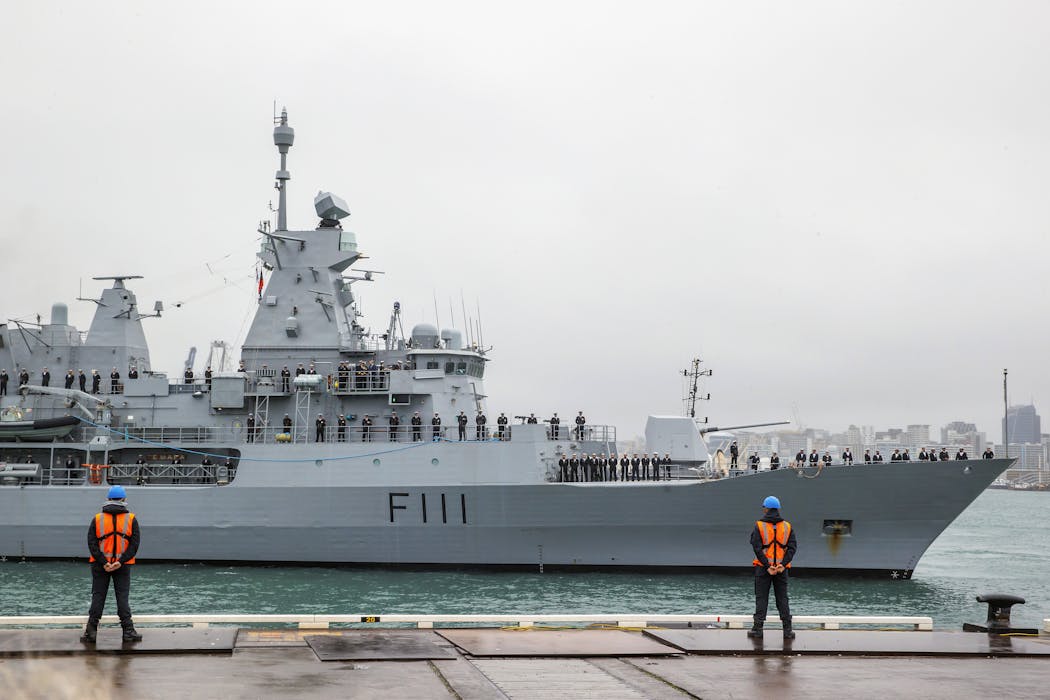
This is directly relevant to one of New Zealand’s largest looming defence decisions: replacing its Anzac-class frigates. The Japanese Mogami-class, already selected by Australia, is among the options, alongside the United Kingdom’s Type 31 frigates.
But the choice is about more than the ships themselves. It is also about who New Zealand will rely on for training, spare parts, software upgrades and repairs over the coming decades.
The Mogami’s heavy automation suits a country with vast maritime responsibilities and limited crew. Purchasing the platform would embed New Zealand in an emerging Australia–Japan network – Canberra is acquiring 11 of the vessels – and Japan geographically is far closer than the United Kingdom.
The latter could be critical during a future regional crisis or conflict during which interoperability with regional partners becomes critical.
Defence choices can no longer wait
Of course, none of this requires that Wellington abandon an independent foreign policy – nor pick a favourite partner.
Japan would be one among several, although New Zealand’s closest ally, Australia, remains indispensable – as is the US in maintaining balance in the region.
But the period in which New Zealand could treat distance as a substitute for strategy is over.
The geopolitical challenge facing it is growing, the pace of its spending response is arguably lacking and, of the partners able to help close the gap, Japan is the partner Wellington is most likely to prioritise.
Allies are already signalling they expect more from New Zealand – and the cost of moving too slowly will be measured not only in capability, but in credibility.
Reuben Steff does not work for, consult, own shares in or receive funding from any company or organisation that would benefit from this article, and has disclosed no relevant affiliations beyond their academic appointment.