The Voice would have renewed Australian democracy. Its failure leaves us all worse off
- Written by: Sana Nakata, Principal Research Fellow, James Cook University
There’s long been a fundamental issue underpinning Australia’s approach to Indigenous affairs. The state makes laws specifically about Aboriginal and Torres Strait Islander peoples without any protected mechanism giving them a say in the process.
The proposed Voice to Parliament[1] sought to remedy this democratic deficit. Had the referendum succeeded, it would have established a formal representative connection between Indigenous peoples and the Commonwealth parliament.
The Voice proposal was a reform to democratic representation. Its failure was a missed opportunity to renew Australian democracy.
But it was also an explicit choice: to sustain the political subjugation[2] of Indigenous people by denying them representative channels for making their voices heard on matters that affect them.
This enduring structural limitation leaves the parliament without any representative mechanism to consult with, or be accountable to, Aboriginal and Torres Strait Islander peoples.
What does Indigenous representation look like?
Even as we have seen increasing numbers of Aboriginal members in the federal parliament, they do not represent all Aboriginal and Torres Strait Islander people.
Nor are they empowered to. In the 125 years since federation, there has never been a Torres Strait Islander representative at the Commonwealth level.
A key aspect of political accountability is the ability of a constituency to remove their representative at the ballot box. If a majority feels their MPs have failed to advance their interests or otherwise represent them, they can vote them out.
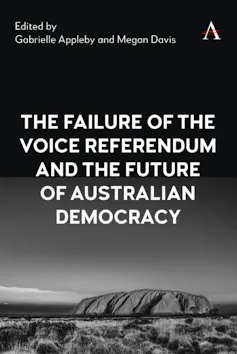
This article is an edited extract from the new book The Failure of the Voice Referendum and the Future of Australian Democracy[3], edited by Professors Gabrielle Appleby[4] and Megan Davis[5].
For minority populations, this mechanism fails because their votes will, by definition, always fall short of a majority. This has long been called[6] “the tyranny of the majority”.
While this is a problem for all minorities, the political claims of Aboriginal and Torres Strait Islander people are distinct from other minority groups. This is because they’ve been politically subjugated through unlawful dispossession.
Voting rights alone cannot remedy this. We need to move beyond this narrow view of political representation.
More than politics
Being represented is not just about aggregating votes or delegating decision-making power to elected parliamentarians.
There are many types of democratic representation, far beyond formal political institutions. There are also unions, nongovernmental organisations, social movements, media organisations and community advocates.
These actors represent themselves and others through various channels, such as:
Through this lens, we can see Aboriginal and Torres Strait Islander people have long maintained and exercised their representative power, even when formal political institutions exclude or silence their voices.

Critics of the Voice proposal from both conservative and progressive perspectives focused on the power of direct decision making.
But it’s crucial to recognise representative power entails more than just making decisions in formal political institutions. Representative power can also set new agendas, shape political debates and transform public attitudes and values.
The proposed Voice offered what we might call “connective tissue” between First Nations peoples and communities, and the Australian state that continues to govern them.
The Voice proposed a new focal point for channelling the varied interests of diverse First Nations communities directly to government, as well as the broader Australian public. In similar ways to the Yoorrook Commission and First Peoples’ Assembly of Victoria[8] (and now Gellung Warl), the Voice promised to highlight new priorities for action.
Read more: Why the Voice referendum failed -- and what the government hasn't learned from it[9]
In Victoria, this mobilised public attention on issues such as policing[10] and self-determination[11].
This is why the proposal’s defeat represents more than just maintaining the status quo. It transforms the political subjugation of Aboriginal and Torres Strait Islander peoples from a historical legacy into the contemporary choice of the nation.
Despite decades of Aboriginal and Torres Strait Islander advocacy, careful institutional design and extensive consultation, the Australian public collectively decided to maintain political structures that exclude First Nations perspectives from decision-making processes that affect them.
Strengthening democracy for all
As we move forward, the implications of this decision extend beyond Aboriginal and Torres Strait Islander affairs. It raises questions about Australia’s capacity to renew its democracy.
The capacity of democracies to change themselves in response to shifting social conditions and emerging demands is a key part[12] of what keeps them democratic.
References
- ^ Voice to Parliament (theconversation.com)
- ^ political subjugation (theconversation.com)
- ^ The Failure of the Voice Referendum and the Future of Australian Democracy (anthempress.com)
- ^ Gabrielle Appleby (theconversation.com)
- ^ Megan Davis (theconversation.com)
- ^ long been called (www.oxfordreference.com)
- ^ Con Chronis/AAP (photos.aap.com.au)
- ^ Yoorrook Commission and First Peoples’ Assembly of Victoria (theconversation.com)
- ^ Why the Voice referendum failed -- and what the government hasn't learned from it (theconversation.com)
- ^ policing (firstpeoplesvic.org)
- ^ self-determination (firstpeoplesvic.org)
- ^ a key part (www.quarterlyessay.com.au)
- ^ Anthem Press (anthempress.com)
Authors: Sana Nakata, Principal Research Fellow, James Cook University