New Orleans attacker’s apparent loyalty to Islamic State group highlights persistent threat of lone wolf terrorism
- Written by: Sara Harmouch, Ph.D. candidate in Public Affairs, American University
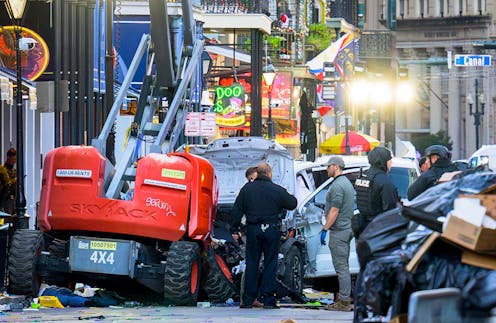
The deadly Jan. 1, 2025, attack in New Orleans[1] serves as a reminder of the persistent threat to the U.S. from individuals inspired by extremist Islamist groups.
While the investigation is still ongoing, some details about the suspect have been released. Authorities say Shamsud-Din Jabbar[2], a U.S. Army veteran, was behind the assault in which a truck was driven into a dense crowd in New Orleans’ French Quarter a few hours after midnight, killing at least 15 people and injuring dozens more. Jabbar, who died in a shoot-out with police, had pledged loyalty[3] to the Islamic State group in online videos posted on Dec. 31, according to the FBI.
It represents the first major assault on an American city by an individual purportedly influenced by the Islamic State group, or one of its affiliates, since a 2017 truck assault[4] in New York City that killed eight.
The New Orleans attack, like that earlier incident, underscores an important point: While the Islamic State group’s territorial caliphate – the area in Syria and Iraq in which it assumed both political and religious authority and sought to enforce its interpretation of Islamic law – has been dismantled[5], the group’s ability to inspire acts of terror on U.S. soil through online propaganda and ideological influence remains[6] alarmingly potent.
As a terrorism expert[7] and a scholar specializing in radical Islamist militant groups, I believe the case of Jabbar – an American soldier who was radicalized in the U.S. – echoes similar lone wolf attacks[8] in the West over the past decade.
With lost territory in the Middle East, the Islamic State group has sought to exploit personal grievances, mental health struggles and ideological vulnerabilities, transforming isolated individuals in the West into deadly instruments of violence.
An attack inspired by the Islamic State
The New Year’s Day attack took place in New Orleans’ famous French Quarter. At about 3:15 a.m., Jabbar plowed his truck into a dense crowd along the popular Bourbon Street.
In the immediate aftermath, investigators discovered a black banner in his vehicle – the flag used by many Islamist militant groups, including the Islamic State.
While the Islamic State has not yet officially claimed the attack on any of its social media platforms, subsequent reviews of Jabbar’s online activity revealed videos posted just hours[9] before the incident, in which he pledged allegiance to the group. On Jan. 2, Christopher Raia of the FBI’s counterterrorism division said Jabbar was “100% inspired by ISIS[10],” using an alternative name for the group.
Jabbar’s background adds complexity[12] to the narrative. A 42-year-old veteran, he had no prior known links to extremist networks, according to the FBI, underscoring the challenge posed by self-radicalized individuals who operate outside the scope of traditional terrorist cells.
At this early stage of the investigation, it appears the attack was planned independently, driven by an ideological alignment with the Islamic State group rather than at the direction of any of its leaders. This highlights the decentralized and unpredictable nature of the current terrorist threat landscape.
The growing threat of lone actor attacks
At the height of its power in 2014-2015, the Islamic State group controlled significant territory across Syria and Iraq, establishing a self-declared caliphate. While this physical caliphate was dismantled by 2019, following sustained efforts by the U.S.-led Global Coalition to Defeat the Islamic State[13], the group continues to operate, conduct and inspire attacks.
Lone wolf attacks, inspired by Islamic State group propaganda but lacking direct operational support, have become[14] the hallmark of the post-caliphate era.
By inspiring individuals[15] to carry out attacks independently, the Islamic State group aims to create an atmosphere of fear and instability, demonstrating its global influence[16] despite lacking a physical caliphate.
It has actively sought to radicalize and mobilize individuals in the U.S. through digital platforms[17], spreading violent narratives and offering tactical guidance to potential attackers.
This strategy allows the group to maintain relevance and project strength despite its physical losses in the Middle East.
The New Orleans incident follows a pattern seen in previous attacks in the West — such as the 2016 Nice truck attack[18] in France, the 2016 Berlin Christmas market attack[19] and the 2017 London Bridge attack[20]. In each case, individuals were motivated by the Islamic State group’s call to action, using readily available means – vehicles, knives or firearms – to inflict mass casualties.
This model of terrorism is not only low cost but also difficult[21] for intelligence agencies to intercept[22], as it often lacks the logistical trail associated with larger, coordinated plots.
Ideological reach and online propaganda
A critical component of the Islamic State group’s continued influence is its sophisticated use of online platforms[23] to spread propaganda.
Even after significant efforts[24] by social media companies to dismantle extremist content, the Islamic State group, al-Qaida and their affiliates have adapted[25] by migrating to encrypted messaging services, dark web[26] forums and niche platforms.
These digital spaces[27] enable extremist groups to distribute radical content[28], call for violence and foster a sense of global community among supporters.
Jabbar’s apparent radicalization is, I believe, likely to have been driven by such online materials – more will be known when the FBI is through investigating the many[29] phones and laptops agents retrieved after the attack.
Such online propaganda frequently blends[30] religious rhetoric with narratives of personal empowerment and martyrdom. The psychological appeal[31] of Islamic State group propaganda lies in its ability to offer disenfranchised individuals a sense of purpose, framing violence as a form of spiritual fulfillment and resistance against perceived oppression.
The case of Jabbar also raises broader questions about domestic radicalization within the United States.
Individuals like Jabbar – who are not part of any terrorist cell and seemingly have no prior known links to extremism – are often able to operate undetected until they commit acts of violence.
Islamist militant groups’ Western strategy
The Islamic State group’s broader strategy in inspiring lone actor attacks extends beyond mere acts of violence.
By inciting terror in Western nations, the group aims[33] to polarize societies, foster anti-Muslim sentiment and provoke overreactions from governments – conditions that can fuel further radicalization and recruitment.
This cycle of violence and social division serves not just the Islamic State group, but other Islamist militant groups’ long-term objective of destabilizing the West and reinforcing its narrative of a civilizational clash between Islam and the West.
Attacks such as that in New Orleans serve as powerful propaganda tools, demonstrating that the Islamic State group’s ideology remains alive despite its territorial losses. Each successful attack amplifies the perception of the Islamic State group’s resolve, bolstering the morale of supporters and attracting new recruits.
The New Orleans attack is a sobering reminder that the influence of extremist Islamist groups extends far beyond the borders of the Middle East. As the Islamic State group and other radical militant groups evolve and adapt, the threat of lone wolf attacks looms over the U.S. and other nations.
References
- ^ deadly Jan. 1, 2025, attack in New Orleans (apnews.com)
- ^ Shamsud-Din Jabbar (www.nytimes.com)
- ^ pledged loyalty (www.nytimes.com)
- ^ 2017 truck assault (www.nytimes.com)
- ^ has been dismantled (www.bbc.com)
- ^ online propaganda and ideological influence remains (www.cnn.com)
- ^ terrorism expert (www.american.edu)
- ^ lone wolf attacks (www.pbs.org)
- ^ revealed videos posted just hours (apnews.com)
- ^ 100% inspired by ISIS (www.nbcnews.com)
- ^ FBI/AFP via Getty Images (www.gettyimages.com)
- ^ background adds complexity (apnews.com)
- ^ U.S.-led Global Coalition to Defeat the Islamic State (www.state.gov)
- ^ have become (www.govinfo.gov)
- ^ inspiring individuals (ctc.westpoint.edu)
- ^ global influence (www.voanews.com)
- ^ digital platforms (ctc.westpoint.edu)
- ^ Nice truck attack (www.theguardian.com)
- ^ Berlin Christmas market attack (www.cnn.com)
- ^ London Bridge attack (www.npr.org)
- ^ not only low cost but also difficult (www.defense.gov)
- ^ intelligence agencies to intercept (www.politico.com)
- ^ online platforms (icct.nl)
- ^ significant efforts (minerva.defense.gov)
- ^ have adapted (www.un.org)
- ^ dark web (www.jstor.org)
- ^ digital spaces (gnet-research.org)
- ^ distribute radical content (ctc.westpoint.edu)
- ^ investigating the many (thehill.com)
- ^ frequently blends (ctc.westpoint.edu)
- ^ psychological appeal (doi.org)
- ^ Michael DeMocker/Getty Images (www.gettyimages.com)
- ^ group aims (csis-ilab.github.io)
Authors: Sara Harmouch, Ph.D. candidate in Public Affairs, American University