Alice Springs is under a snap curfew. But where’s the evidence it will actually work to reduce violence?
- Written by: Thalia Anthony, Professor of Law, University of Technology Sydney
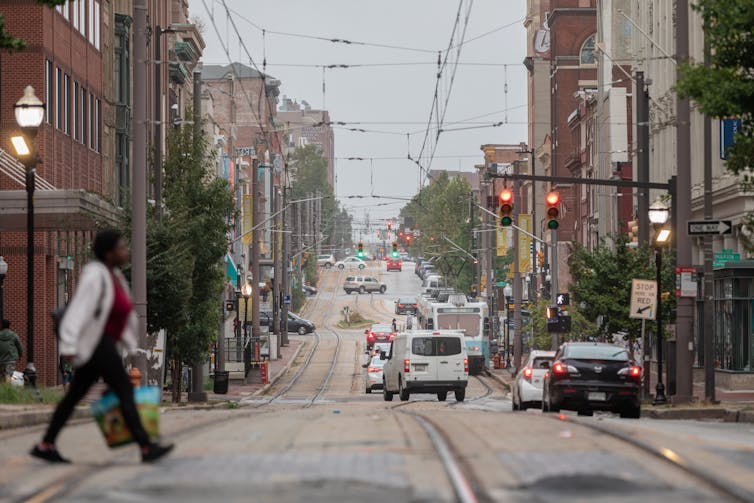
Since early 2023, the Northern Territory and federal governments have been trialling a range of social control measures in Alice Springs (Mparntwe) to address moral panics[1] in relation to youth crime.
The initial focus was on reinstating restrictive alcohol laws[2] in Aboriginal communities, then more police and funding for prisons, and now curfews.
Yesterday, the NT Police Commissioner announced[3] a snap three-day curfew following violent incidents[4], including off-duty police officers being assaulted.
But there’s little evidence to suggest it will work, either to drive down violent behaviour or to protect the public.
Curfew fears realised
In January 2023, trailblazing Arrernte midwife Cherisse Buzzacott saw the writing on the wall. She said, “We fear curfews[5]”. Cherisse grew up during the NT Intervention years[6] and knows what it is like to be an Aboriginal young person surveilled by police and subject to racially discriminatory laws.
Barely a year on from her comments, these fears were realised. In March 2024, the NT government announced a two-week curfew[7] to ban young people from the Alice Springs CBD between 6pm and 6am. This was then extended by a further week.
Following advice from the NT Police[8], the territory government granted powers under the Police Administration Act[9] to declare 72-hour curfews when the police commissioner reasonably believes there is public disorder or a significant risk of it. The commissioner can also request an extension of up to seven days.
Unlike the previous curfew, the new legislation allows for criminal penalties. Non-compliance with curfew orders is a “strict liability” criminal offence, which means even if the person honestly believes they are complying, they will be criminalised. The maximum penalty is a fine of A$1,480.
The NT government suspended the Anti-Discriminatory Act 1992[10] to enable the enforcement of curfews. This raises a red flag about its potential discriminatory impacts, even though the laws are ostensibly neutral.
The North Australian Aboriginal Justice Association (NAAJA) has raised concerns about police targeting Aboriginal young people in the enforcement of curfews, and described the curfews as “racist lockdown laws[11]”.
History of curfews, here and abroad
Curfews are not a new government strategy. They have been deployed for decades to restrict the movement and liberties of Aboriginal people in Australia. Curfews were enabled by the Aboriginal Protection Acts – a legislative regime that controlled and segregated Aboriginal people.
In the NT, Aboriginal people were barred from entering Alice Springs between sunset and sunrise[12] from 1928 to 1964. In Western Australia, curfew laws were passed in 1905 that barred Noongar people from central Perth after 6pm[13]. There were also 9pm curfews on Aboriginal reserves[14] in Queensland.
More recently in Redfern and surrounding areas in Sydney in the 1960s and ‘70s, police enforced[15] nightly 10pm curfews on Aboriginal people. The same strategy had been used for slaves[16] across the colonies, including in the United States[17].
Do curfews increase safety?
The most rigorous studies in relation to curfews have been undertaken in relation to youth curfews in the US. One study in 1994 showed 77%[18] of large US cities having a curfew policy, and another in 1997 indicated it was as high as 80%[19].
Studies of these curfews have repeatedly found that they do not reduce crime. US curfews have been imposed on the assumption[20] that restricting young peoples’ hours in public will “limit their opportunities to commit crimes or become victims”, but this objective has not been realised.
A 2016 review[21] of ten studies on the impact of youth curfews in the US since 1960 found they were ineffective in reducing criminal behaviour and victimisation among youth.
In fact, young people were slightly more likely to commit crime during the curfew hours, compared to the hours when the curfew was not imposed.

Similarly, victimisation rates were not affected by the curfew. A contemporaneous study of the tightening of Baltimore’s youth curfew laws[23] found it “did not have the desired effect of reducing juvenile crime during curfew hours”, but did have the effect of increasing arrests of young people. Another review in 2018 found the basis for curfews lacked “empirical[24]” evidence.
Studies in relation to particular offences, such as knife crimes[25], also found curfews did not have a significant impact.
There do not appear to be similar studies on whole-of-population curfews, which is occurring in relation to the Alice Springs curfew. This type of curfew appears unprecedented in its extension to adults.
However, it is likely to manifest in a similar way to the curfews that sought to control Aboriginal people. From the experience in Redfern, the overwhelming consequence was an increase in police charges, arrests and violence[26].
What are the risks?
In Alice Springs, there are risks for particular groups that are unable to comply with curfew orders. The NT has the highest homeless population[27] in the country, and people who are unable to find shelter outside of the town are likely to be subject to law enforcement.
Young people who are in the child protection system[28] are also likely to walk the streets at night due to neglect by state agencies, as exposed in the Royal Commission[29] into the Protection and Detention of Children in the Northern Territory. In addition, people with mental health and trauma needs may be unable to comply with the curfew requirements.
The curfew approach has high risks for little proven gain. After almost 20 years of top-down punitive interventions in NT Aboriginal communities, since the NT Emergency Response was rolled out in 2007, it is time to critically reflect on this track record.
The response to the colonial curfews in Alice Springs in the early 20th century was to build Alice Springs town camps that would restrict Aboriginal movement into the CBD after hours. This new curfew policy is repeating a process that has not changed.
At a time when the NT police is facing intense scrutiny and accusations of a culture of racism[30], handing executive powers to the NT Police Commissioner to declare curfews is unlikely to improve community safety and may likely increase community tensions.
References
- ^ moral panics (theconversation.com)
- ^ alcohol laws (theconversation.com)
- ^ announced (www.abc.net.au)
- ^ violent incidents (www.abc.net.au)
- ^ We fear curfews (www.theguardian.com)
- ^ NT Intervention years (www.monash.edu)
- ^ two-week curfew (www.theguardian.com)
- ^ advice from the NT Police (nit.com.au)
- ^ Police Administration Act (legislation.nt.gov.au)
- ^ Anti-Discriminatory Act 1992 (legislation.nt.gov.au)
- ^ racist lockdown laws (www.sydneycriminallawyers.com.au)
- ^ sunset and sunrise (alicespringsnews.com.au)
- ^ after 6pm (www.noongarculture.org.au)
- ^ Aboriginal reserves (www.aph.gov.au)
- ^ police enforced (www.alsnswact.org.au)
- ^ slaves (www.huffpost.com)
- ^ United States (www.washingtonpost.com)
- ^ 77% (link.springer.com)
- ^ 80% (digitalcommons.unl.edu)
- ^ assumption (link.springer.com)
- ^ review (link.springer.com)
- ^ Shutterstock (www.shutterstock.com)
- ^ tightening of Baltimore’s youth curfew laws (journals.sagepub.com)
- ^ empirical (digitalcommons.unl.edu)
- ^ knife crimes (www.sciencedirect.com)
- ^ charges, arrests and violence (redfernoralhistory.org)
- ^ highest homeless population (www.aihw.gov.au)
- ^ child protection system (www.abc.net.au)
- ^ Royal Commission (www.royalcommission.gov.au)
- ^ culture of racism (www.abc.net.au)
Authors: Thalia Anthony, Professor of Law, University of Technology Sydney