Robert Irwin wanted to sue One Nation for using his likeness. We don’t really have laws for that
- Written by: Brendan Clift, Lecturer in Law, The University of Melbourne
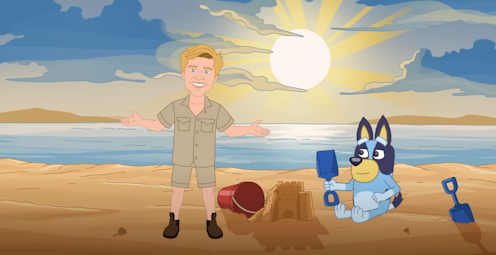
Robert Irwin, son of Steve “Crocodile Hunter” Irwin, recently threatened to sue[1] a video production company if they didn’t take down an episode[2] in One Nation’s “Please Explain[3]” animated video series. It depicted him – together with canine sidekick Bluey – spruiking the virtues of Queensland as they crumble around him.
But several days after the deadline imposed by Irwin’s legal team, the video remains live and there’s no sign of legal proceedings[4]. One Nation is harvesting political capital from the spat.
This storm in a teacup reveals the weaknesses and inconsistencies of Australian law on certain personal rights.
An uphill defamation battle
Irwin’s letter hints at a few legal avenues, primarily defamation. This is a powerful course of action, but not an easy case to make.
Irwin would need to prove the video lowers him in the estimation of the ordinary reasonable viewer, or exposes him to substantial ridicule, or would cause him to be shunned or avoided.
As the video depicts Irwin as a largely well-meaning character experiencing a series of unfortunate events, it’s hard to see how this would be made out.
Irwin was unlikely keen to litigate and more likely acting on advice that a stern threat of expensive defamation proceedings would see the video removed posthaste. But the weakness of his case meant that One Nation could confidently – and gleefully – refuse the request.
Litigation can bring vindication and court-ordered remedies, but even when successful it can result in unwelcome publicity – the so-called Streisand effect[5]. This is something Irwin will now realise all too well, with this story being widely reported and the original video garnering more than 300,000 views, around double those of its counterparts.
The “Please Explain” videos are at least partly trolling, and the troll has been fed.
Ineffective legal weapons
If you were thinking that a lot of public figures are complaining about defamation lately, you’d be onto something.
Defamation is a very popular weapon for those who can afford it (or who think they can). Setting aside its tactical use as a coercive measure, sometimes it fits the facts of the case and sometimes it does not.
The more difficult cases reveal some stark gaps in Australian law’s protection of personal interests, driving aggrieved parties towards defamation where little else is available.
For instance, Australians enjoy no general right to privacy. That was why former rugby league player Andrew Ettingshausen sued for defamation[6] after a magazine published a blurry photo of his naked form in the shower. To fit defamation law, the publication had to be tortuously framed as suggesting that “ET” was the kind of person who would agree to such a publication.
More recently, Alex Greenwich’s defamation suit[7] against Mark Latham was gymnastically constructed to frame a tirade of vulgar abuse as suggesting that Greenwich was unfit to serve as a member of New South Wales parliament. An imputation that a person is professionally incompetent is defamatory, whereas mere abuse is not.

Reportedly[9], Irwin’s legal letter complained that the video attempted to “pass off” One Nation as being affiliated with Irwin. “Passing off” is a legal cause of action that protects a trader’s goodwill and business reputation.
However, passing off requires deceptive conduct. It would be hard to argue that such transparent satire purports to be authorised by Irwin.
The letter also complained of unauthorised use of Irwin’s image. In the United States – the home of Hollywood – the “publicity right[10]” gives a person exclusive commercial use of their name or likeness.
But that isn’t the case in Australia, and even the US has an exception for parody and satire – see the TV series South Park[11] for evidence of that.
Satire and parody exceptions exist in some Australian laws – for example, in defence of some copyright infringements[12] – but if the satirist creates their own image of a person, as cartoonists do, there isn’t a copyright infringement to start with.
As an aside, these gaps around privacy, obscenity and image rights also leave Australians legally unprotected from deepfakes, unless other, usually criminal laws are engaged, such as those against direct victimisation or child exploitation material.
Is it defamatory, or just objectionable?
Political satire is an important form of expression, protected in most liberal jurisdictions. It is strongly guarded by the US First Amendment and it will often deserve the protection of the Australian Constitution’s implied freedom[13] of political communication.
But free speech is not a trump card. It exists within boundaries and the law of defamation represents one of many areas in which speech can attract legal sanction, notwithstanding underlying commitments to expressive freedom.
As of now, satire is not a defence under Australian defamation law – but the publication needs to be defamatory in the first place. Plenty of material to which people might object simply does not meet that test.
References
- ^ threatened to sue (www.smh.com.au)
- ^ an episode (www.youtube.com)
- ^ Please Explain (www.youtube.com)
- ^ no sign of legal proceedings (www.abc.net.au)
- ^ Streisand effect (www.britannica.com)
- ^ sued for defamation (www.thelawproject.com.au)
- ^ defamation suit (www.abc.net.au)
- ^ Dan Himbrechts/AAP (www.photos.aap.com.au)
- ^ Reportedly (www.smh.com.au)
- ^ publicity right (www.inta.org)
- ^ South Park (www.vulture.com)
- ^ copyright infringements (www8.austlii.edu.au)
- ^ implied freedom (www.ag.gov.au)
Authors: Brendan Clift, Lecturer in Law, The University of Melbourne