remembering the Anzacs not as a ‘coming of age’ tale but as a lesson for the future
- Written by: Olli Hellmann, Associate Professor of Political Science, University of Waikato
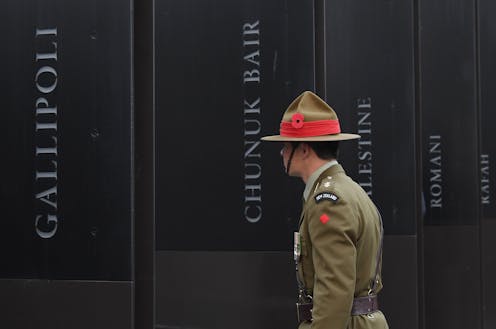
When New Zealanders commemorate Anzac Day on April 25, it’s not only to honour the soldiers who lost their lives in World War I and subsequent conflicts, but also to mark a defining event for national identity.
The battle of Gallipoli against the Ottoman Empire, the story goes, was where the young nation passed its first test of courage and determination.
The question of why New Zealand soldiers ended up on Turkish beaches in April 1915 is typically not part of these commemorations. Rather, our collective memories begin with the moment of the early morning landing.
Consider, for example, the timing of the Anzac Day dawn service, or the Museum of New Zealand-Te Papa Tongarewa’s exhibition, Gallipoli: The Scale of Our War[1], which plunges visitors straight into the action.
This selective retelling of history is necessary for the “coming of age” narrative to work. It helps conceal that Britain was pursuing its own colonial ambitions against the Ottomans, and that New Zealand took part in World War I as “a member of the British club”, as historian Ian McGibbon[2] puts it, loyally devoted to the imperial cause.
Against the background of the recent horrors and escalating tensions in the Middle East, however, it seems more important than ever to make these silences speak in our commemorations of Gallipoli.
Britain’s colonial interests
While the causes of World War I are complex and multifaceted, historians have extensively documented that Britain had long seen parts of the decaying Ottoman Empire as prey for colonial expansion. Already, in the late 1800s, Britain had taken control of Cyprus and Egypt.
Turkey’s Middle Eastern possessions were of interest to the government in London because they provided not only a land route to the colony in India, but also rich oil reserves[3].
Hence, when the Ottoman Empire signed an alliance with Germany – mainly to guard against Russian territorial aspirations – and somewhat reluctantly entered World War I, the British did not lament this as a diplomatic defeat.
Read more: New lessons about old wars: keeping the complex story of Anzac Day relevant in the 21st century[4]
“The decrepit Ottoman Empire was more useful to them as a victim than as a dependent ally,” as the late historian Michael Howard[5] explained.
The day after Britain declared war on the Ottomans on November 5 1914, British troops attacked Basra (in today’s southern Iraq) to secure nearby oil facilities.
In the following months, the Triple Entente of Britain, France and Russia won a number of easy victories, which fuelled the belief the Turkish military was weak. This in turn led Britain to devise a plan to launch a direct strike on Constantinople, the Ottoman capital.
First, however, they had to clear the Gallipoli peninsula of enemy defences. And who better suited to this task than the first convoy of Anzac troops, just a short distance away in Egypt after passing through the Suez Canal?
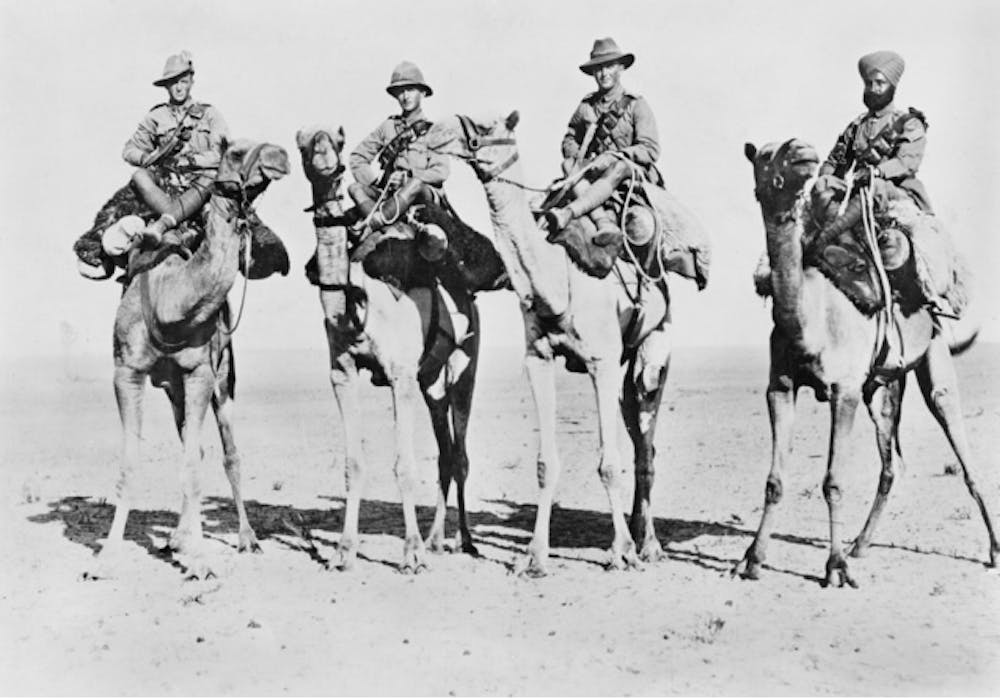
Palestine: a complex tangle of pledges
As is well known, war planners in London had underestimated the enemy’s military strength. The battle of Gallipoli ended in a Turkish victory over Britain and its allies. Nevertheless, fortunes eventually turned against the Ottoman Empire.
Although a whole century has gone by, British diplomatic efforts and secret agreements that were meant to accelerate the collapse of the Ottoman Empire still shape the Middle East today.
Read more: A century on, the Balfour Declaration still shapes Palestinians' everyday lives[6]
Most significantly, it is the violent conflict over Palestine that can be traced back to colonial power dealings during World War I. The crux of the problem is that Britain affirmed three irreconcilable wartime commitments in relation to Palestine.
First, in the hope of initiating an Arab revolt against Ottoman rule, the British made promises to Sharif Husayn, the emir of Mecca, about the creation of an independent Arab kingdom[7].
Second, in the Sykes-Picot Agreement[8], which divided the Ottomans’ Arab lands into British and French spheres of interest, Palestine was designated for international administration.
Third, in the Balfour Declaration[9] of November 1917, the British government pledged support for a “Jewish national home” in Palestine – a move motivated by a mixture of realpolitik and Biblical romanticism.
In the end, it was the third commitment that turned out to be the most enduring.
How should we remember Gallipoli?
Amid this complex history, we must not forget the thousands of New Zealand soldiers who died in World War I – men who had either volunteered, expecting a quick and heroic war, or served as draftees.
However, we need to have a public discussion about whether it is still appropriate for our commemorations to skip over the question of why these men fought in Europe and the Mediterranean.
Facing up to this question not only makes us aware of our responsibilities towards the Middle East problem, but it can also serve as a lesson for the future – not to blindly follow great powers into their military adventures.
Read more: Less than illustrious: remembering the Anzacs means also not forgetting some committed war crimes[10]
References
- ^ Gallipoli: The Scale of Our War (www.tepapa.govt.nz)
- ^ Ian McGibbon (doi.org)
- ^ oil reserves (www.internationalaffairs.org.au)
- ^ New lessons about old wars: keeping the complex story of Anzac Day relevant in the 21st century (theconversation.com)
- ^ Michael Howard (global.oup.com)
- ^ A century on, the Balfour Declaration still shapes Palestinians' everyday lives (theconversation.com)
- ^ independent Arab kingdom (aeon.co)
- ^ Sykes-Picot Agreement (www.britannica.com)
- ^ Balfour Declaration (theconversation.com)
- ^ Less than illustrious: remembering the Anzacs means also not forgetting some committed war crimes (theconversation.com)
Authors: Olli Hellmann, Associate Professor of Political Science, University of Waikato