Google AI

Weekend Times


The Times

Business News

More mergers to come under scrutiny in another leg of Chalmers’ competition policy

  • Written by: Michelle Grattan, Professorial Fellow, University of Canberra
More mergers to come under scrutiny in another leg of Chalmers’ competition policy

Treasurer Jim Chalmers has unveiled new rules governing company mergers that will bring more of them under scrutiny to ensure they don’t worsen competition.

Chalmers says the changes – to be formally announced on Wednesday in a speech released ahead of time – are the most substantial in nearly half a century.

A mandatory notification system will be brought in and the Australian Competition and Consumer Commission will be the single decision-maker on all mergers.

At the moment, notifications are voluntary, with the ACCC having the right to object after they have gone ahead.

Mergers above a yet-to-be-determined threshold and mergers which could significantly change market concentration will have to be notified and approved before going ahead.

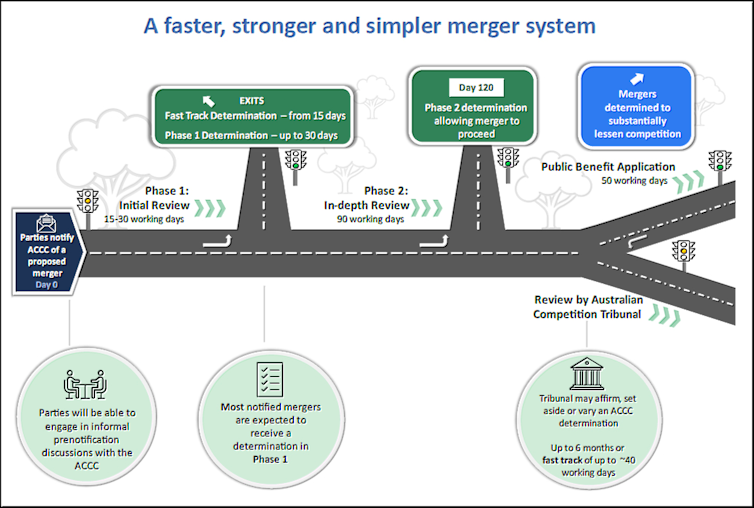
Under the new plan, which will apply from January 1 2026, mergers will be approved within 30 working days unless the ACCC raises concerns.

Firms will also have the option of “fast track” ruling within 15 working days.

Chalmers says the new system will be simpler, because there will be a single, streamlined path to approval, removing duplication and standardising notification requirements.

“It will be more targeted, because mergers that create, strengthen or entrench substantial market power will be identified and stopped while those consistent with our national economic interest will be fast tracked,” the Treasurer says.

For the first time, firms wanting to merge will be charged cost recovery fees, scaled to reflect the complexity and risk of the merger. The Treasury expects them to be in the range of $50,000 to $100,000, with additional fees for a review by the Competition Tribunal. The fees will not apply to small businesses.

Commonwealth Treasury All mergers considered by the ACCC will be listed on a public register, with brief information including the names of the merger parties, a short description of the transaction and affected products and/or services, and the review timeline. Merger parties will be able to engage in confidential pre-notification discussions as to the information to be provided to the ACCC but will no longer be able to receive an “informal view” ahead of formally applying. The ACCC looked at an average of 330 mergers annually over the past decade – only about a quarter of the total. Chalmers expected the workload to remain at about 330, but said it was more likely to be “the right 330” those with the greatest potential to cause harm. The Treasurer hasn’t gone as far as the Competition and Consumer Commission wanted. The ACCC wanted merger parties to have to satisfy it that a merger was not likely to substantially lessen competition in order to get approval. Several firms objected that this “reversed the onus of proof”, effectively introducing a presumptive ban on mergers. Read more: Inquiry into supermarkets says make voluntary code of conduct mandatory but don't bring in divestiture power[1] The changes are part of the Albanese government’s general shakeup of competition rules which also includes a review of the food and grocery code[2] governing supermarkets undertaken by former government minister Craig Emerson and proposals to loosen “non-compete[3]” clauses governing workers who change jobs. “Australia’s competitiveness has been declining since the 2000s,” Chalmerssays. “We see this in increasing market concentration.” “Australia is one of only three OECD countries that doesn’t require compulsory notification of mergers.” The Treasurer is also appointing merger specialist Philip Williams to the ACCC and updating the ACCC’s statement of expectations. Williams is a former Professor of Law and Economics at the University of Melbourne. References^ Inquiry into supermarkets says make voluntary code of conduct mandatory but don't bring in divestiture power (theconversation.com)^ food and grocery code (theconversation.com)^ non-compete (theconversation.com)Authors: Michelle Grattan, Professorial Fellow, University of Canberra

Read more https://theconversation.com/more-mergers-to-come-under-scrutiny-in-another-leg-of-chalmers-competition-policy-227454

The Weekend Times Magazine

Tips For Creating A Safe Pool Environment For Your Growing Family

Having a pool in the backyard is a dream for many Australian families. It offers hours of entertainment, a way to stay active, and a place to cool off during...

Finding the Perfect Wedding Suit in Adelaide: Your Ultimate Guide

Your wedding day is one of the most important days of your life, and every detail matters. From the venue to the vows, everything should be perfect, especially your attire...

Out of 500 Nominations, My Guardian Breaks into Top 3 at Australia’s Prestigious 2025 ACE Awards

Sydney, 22 July 2025 – From humble beginnings to national recognition, My Guardian is celebrating a milestone achievement - being selected as one of the top three finalists in the...

The Quiet Drive Home: Why Weekends Away Can Leave Us Feeling Empty

There is a curious emotional moment that arrives at the end of a wonderful weekend. The bags are packed, the holiday house is tidied, the final coffees are finished, and...

The official ANZ launch of EPOS

Sydney - Following a panel discussion with Australian businessman Mark Bouris and panellists Alyce Tran, Scott Bidmead and Jahan Sheikh from Microsoft EPOS was launched. Attendees experienced...

Australia’s top economists oppose the next increases in compulsory super: new poll

The five consecutive consecutive hikes in compulsory super contributions due to start next July should be deferred or abandoned in the view of the overwhelming majority of the leading Australian...

The Hidden Financial World Most Australians Never See

Most Australians know their local bank. Few realise that an enormous financial market now operates largely behind the scenes. Private credit funds quietly finance office towers, apartment buildings, renewable energy projects, factories...

Trading With Quantum AI: A How-To Guide

Quantum AI can be used in any country where retail CFD trading is legal. The site does warn that registration spots are limited, so your first try might not be successful. If...

How to work from home and not get divorced

Covid has triggered life-changing decisions for some people and has put a lot of relationship strain on couples. The stress of working from home and having to home school the...