How both health and safety are compromised for people living with long COVID and intimate partner violence
- Written by: Kate Fitz-Gibbon, Professor of Social Sciences, Faculty of Arts, Monash University, Monash University
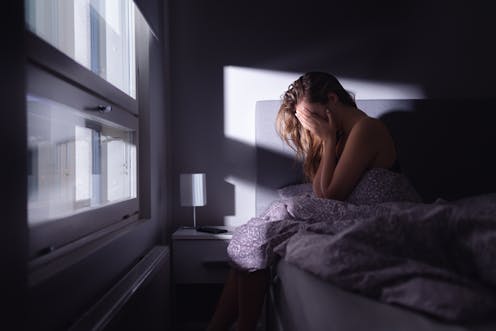
What happens when a person is experiencing long COVID and intimate partner violence at the same time? There has been no attention paid to this question anywhere in the world since the onset of the pandemic in 2020.
This is staggering, given previous research[1] shows women who are victim-survivors of intimate partner violence are twice as likely to develop long-term illnesses, including chronic fatigue syndrome and fibromyalgia.
The World Health Organisation[2] defines long COVID as the continuation, or development of new symptoms three months after the initial COVID infection. Global studies[3] estimate one in ten infected people go on to develop long COVID symptoms.
Our research[4] reveals the previously unseen impacts of long COVID on individuals experiencing domestic violence. We found that each of these conditions worsened an individual’s experience of the other.
Our study
We conducted an anonymous online survey[5] between April and October 2023 with 28 Australian adults affected by intimate partner violence and diagnosed with long COVID. The survey asked participants about the impact of long COVID on their experiences of intimate partner violence as well as about their safety and support needs.
The majority of survey participants (18 of the 28) identified as female and as heterosexual (21 of 28). Most participants were between 31 and 50 years old and identified English as the main language spoken at home.
The majority of respondents contracted long COVID in 2022 and had experienced symptoms for more than a year. Three-quarters of them said long COVID “significantly” affected their day-to-day functioning.
Experiences of partner abuse since contracting long COVID
Thirteen participants had experienced abuse in the relationship prior to their diagnosis with long COVID. Another seven experienced abuse for the first time following their long COVID diagnosis. These victim-survivors talked about the abuse beginning as their health deteriorated.
One participant described:
I think the illness on top of my other conditions made him perceive me as more of a burden, leading to poor behaviour. There were a few signs of this prior to my having COVID, but I think my being vulnerable when I had previously been the ‘strong’ and ‘independent’ partner really threw him off and he rejected that.
Another victim-survivor put the rapid increase in abuse down to the difficult social conditions of living through lockdowns and in isolation:
[The pandemic] gave us too much time to know so much about each other. That worsened the abusive tendencies.
Eighteen survey participants believed contracting long COVID had put them at higher risk of abuse due to a range of factors, including reduced brain functioning, low self-worth, social isolation associated with COVID restrictions, and the burden of care placed on their partners.
As two victim-survivors described:
My self-worth has decreased and my need for help and support has increased. He makes me feel like I need him.
I seemed to be a burden at all times.
Several participants said they were too unwell as a result of long COVID to even consider leaving their abusive partner. As two participants commented:
I felt that I had no choice but to stay. I can’t handle another huge change or unknown.
It [long COVID] makes me feel helpless. My health is my ticket to a better life. I’m not actioning my thoughts to leave as it all seems too big, too messy. I won’t cope physically or mentally. I cannot take care of five children on my own.
Victim-survivors who had not separated from their abusive partner acknowledged that it would be impossible to recover physically from long COVID while continuing to experience intimate partner violence.
Read more: I have COVID. How likely am I to get long COVID?[6]
The weaponisation of long COVID symptoms
Victim-survivors described how their partners weaponised or manipulated their long COVID symptoms to perpetrate abusive behaviours. Perpetrators exploited the mental and physical impacts of long COVID to further entrap victim-survivors in coercively controlling relationships.
One victim-survivor described their partner in the following way:
yelling and pushing due to me not knowing what I want to say quickly and words getting muddled up.
Another victim-survivor lost their sex drive, a well-documented symptom of long COVID, which led to their abuser shifting towards sexually abusive behaviours.
Missed opportunities
Many victim-survivors in this study[7] talked about missed opportunities for intervention by health professionals. One in five victim-survivors surveyed said that they were never asked about violence by a medical professional.
Several participants also said family violence support services were partially or completely inaccessible due to their long COVID symptoms. One victim-survivor commented:
Nothing was able to be provided in a practical sense, the best that could be done is acknowledging that there’s a gap in services.
Several victim-survivors who accessed support did so via phone or webchat. This is unsurprising given the health vulnerabilities of victim-survivors experiencing long COVID. But it highlights the importance of continued funding for the delivery of remote domestic violence supports and health care services across Australia.
Read more: How technology can help victims of intimate partner violence[8]
Supporting the safety and recovery needs of all victim-survivors
Our study[9] provides critical information relevant to the continued implementation of the Australian government’s National Plan to End Violence against Women and Children[10] as well as ongoing public health policy and practice in all Australian states and territories.
The unique experiences of victim-survivors with long COVID and other chronic health conditions must be recognised and addressed across the spectrum of prevention, early intervention, response and recovery efforts.
In this study[11], victim-survivors commonly described losing control of their health and then losing control of their safety within their relationship. Addressing this issue requires workers responding to domestic violence to be alive to the complex intersection of chronic illness, ableism, and gender-based violence.
References
- ^ previous research (www.birmingham.ac.uk)
- ^ World Health Organisation (www.who.int)
- ^ Global studies (www.nature.com)
- ^ Our research (bridges.monash.edu)
- ^ an anonymous online survey (bridges.monash.edu)
- ^ I have COVID. How likely am I to get long COVID? (theconversation.com)
- ^ this study (bridges.monash.edu)
- ^ How technology can help victims of intimate partner violence (theconversation.com)
- ^ Our study (bridges.monash.edu)
- ^ National Plan to End Violence against Women and Children (www.dss.gov.au)
- ^ this study (bridges.monash.edu)
Authors: Kate Fitz-Gibbon, Professor of Social Sciences, Faculty of Arts, Monash University, Monash University