Google AI

Weekend Times


The Times

Business News

Almost no one uses Bitcoin as currency, new data proves. It's actually more like gambling

  • Written by: John Hawkins, Senior Lecturer, Canberra School of Politics, Economics and Society, University of Canberra
Almost no one uses Bitcoin as currency, new data proves. It's actually more like gambling

Bitcoin boosters like to claim[1] Bitcoin, and other cryptocurrencies[2], are becoming mainstream. There’s a good reason to want people to believe this.

The only way the average punter will profit from crypto is to sell it for more than they bought it[3]. So it’s important to talk up the prospects to build a “fear of missing out”.

There are loose claims[4] that a large proportion of the population – generally in the range of 10% to 20%[5] – now hold crypto. Sometimes these numbers are based on counting crypto wallets[6], or on surveying wealthy people[7].

But the hard data on Bitcoin use shows it is rarely bought for the purpose it ostensibly exists: to buy things.

Little use for payments

The whole point of Bitcoin, as its creator “Satoshi Nakamoto[8]” stated in the opening sentence of the 2008 white paper[9] outlining the concept, was that:

A purely peer-to-peer version of electronic cash would allow online payments to be sent directly from one party to another without going through a financial institution.

The latest data demolishing this idea comes from Australia’s central bank.

Every three years the Reserve Bank of Australia surveys a representative sample of 1,000 adults about how they pay for things[10]. As the following graph shows, cryptocurrency is making almost no impression as a payments instrument, being used by no more than 2% of adults.

Payment methods being used by Australians
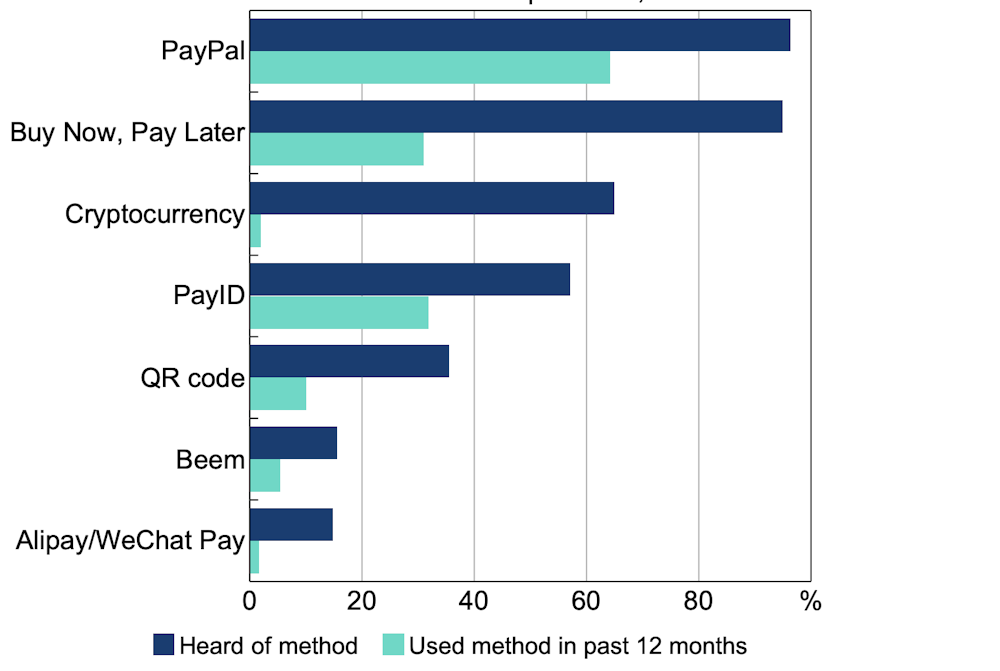
Alternative payment methods, share of all respondents, 2022
Reserve Bank calculations of Australians' awareness vs use of different payment methods, based on Ipsos data. By contrast more recent innovations, such as “buy now, pay later[11]” services and PayID[12], are being used by around a third of consumers. These findings confirm 2022 data from the US Federal Reserve[13], showing just 2% of the adult US population made a payment using a cryptocurrrency, and Sweden’s Riksbank[14], showing less than 1% of Swedes made payments using crypto. The problem of price volatility One reason for this, and why prices for goods and services are virtually never expressed in crypto, is that most fluctuate wildly in value. A shop or cafe with price labels or a blackboard list of their prices set in Bitcoin could be having to change them every hour. The following graph from the Bank of International Settlements shows changes in the exchange rate of ten major cryptocurrencies against the US dollar, compared with the Euro and Japan’s Yen, over the past five years. Such volatility negates cryptocurrency’s value as a currency. Cryptocurrency’s volatile ways 90-day rolling standard deviation of daily returns for major cryptocurrencies compared with the Euro and Yen. The Crypto Multiplier, BIS Working Papers, No. 1104, CC BY[15][16] There have been attempts to solve this problem with so-called “stablecoins”. These promise to maintain steady value (usually against the US dollar). But the spectacular collapse of one of these ventures, Terra[17], once one of the largest cryptocurrencies, showed the vulnerability[18] of their mechanisms. Even a company with the enormous resources of Facebook owner Meta has given up on its stablecoin venture[19], Libra/Diem. This helps explain the failed experiments with making Bitcoin legal tender in the two countries that have tried it: El Salvador and the Central African Republic[20]. The Central African Republic has already revoked Bitcoin’s status[21]. In El Salvador[22] only a fifth of firms accept Bitcoin, despite the law[23] saying they must, and only 5% of sales are paid in it. Read more: One year on, El Salvador's Bitcoin experiment has proven a spectacular failure[24] Storing value, hedging against inflation If Bitcoin’s isn’t used for payments, what use does it have? The major attraction – one endorsed by mainstream financial publications – is as a store of value, particularly in times of inflation, because Bitcoin has a hard cap on the number of coins that will ever be “mined”. As Forbes writers[25] argued a few weeks ago: In terms of quantity, there are only 21 million Bitcoins released as specified by the ASCII computer file. Therefore, because of an increase in demand, the value will rise which might keep up with the market and prevent inflation in the long run. The only problem with this argument is recent history. Over the course of 2022 the purchasing power of major currencies (US, the euro and the pound) dropped by about 7-10%. The purchasing power of a Bitcoin dropped by about 65%. Speculation or gambling? Bitcoin’s price has always been volatile, and always will be. If its price were to stabilise somehow, those holding it as a speculative punt would soon sell it, which would drive down the price. But most people buying Bitcoin essentially as a speculative token, hoping its price will go up, are likely to be disappointed. A BIS study[26] has found the majority of Bitcoin buyers globally between August 2015 and December 2022 have made losses. The “market value[27]” of all cryptocurrencies peaked at US$3 trillion in November 2021. It is now about US$1 trillion. Bitcoins’s highest price in 2021 was about US$60,000; in 2022 US$40,000 and so far in 2023 only US$30,000. Google searches show that public interest in Bitcoin also peaked in 2021. In the US, the proportion of adults with internet access holding cryptocurrencies fell from 11% in 2021 to 8% in 2022. Read more: What is Bitcoin's fundamental value? That's a good question[28] UK government research[29] published in 2022 found that 52% of British crypto holders owned it as a “fun investment”, which sounds like a euphemism for gambling. Another 8% explicitly said it was for gambling. The UK parliament’s Treasury Committee[30], a group of MPs who examine economics and financial issues, has strongly recommended[31] regulating cryptocurrency as form of gambling rather than as a financial product. They argue that continuing to treat “unbacked crypto assets as a financial service will create a ‘halo’ effect that leads consumers to believe that this activity is safer than it is, or protected when it is not”. Read more: Crypto trading: politicians who say it should be treated like gambling are completely wrong[32] Whatever the merits of this proposal, the UK committtee’s underlying point is solid. Buying crypto does have more in common with gambling than investing. Proceed at your own risk, and and don’t “invest” what you can’t afford to lose. References^ claim (cointelegraph.com)^ cryptocurrencies (www.rba.gov.au)^ more than they bought it (www.scienceabc.com)^ loose claims (www.rba.gov.au)^ 10% to 20% (cointelegraph.com)^ counting crypto wallets (www.grandviewresearch.com)^ surveying wealthy people (apnews.com)^ Satoshi Nakamoto (markets.businessinsider.com)^ white paper (bitcoin.org)^ pay for things (www.rba.gov.au)^ buy now, pay later (www.rba.gov.au)^ PayID (www.rba.gov.au)^ US Federal Reserve (www.federalreserve.gov)^ Sweden’s Riksbank (www.riksbank.se)^ The Crypto Multiplier, BIS Working Papers, No. 1104 (www.bis.org)^ CC BY (creativecommons.org)^ Terra (www.nber.org)^ the vulnerability (www.degruyter.com)^ given up on its stablecoin venture (www.bbc.com)^ Central African Republic (www.bbc.com)^ revoked Bitcoin’s status (www.imf.org)^ El Salvador (www.nber.org)^ law (twitter.com)^ One year on, El Salvador's Bitcoin experiment has proven a spectacular failure (theconversation.com)^ Forbes writers (www.forbes.com)^ BIS study (www.bis.org)^ market value (www.statista.com)^ What is Bitcoin's fundamental value? That's a good question (theconversation.com)^ government research (www.gov.uk)^ Treasury Committee (committees.parliament.uk)^ strongly recommended (publications.parliament.uk)^ Crypto trading: politicians who say it should be treated like gambling are completely wrong (theconversation.com)Authors: John Hawkins, Senior Lecturer, Canberra School of Politics, Economics and Society, University of Canberra

Read more https://theconversation.com/almost-no-one-uses-bitcoin-as-currency-new-data-proves-its-actually-more-like-gambling-207909

The Weekend Times Magazine

The Biggest Mistakes People Make When Hiring Lawyers in Sydney

Choosing the right legal help can feel daunting, especially when time is short and the stakes feel high. Many people start by searching for lawyers in Sydney, then rely on...

5 Ways to Make Maths Fun

For many students, maths can seem like a daunting subject, but with the right approach, it can become one of the most enjoyable and rewarding parts of learning. Whether you’re...

Strong Australia panel interview with Kieran Gilbert

Kieran Gilbert, chief news anchor Sky News: The Business Council of Australia continued its Strong Australia series today. This time the spotlight on the city of Wagga. How are regional cities...

House Builders in Melbourne Delivering Homes Built for Modern Living

Choosing the right house builders Melbourne is one of the most important steps in creating a home that feels comfortable, functional, and built to last. House builders play a central role...

Lifestyle Awnings – Bringing Style and Comfort to Melbourne Outdoor Living

Melbourne homeowners are always looking for ways to make better use of their outdoor areas. Whether it's entertaining, relaxing, or adding value to the property, installing Lifestyle Awnings is one of...

AI Landing Pages for Product Launches: Reusing Headless CMS Content with Speed

Product launches come with a deadline and pressure to be right, effective, and implemented quickly. Landing pages, for example, are the first step in such pages with customers ultimately seeing...

Coasting through Australia: 5 things you need to know

No matter where you choose to explore, you can never go wrong with Australia. The best time to spend time on the water in Australia is during the autumn and...

Australia’s Best Outlet Shopping Centres: Where Bargain Hunters Find the Brands

Outlet shopping has become one of the strongest parts of Australian retail. At a time when household budgets are under pressure, shoppers still want quality, but they are more willing...

How TPD Solicitors Unlock Your Super Insurance Payout Fast

Up to 70% of Australians don't realize they have TPD insurance through their super, potentially missing out on life-changing payouts when they need them most. This staggering statistic reveals a...