NZ biggest firms will soon have to disclose their climate risk – but will it really curb climate change?
- Written by: Ilan Noy, Chair in the Economics of Disasters and Climate Change, Te Herenga Waka — Victoria University of Wellington
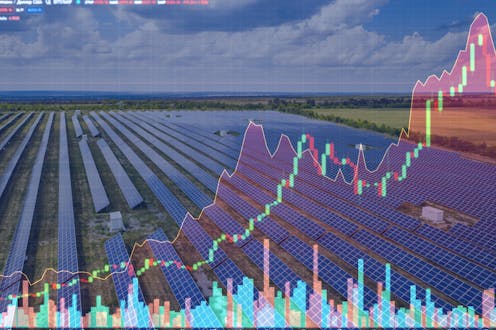
Climate change has many catastrophic consequences[1], including droughts, floods[2], wildfires, heat waves, rising sea levels[3] and biodiversity loss[4]. These all have adverse implications for social cohesion, economic development and financial stability.
Regrettably, the goals of advancing a better environment and a flourishing economy don’t always line up. Driving greater awareness of climate-related risks among large firms and powerful financial institutions is therefore of paramount importance and urgency.
Read more: Green investing: the global system for rating companies' ethical credentials is meaningless[5]
Responding to this challenge, economists, environmentalists, activists and politicians have sought ways to ensure financial decisions factor in climate change[6]. To that end, policymakers are now considering the introduction of mandatory climate-related disclosures for firms and financial institutions.
In essence, the idea is to employ disclosures to force large financial actors to consider their impact on climate change, and the impact of climate change on them.
For example, consider the potential exposure of a bank to climate risks. Home loans may not be recoverable if houses become uninhabitable because of rising seas. Other homes may become uninsurable because of increasing flood risks.
Likewise, agricultural loans may become riskier because of the increasing intensity of droughts. All of these risks are important not only to the bank’s profitability but also to the homeowners, farmers and manufacturers who borrowed money from that bank.
Who should disclosures target?
New Zealand’s recently published draft General Requirements for Climate-related Disclosures[7] defines climate-related disclosures as:
disclosures about climate-related risks and opportunities that are useful to primary users when they assess, and make decisions about, an entity’s enterprise value, including information about its governance, strategy and risk management, and metrics and targets.
Read more: Business can no longer ignore extreme heat events – it’s becoming a danger to the bottom line[8]
The rationale behind the proposed framework is that consistent, comparable and understandable disclosures will encourage better climate-related decision-making and risk management. In turn, this will encourage firms to adopt more climate-resilient strategies, smoothing the transition to a net-zero economy.
The disclosures themselves seek to inform “primary users” – defined as “existing and potential investors, lenders and other creditors” – how companies respond to and consider[9] the impacts of climate change. Armed with this knowledge, primary users are then presumed to be able “to assess the merits of how entities are considering climate-related risks and opportunities”.
But the proposed framework regards only investors, lenders and other creditors as primary users. The definition does not include employees, customers or the public. This narrow definition represents a missed opportunity.
Stakeholders versus shareholders
Focusing on a relatively narrow range of primary users undermines the potential for disclosures to bring about change. Including employees, customers and the public would make the disclosures more powerful. By increasing their impact and relevance, the disclosures would better serve their goals.
This touches on the modern concept of stakeholders and “stakeholder capitalism” rather than only shareholders. Shareholders will mostly (or only) care about one limited dimension of the firm’s impact: profits. If they own only a small share of the entity through the stock market or their superannuation or pension fund, shareholders may not even pay much attention to what the firm does.
Stakeholders, however, include the firm’s employees, customers and everyone directly affected by its activities. Unlike shareholders, stakeholders often have a long-term perspective and a more immediate and direct interest in what the entity does.
The public interest
Stakeholders will therefore typically look beyond the firm’s profits to consider the broader social and community interests at stake. Stakeholders will desire, or indeed demand, more sustainable strategies that benefit a larger set of groups (rather than just the shareholders).
Interestingly, the European Union adopted a similarly broad perspective in its “guidelines on reporting climate-related information[10]” in 2019. These require firms to adopt a “double materiality” standard: looking at what is material for both shareholders (the financial audience) and stakeholders (the environmental and social audiences).
Read more: SEC proposes far-reaching climate disclosure rules for companies – here’s where the rules may be vulnerable to legal challenges[11]
Considering the public’s interest in financial disclosures about climate change also aligns with other recent regulatory efforts, such as the Plain Language Bill[12] currently before parliament. This signals that citizens have a democratic right to receive comprehensible information from government organisations.
While the bill focuses on public service and Crown agencies, it illustrates the need to put citizens at the centre of laws and communicate with them effectively.
Read more: The end of jargon: will New Zealand's plain language law finally make bureaucrats talk like normal people?[13]
Disclosure for all
The New Zealand External Reporting Board, which is responsible for the proposed disclosure framework, has invited responses and is now considering the submissions.
This final review and consultation[14] stage provides a valuable opportunity to reconsider the definition of primary users.
While New Zealand is a world leader in advancing these measures, just how effective and useful they will be remains to be seen. A revised definition that will encompass all stakeholders – including customers, employees and the public at large – will increase the disclosures’ efficacy.
In New Zealand and elsewhere, governments should adopt as wide a target audience as is feasible for climate-related disclosures. Otherwise, we risk undermining the promise of disclosures to mitigate climate change and contribute to a more climate-resilient future economy.
References
- ^ many catastrophic consequences (www.ipcc.ch)
- ^ floods (www.nytimes.com)
- ^ rising sea levels (www.climate.gov)
- ^ biodiversity loss (www.gov.uk)
- ^ Green investing: the global system for rating companies' ethical credentials is meaningless (theconversation.com)
- ^ factor in climate change (www.ft.com)
- ^ General Requirements for Climate-related Disclosures (www.xrb.govt.nz)
- ^ Business can no longer ignore extreme heat events – it’s becoming a danger to the bottom line (theconversation.com)
- ^ respond to and consider (www.fsb-tcfd.org)
- ^ guidelines on reporting climate-related information (ec.europa.eu)
- ^ SEC proposes far-reaching climate disclosure rules for companies – here’s where the rules may be vulnerable to legal challenges (theconversation.com)
- ^ Plain Language Bill (www.parliament.nz)
- ^ The end of jargon: will New Zealand's plain language law finally make bureaucrats talk like normal people? (theconversation.com)
- ^ final review and consultation (www.xrb.govt.nz)
Authors: Ilan Noy, Chair in the Economics of Disasters and Climate Change, Te Herenga Waka — Victoria University of Wellington