Hawke's special skill was levelling with the Australian people. It's Albanese's only option
- Written by: Emily Millane, Senior Fellow, Melbourne Law School, The University of Melbourne
As every historian knows, the frame you use to analyse the past affects the stories you tell about that past. Time is foremost among those frames.
Richard Flanagan wrote last month that the 2022 federal election result marked the end of the Howard Era[1]. By that he meant the end of a pernicious kind of politics where institutions were not only hollowed out, but rubbished.
Wind the clock back further, and you start to see echoes of an earlier era, specifically one Labor governments presided over.
Once again, we are in the grip of an energy crisis. Russia’s invasion of Ukraine is doing what events in the Middle East did in the 1970s.
The 1973 oil crisis forced massive inflation upon the Whitlam government. By 1975 inflation was 15% and Australia was teetering on the edge of recession.
Unemployment, previously within a narrow band of 1-3%, jumped above 3% and then above 4% where it stayed for half a century.
Governing in crisis
In 1983 the Hawke Labor government came to office with inflation still at 11.5%, unemployment at 10.3% and Australia in the middle of a long-lasting recession.
Hawke’s treasurer Paul Keating would later say about his early period as treasurer that there was no obvious place to look for an answer to the economy’s problems.
This was especially so at a time when the West was embracing economic liberalism and turning decisions over to markets rather than governments.
But the Hawke government had one critical instrument at its disposal: centralised wage fixation.
Finding the bargain
Keating as a treasurer, and as a politician, understood bargains. You don’t get big change without giving something away.
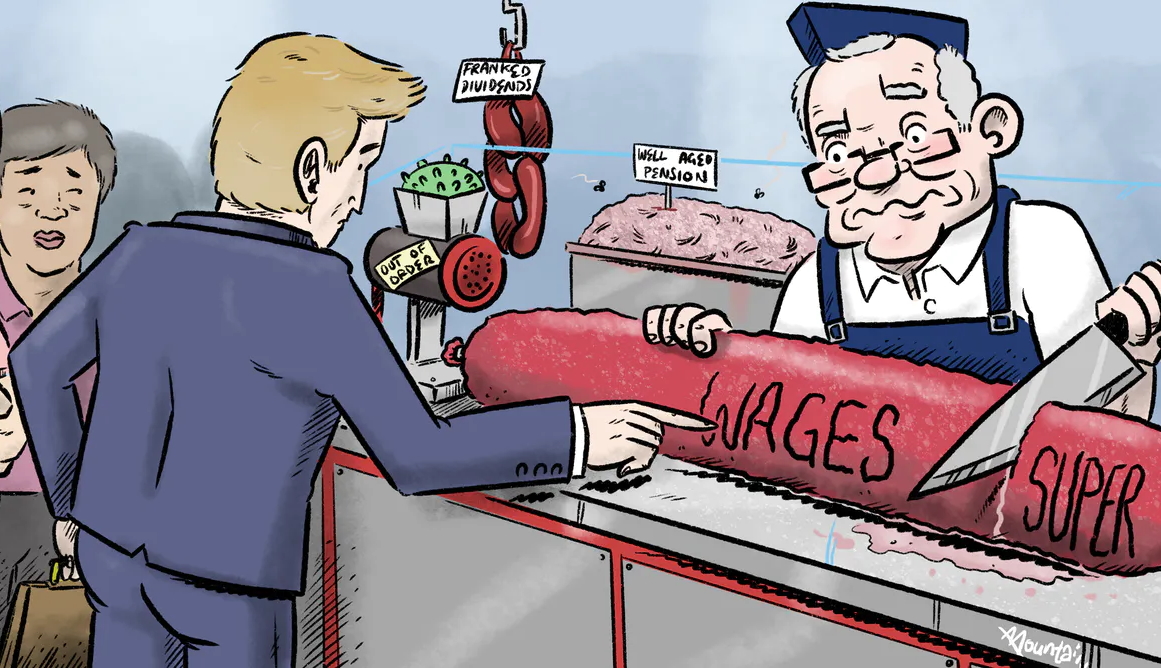
The series of prices and incomes Accords[2] that began in 1983 pulled back wage-driven inflation by a trade-off: workers would forgo wage rises in exchange for social programs and better retirement incomes.
That’s how modern superannuation began.
Today, inflation is 5.1% – hardly the stuff of 1973 or 1983, but way beyond the 1-2% we have had for most of the last decade.
Less to bargain with
The Albanese government comes to power intending to call an economic summit of business, union and community leaders. It’s an idea straight out of the Hawke government’s 1983 playbook.
In the industrial relations portfolio, minister Tony Burke has a mandate from his leader to pursue a Hawke-style Accord.
But it’s unclear where the policy levers for significant reform are.
These days, workers don’t have big wage rises[3] to trade away.
Trade unions have neither the coverage nor bargaining power they did. In the early 1980s, almost 50% of employees were members of a union. Today, it’s 14%[4].
And we don’t have much centralised wage fixing. It was Keating who began the process of decentralising wages, moving away from a system of nationwide awards towards enterprise-by-enterprise bargaining.
It is difficult to see how a 1980s-style Accord-style could be struck in these circumstances. The genie bottle of private market forces has been unleashed.
George Megalogenis observed in his book The Longest Decade[5] that deregulation, by definition, removed the government from economy
and yet Keating talked as if he were the maestro. But he didn’t conduct; rather, he gave the orchestra a licence to improvise.
And the Albanese lacks a mandate for serious reform. The election result shows the nation in favour of some light progressivism, but not up for major tax changes or redistribution.
Labor failed to gain office when it promised big changes in 2019. In the lead-up to the 2022 election, it agreed to pass[6] so-called stage 3 tax reforms that will deliver the biggest benefits to those on the highest incomes.
Read more: A new dawn over stormy seas: how Labor should manage the economy[7]
Albanese’s ministers will need to be good communicators. They will need to explain that they can only do so much.
But when the time comes, as it inevitably will, for a discussion about significant economic reform, they will need to level with the electorate, like Hawke.
All the more need to be bold
Treasurer Jim Chalmers has given very clear signals about the parlous state of the books ahead of the budget in October. He’ll likely be delivering that budget after more interest rate rises from the Reserve Bank.
It has become fashionable to say this year’s election might have been a good one to lose. But ironically, this might also be a period of such significant turmoil that policymakers have no choice but to be bold, and to take people with them.
It was Albanese himself who said the nation is at a critical juncture[8].
The tools mightn’t be all he would want, but there is nothing like a crisis to force a reformer’s hand.
References
- ^ end of the Howard Era (www.smh.com.au)
- ^ Accords (theconversation.com)
- ^ don’t have big wage rises (theconversation.com)
- ^ 14% (theconversation.com)
- ^ The Longest Decade (www.angusrobertson.com.au)
- ^ agreed to pass (theconversation.com)
- ^ A new dawn over stormy seas: how Labor should manage the economy (theconversation.com)
- ^ critical juncture (anthonyalbanese.com.au)
Authors: Emily Millane, Senior Fellow, Melbourne Law School, The University of Melbourne