An unemployment rate below 4% is possible. But for how long?
- Written by: Jeff Borland, Professor of Economics, The University of Melbourne
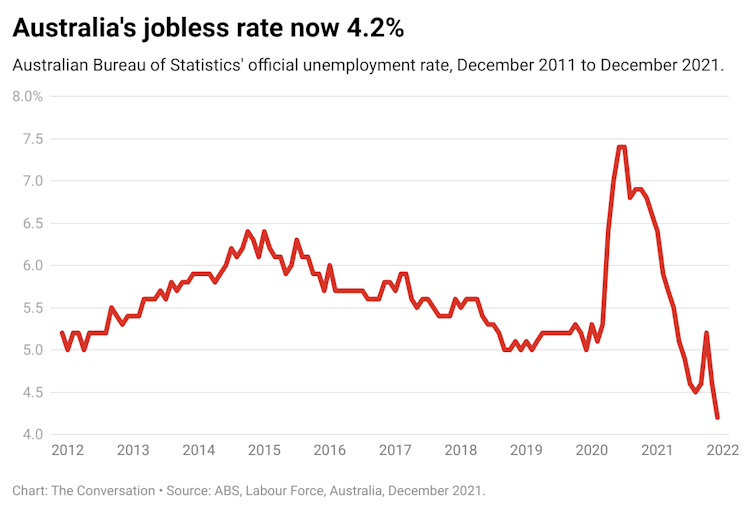
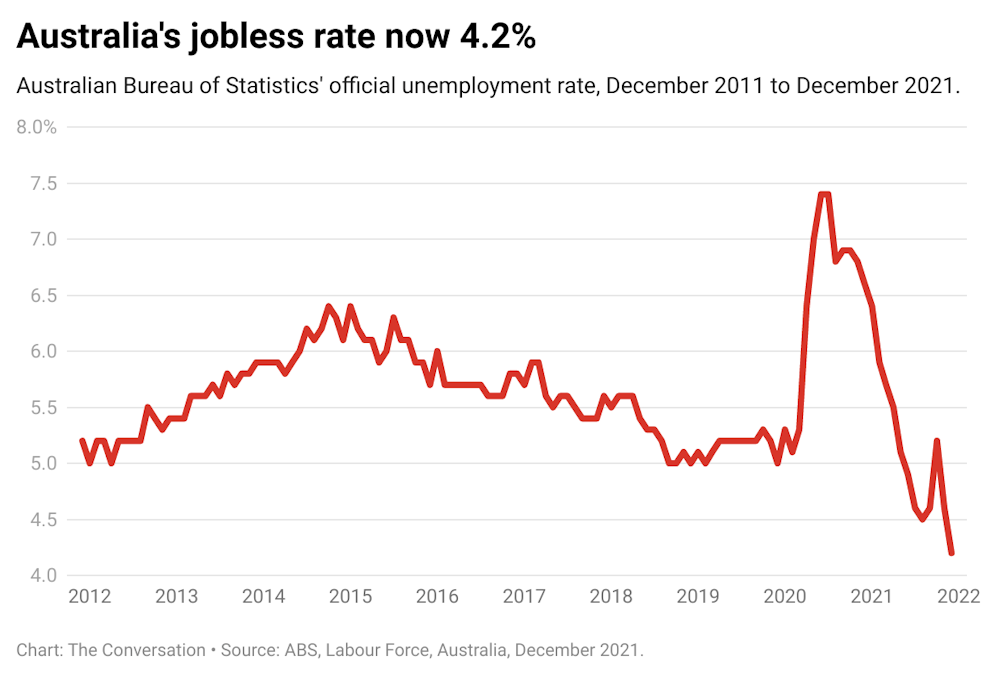
It would be nice to think Australia’s low unemployment rate – now 4.2%, the lowest since August 2008 – is here to stay.
We’ve been waiting a long time to see this. In the decade before the onset of COVID-19 the jobless rate hardly moved. In March 2010 it was 5.4%. Ten years later, in March 2020, it was 5.3%. In between the lowest the rate was to 4.9% - and then just for two months.
 CC BY[4]
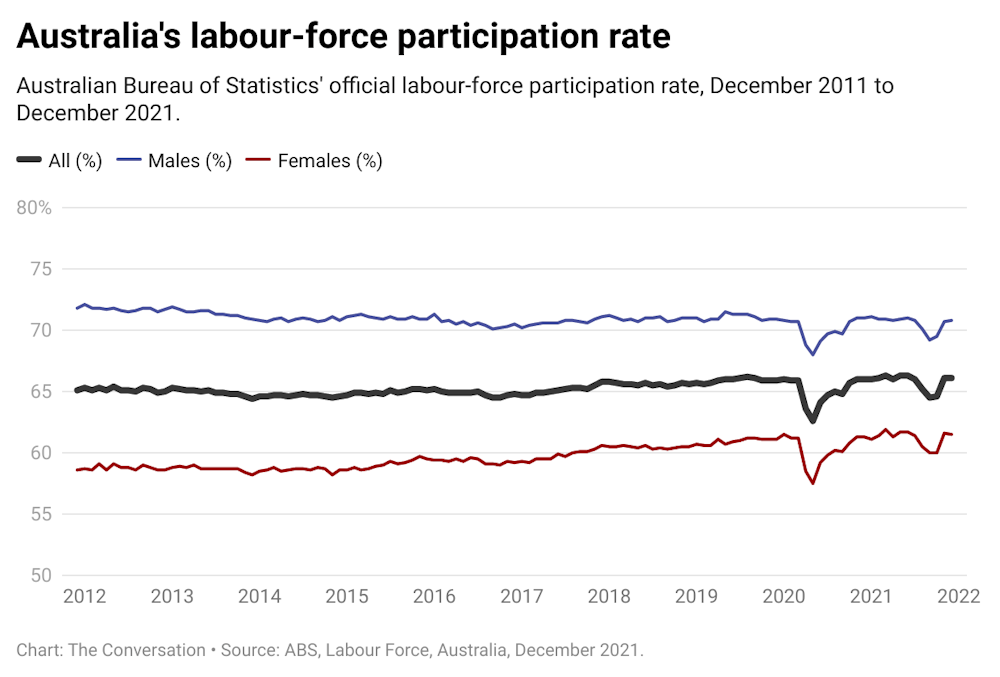
Should growth in the labour-force participation rate return to its previous pace once the impact of COVID-19 recedes, the rate of unemployment will be pushed back up.
Read more:
Just 4.5% during lockdowns? The unemployment rate is now meaningless[5]
Statistics for young workers
Issues to do with measurement may also be temporarily making the rate of unemployment artificially low.
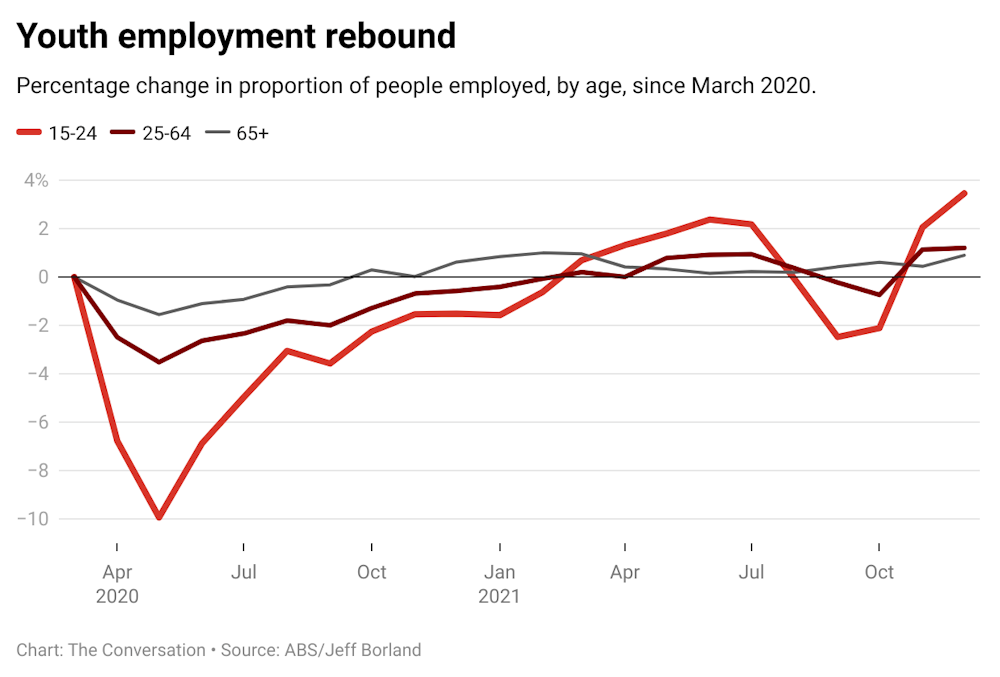
The strongest employment growth from March 2020 to December 2021 was for those aged 15 to 24 years.
Younger workers were hardest hit during the 2020 downturns associated with COVID-19. But by December 2021 the proportion of young people employed was 3.5 percentage points higher than in March 2020. This compares with the employment rate being 1.2 percentage points higher than before the pandemic for those aged 25-64 years, and 0.9 percentage points higher for those 65 years and older.
CC BY[4]
Should growth in the labour-force participation rate return to its previous pace once the impact of COVID-19 recedes, the rate of unemployment will be pushed back up.
Read more:
Just 4.5% during lockdowns? The unemployment rate is now meaningless[5]
Statistics for young workers
Issues to do with measurement may also be temporarily making the rate of unemployment artificially low.
The strongest employment growth from March 2020 to December 2021 was for those aged 15 to 24 years.
Younger workers were hardest hit during the 2020 downturns associated with COVID-19. But by December 2021 the proportion of young people employed was 3.5 percentage points higher than in March 2020. This compares with the employment rate being 1.2 percentage points higher than before the pandemic for those aged 25-64 years, and 0.9 percentage points higher for those 65 years and older.
 CC BY[6]
The strength of employment growth for the young – given all we know about the increasing difficulties they faced in the labour market in the 2010s – is surprising.
My guess is it may in part be due to young Australian permanent residents taking over jobs previously held by international students and working holiday makers, and being more likely to be captured in official surveys.
Read more:
The economy can't guarantee a job. It can guarantee a liveable income for other work[7]
In that case,total employment of the young may not actually have changed by much, but the statistics show it increasing because of who is doing the work.
Before COVID-19 we could reasonably have expected the rate of unemployment today to be 5%. Instead, we’re at 4.2% and looking ahead in 2022 to further falls in unemployment. What lies beyond that is less certain.
References^ CC BY (creativecommons.org)^ Australia has record job vacancies, but don't expect higher wages (theconversation.com)^ big reason (drive.google.com)^ CC BY (creativecommons.org)^ Just 4.5% during lockdowns? The unemployment rate is now meaningless (theconversation.com)^ CC BY (creativecommons.org)^ The economy can't guarantee a job. It can guarantee a liveable income for other work (theconversation.com)Authors: Jeff Borland, Professor of Economics, The University of Melbourne
CC BY[6]
The strength of employment growth for the young – given all we know about the increasing difficulties they faced in the labour market in the 2010s – is surprising.
My guess is it may in part be due to young Australian permanent residents taking over jobs previously held by international students and working holiday makers, and being more likely to be captured in official surveys.
Read more:
The economy can't guarantee a job. It can guarantee a liveable income for other work[7]
In that case,total employment of the young may not actually have changed by much, but the statistics show it increasing because of who is doing the work.
Before COVID-19 we could reasonably have expected the rate of unemployment today to be 5%. Instead, we’re at 4.2% and looking ahead in 2022 to further falls in unemployment. What lies beyond that is less certain.
References^ CC BY (creativecommons.org)^ Australia has record job vacancies, but don't expect higher wages (theconversation.com)^ big reason (drive.google.com)^ CC BY (creativecommons.org)^ Just 4.5% during lockdowns? The unemployment rate is now meaningless (theconversation.com)^ CC BY (creativecommons.org)^ The economy can't guarantee a job. It can guarantee a liveable income for other work (theconversation.com)Authors: Jeff Borland, Professor of Economics, The University of MelbourneRead more https://theconversation.com/an-unemployment-rate-below-4-is-possible-but-for-how-long-175618