Can an app change Australia's car culture? Only if all moving parts work together
- Written by: Sophia Duan, Lecturer in Information Systems, RMIT University
Getting around an Australian city without a car can be a real hassle. Imagine how much easier it would be if you had the option of combining public transport and shared services — be it bus, train, tram, taxi, car share, electric bicycle or e-scooter — and could book and pay for the lot using a single app.
In Finland, this is already an option. The digital platform Whim[1] enables you to book and pay for a trip mixing public transport, ferry service, car rental, taxi, shared bike and even e-scooter.
You simply have to enter your destination in the app, and Whim recommends the best options. You can pay on a subscription or pay-as-you-go basis. It’s convenient, flexible and better value than booking each leg separately.
The concept and technology behind Whim is known as Mobility as a Service[2] — or MaaS. The aim is to promote more sustainable modes of travel and make individual car ownership unnecessary for urban mobility.
Whim has now expanded to the Netherlands, Belgium, Austria and Switzerland. Could such service work in Australia?
MaaS in Australian cities must obviously contend with both supply and demand challenges. On the supply side, challenges include lower population densities with less comprehensive alternatives to private vehicle use. Emulating the success of Whim would also need something like Finlnad’s national transport law[3], which requires mobility services to make their data and APIs open to third parties.
On the demand side, Australians have a high rate of car ownership, with fixed costs creating incentives to use those vehicles, rather than alternatives.
Could a MaaS service tempt more Australian to leave the car at home? Our research suggests some room for optimism, with 44% of 331 adults we surveyed saying they would use a MaaS regularly if it was available. But translating that enthusiasm into actual behavioural change will require getting many moving parts to mesh.
Read more: All your transport options in one place: why mobility as a service needs a proper platform[4]
What our survey found
We conducted our survey at the end of 2020. Our survey sample was broadly representative of Australian society. There were more women (59%) and people with degrees (40%, compared with 35% of all Australians[5] aged 20-64). About 13% had an annual income of more than $100,000. About 84% owned a car (roughly in line with the rate of car ownership suggested by statistics[6]).
Attitudes towards the MaaS concept were generally very favourable. Of the 144 of 331 participants who said they would use MaaS on a regular basis if it was available, 75% said they would use for social trips, 72% for commuting to work and study, and 66% for general trips (shopping, errands, visiting the doctor etc).
At the last census of Australian’s travel modes (in 2016[7]), 69% drove to work, with another 5% being car passengers, 4% walking and 5% working from home. This means 17% used other modes. In our survey 31% indicated they were open to using MaaS for commuting.
Of course, there is almost always a difference between good intentions and actual behaviour. The phenomenon of response bias in surveys, with the desire to appear pro-social influencing respondents’ answers, is well documented.
Nonetheless our results do suggest MaaS could make a difference in shifting travel habits, not to mention making urban travel much easier for those without cars.
MaaS in Australia
Our research underlines the importance of a MaaS service being intuitive, easy to use, reliable, efficient and economical.
This last point has also been shown by the results of the one MaaS trial so far done in Australia.
The Sydney Maas trial[8],ran from November 2019 to March 2021 involved 100 employees of insurance company IAG using an app (called Tripi) supplied by MaaS software developer Skedgo[9].
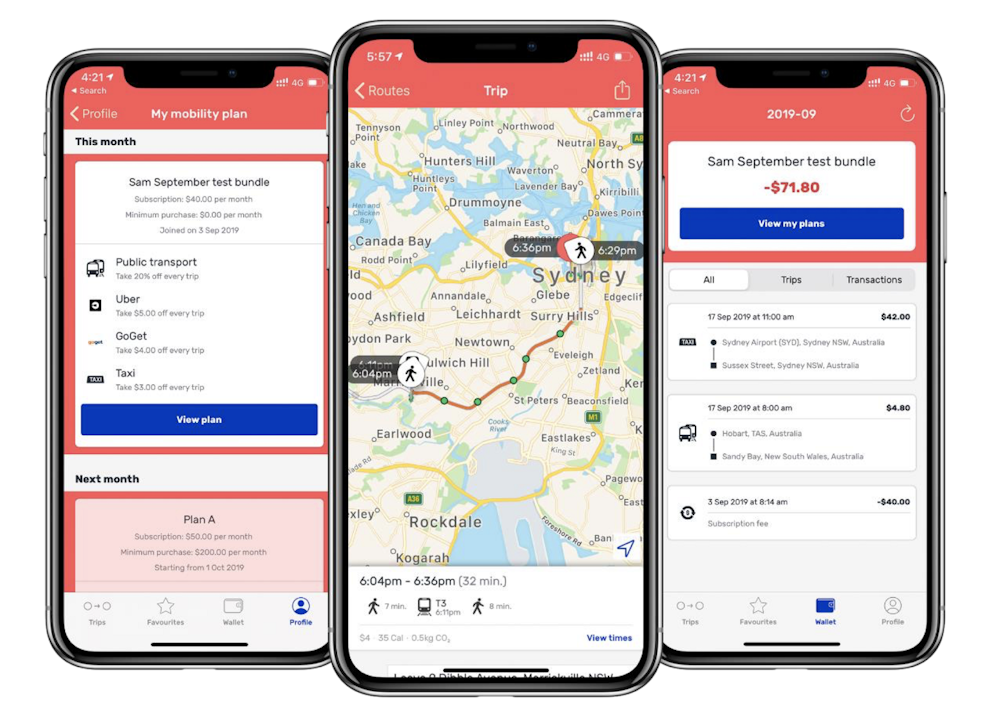 SkedGo’s Tripi app, used in the Sydney Maas trial.
SkedGo[10]
SkedGo’s Tripi app, used in the Sydney Maas trial.
SkedGo[10]
The trial tested, among other things, users’ willingness to pay, either by subscription or pay as you go, for transport bundles combining public transport, taxi, ride share, car share and car rental.
Read more: We subscribe to movies and music, why not transport?[11]
The research was run by the Institute of Transport and Logistics Studies at the University of Sydney. The final report[12] was published in March 2021. The key outcomes were that MaaS had appeal to car owners and frequent car users, but those most keen were already multi-modal travellers.
Notably the researchers reported:
Without a (monetary) incentive, travellers appear to see very little value in MaaS in the presence of existing apps that are improving all the time (such as Opal Connect, Apple Pay, Google Pay, and improved technical platforms that facilitate payment in addition to searching and planning) and hence one may not get enough buy-in to make a currently niche product scalable.
And also:
While a MaaS app (and hence technical actors) is important, it is only one of the many factors that we need to structure a successful MaaS program/product offer.
Read more: For Mobility as a Service (MaaS) to solve our transport woes, some things need to change[13]
So while our survey results show enthusiasm about MaaS, we must be cautious about about its current viability to work at scale. More understanding is needed about the design of MaaS, the sustainability of commercial models, the scalability of trials and users’ reactions and behavioural insights.
References
- ^ Whim (whimapp.com)
- ^ Mobility as a Service (maas-alliance.eu)
- ^ national transport law (maas-alliance.eu)
- ^ All your transport options in one place: why mobility as a service needs a proper platform (theconversation.com)
- ^ 35% of all Australians (www.abs.gov.au)
- ^ suggested by statistics (chartingtransport.com)
- ^ in 2016 (www.abs.gov.au)
- ^ Sydney Maas trial (imoveaustralia.com)
- ^ Skedgo (skedgo.com)
- ^ SkedGo (skedgo.com)
- ^ We subscribe to movies and music, why not transport? (theconversation.com)
- ^ final report (imoveaustralia.com)
- ^ For Mobility as a Service (MaaS) to solve our transport woes, some things need to change (theconversation.com)
Authors: Sophia Duan, Lecturer in Information Systems, RMIT University