5 reasons why banishing backpackers and targeting wealthy tourists would be a mistake for NZ
- Written by: James Higham, Professor of Tourism, University of Otago
Raise your hand if you’ve ever travelled for weeks or months as a backpacker on a limited daily budget. Keep your hand up if you were made welcome in the places you visited on your OE, enjoyed chance encounters and experienced the generosity of strangers.
And did those experiences leave a lifelong affection for the places you visited and people you met? If the answer is yes, then we need to consider what might happen in New Zealand were Tourism Minister Stuart Nash’s latest ideas to become policy.
To recap, Nash told the Tourism Summit in Wellington last week the industry should move away from catering for low-spending backpackers and instead target the rich[1]. This would solve two problems: the environmental damage allegedly caused by freedom campers (including using nature as their toilet[2]), and the pressure of too many visitors in general.
Nash was right to say we cannot return to the pre-COVID normal when the border reopens and the tourism recovery begins. Overcapacity, strained infrastructure and environmental impacts meant growing community resistance[3] was reaching a tipping point.
But do we really want to banish backpackers and position New Zealand as expensive and exclusive — the Switzerland of the South Pacific? There are five reasons this approach would be a mistake.
1. Big spenders are big polluters
Lower-budget travellers generally stay much longer than the average. They usually make a higher aggregate economic contribution than those whose daily spend is high but who pass through quickly.
Does New Zealand really want only the uber-rich to experience our natural wonders, when flying business class, travelling by cruise ship and hiring helicopters are the most environmentally damaging ways to do so?
Read more: Serving time: how fine dining in jail is helping prisoners and satisfying customers[4]
If we were to consider the wider social, economic and environmental impacts of discrete tourism markets, we would be banishing the cruise industry[5] first, not backpackers.
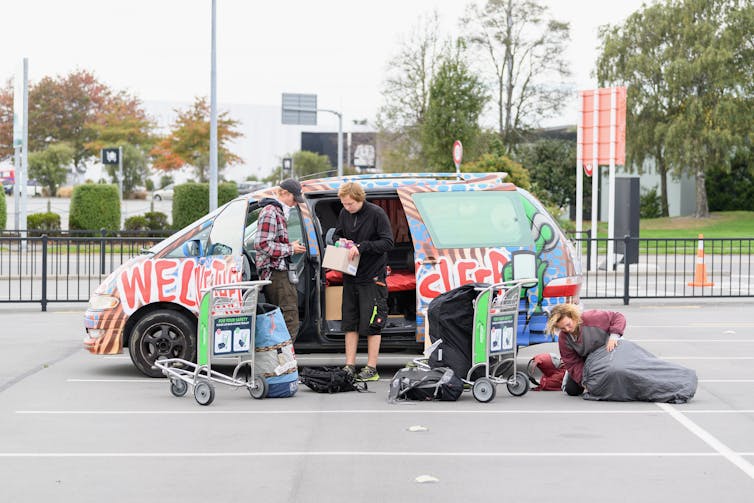 Not welcome? Backpackers unload their cheap camper van before leaving New Zealand.
GettyImages
Not welcome? Backpackers unload their cheap camper van before leaving New Zealand.
GettyImages
2. Backpackers bring many benefits
Because they stay longer, backpackers can bring wider benefits to our society, economy and environment. They tend to be more dispersed, bringing economic development and employment opportunities to regional communities.
Also, their travel behaviours tend to align more with the concept of regenerative tourism[6]. Backpackers are more likely to be conscious of their carbon footprint, engage in beach cleanups, plant trees and involve themselves in conservation projects.
They are a seasonal labour force, too, as has been shown by critical labour shortages[7] in rural and regional economies due to border closures.
3. The importance of diverse tourism
Backpackers and freedom campers support small regional tourism businesses, attractions and local services that would not survive without them. Backpacker hostels, home-stays, camping grounds and other low-budget accommodation subsectors would be at risk, as would many small and medium tourism businesses.
Read more: Traditional skills help people on the tourism-deprived Pacific Islands survive the pandemic[8]
During crises it is important that tourism destinations have a broad portfolio of markets. This ensures resilience and mitigates potential economic impacts from periodic disruptions to global tourism. Furthermore, as the mayor of Queenstown has observed[9], today’s backpackers return in future as high-end visitors.
4. Tackling climate change and overconsumption
Social tourism refers to the principle that opportunities to engage occasionally in leisure and tourism are important for personal well-being and an inclusive society. It is a form of tourism based on an ethic of social inclusion[10], as opposed to exclusion based on wealth.
By contrast, the carbon-intense lifestyles and sense of entitlement of the super-wealthy are major barriers to climate action.
Our tourism policies should not celebrate and encourage over-consumption, which works against shifting attitudes towards less carbon-intensive and more sustainable travel.
5. Damage to our international reputation
Do we really want to be perceived as exclusionary and elitist? A colleague based at a university in the Netherlands, for example, reported a social media backlash:
Everyone is complaining about the news that Kiwis do not want to have us anymore and they are only interested in tourists who fly business class and hire a helicopter around Franz Josef.
Similarly, the policy can look petty. A story[11] headlined “New Zealand vows crackdown on defecating backpackers” in the Times of India reported the New Zealand government’s promise “to take action against backpackers relieving themselves at natural beauty spots as part of post-coronavirus tourism plans”.
The Tiaki Promise is a charter for inclusive tourism based on host and visitor sharing mutual responsibility.The post-COVID challenge
Should New Zealand’s post-coronavirus tourism rebuild really be perceived as revolving around the defecations of low-budget tourists? While there have been cases of disgusting behaviour, this problem can be actively managed.
Non-self-contained campervans could be required to park overnight in fully serviced camping grounds for a nominal fee. New Zealanders should not bear the costs of tourism, anyway. Local councils transfer the costs of freedom camping to ratepayers when they provide “free” overnight parking and toilet facilities — putting rate-paying local camping grounds out of business.
Read more: A four-day working week could be the shot in the arm post-coronavirus tourism needs[12]
Above all, our tourism rebuild should be closely aligned with what makes New Zealand unique. First and foremost, it should be founded on the Māori principles of kaitiakitanga[13] and manaakitanga[14] — a mutual responsibility to care for the land and culture, as expressed in the Tiaki Promise[15] charter.
This would honestly reflect the ideals of generations of Kiwis who have set off on their own OEs to experience the world. If we consider this a birthright, is it fair that we deny the same to others who want to visit us?
References
- ^ target the rich (www.theguardian.com)
- ^ nature as their toilet (www.nzherald.co.nz)
- ^ growing community resistance (www.pce.parliament.nz)
- ^ Serving time: how fine dining in jail is helping prisoners and satisfying customers (theconversation.com)
- ^ cruise industry (www.physics.otago.ac.nz)
- ^ regenerative tourism (pureadvantage.org)
- ^ labour shortages (www.odt.co.nz)
- ^ Traditional skills help people on the tourism-deprived Pacific Islands survive the pandemic (theconversation.com)
- ^ observed (www.odt.co.nz)
- ^ ethic of social inclusion (westminsterresearch.westminster.ac.uk)
- ^ story (timesofindia.indiatimes.com)
- ^ A four-day working week could be the shot in the arm post-coronavirus tourism needs (theconversation.com)
- ^ kaitiakitanga (maoridictionary.co.nz)
- ^ manaakitanga (maoridictionary.co.nz)
- ^ Tiaki Promise (tiakinewzealand.com)
Authors: James Higham, Professor of Tourism, University of Otago