are retail investors even playing to win?
- Written by: Warren Hogan, Industry Professor, University of Technology Sydney
The COVID-19 pandemic has led to a dramatic surge[1] in “mum and dad” retail investors playing stock exchanges across the world.
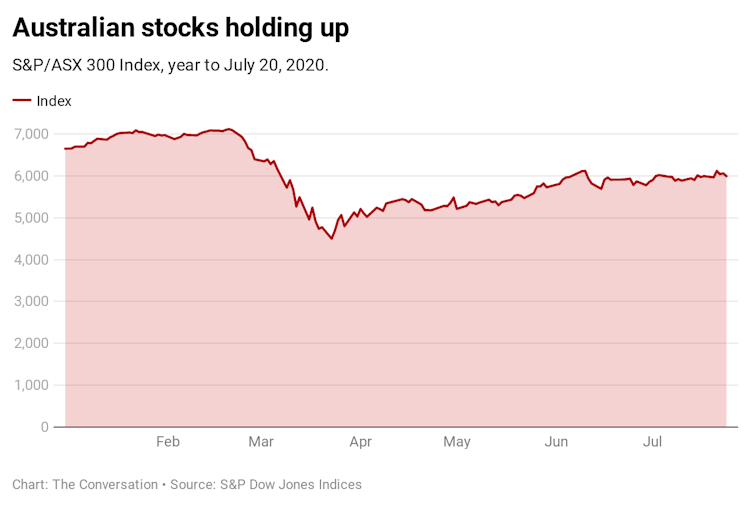
In Australia, retail investors were net buyers of A$9 billion of Australian stocks between late February and mid-May, according to corporate advisory firm Vesparum Capital[2]. In contrast, the professional institutional investors – superannuation funds and the like – were net sellers of A$11 billion of stock.
The amateurs are therefore likely responsible for most of the market’s rebound since its March 23 low.
An Australian Securities and Investments Commission analysis of retail investor trading[3] shows from February 24 (the day after the market peaked) to April 3, retail investors’ daily buying and selling of stocks was double that of the months before (A$3.3 billion to A$1.6 billion). More than 20% of that activity was from new or reactivated accounts.
 bsyJS australian stocks holding up.
The securities regulator has expressed concern this rush of amateurs into the stock market is a train wreck waiting to happen. Its report notes retail investors are, on average, “not proficient” at predicting short-term market movements.
While markets generally recover over the long run and tend to grow with economic fundamentals, short-term trading and poor market timing can be a major risk for investors in volatile markets. Therefore, retail investors should be wary of trying to “play the market” for short-term price movements by day trading.
COVID and risky behaviour
There are several possible explanations for why people are taking a risk on the stock market.
Some might see this as an opportunity to get into the market at a low point, with a view to long-term gains. Others might be out of work and looking to “day trade” - buying and selling shares on short time frames – as a source of income. Yet others may be taking the opportunity of working from home to watch the market through the day.
But another explanation is also worth considering. This is an alternative to gambling. So while it’s risky, it’s arguably no riskier than sports betting, casinos or poker machines.
Read more: Why stocks are soaring even as coronavirus cases surge, at least 20 million remain unemployed and the US sinks into recession[4]
Risk tolerance
This theory (that this is gambling by another means) explains why the appetite for risk among retail investors has ballooned when the natural response to severe economic uncertainty would be to reduce trading.
The financial risk individuals are happy to tolerate – known as financial risk tolerance – is mostly determined by personality. A person’s risk appetite is unlikely to change substantially over their life, even with changing economic conditions.
Most people, however, are adept at making different risk decisions with money allocated to different “accounts”. In behavioural finance this is known as “mental accounting”.
How they think about and use their different accounts isn’t necessarily “rational”. For example, someone might be very prudent with money from their regular budget account while spending frivolously from a discretionary account.
So extreme risk-taking can occur when opportunities arise despite a person generally being risk-averse.
 Dan Peled/AAP
Gambling trends
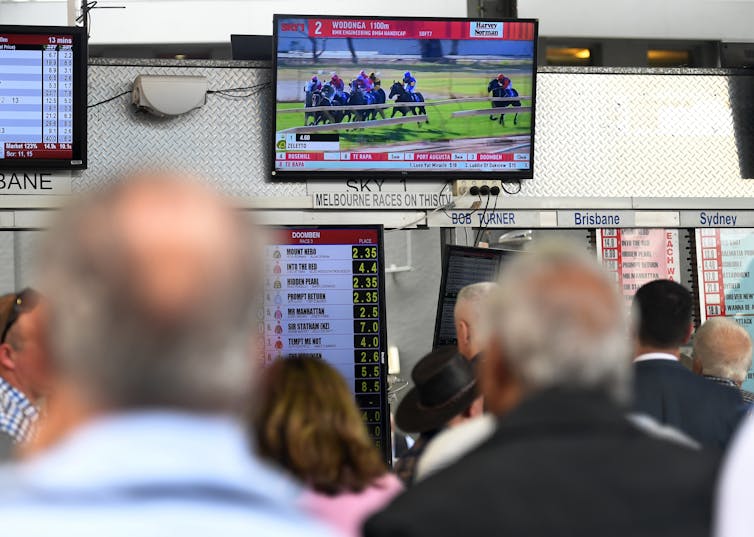
In the first three months of the year, pollster Roy Morgan[5] estimates about half of all Australians gambled in some form.
Its figures indicated 8.4 million adults spent about A$625 million on lottery tickets, 2.4 million spent about A$2.2 billion on poker machines, and 2.1 million spent about A$1 billion on betting – horses, sports etc.
Read more:
With pokies shut down, coronavirus stress could drive more people to reckless online gambling[6]
In Australia, the closure of pubs, clubs and casinos during periods of lockdown has severely curbed these forms of gambling. Between late March and late April, for example, the Alliance for Gambling Reform estimates gamblers saved more than $1 billion[7] on poker machines. The cessation of many sporting events has also reduced betting opportunities.
Pros and cons for society
Does this imply people see the financial markets as just another form of gambling[8]? If so, is this necessarily a bad thing?
If a significant number of people are seriously looking to “day trading” as a way to make money in the short term, the securities regulator’s concerns are valid. There is a good chance most will lose money.
But if these new investors are driven by their interest in gambling, substituting financial markets for poker machines and sports betting, then surely most must be prepared for losses. Very few gamblers are consistent winners from betting on games of chance or sports.
Read more:
There's another health crisis looming – what happens when the pokies switch back on?[9]
In this context there may not be so much to worry about – albeit acknowledging a small percentage will be “problem investors”, losing more than they can afford.
Compared to the almost certain likelihood of losses on gambling, those rushing into the stock market might just find it more rewarding than casinos, sports betting or pokies.
Dan Peled/AAP
Gambling trends
In the first three months of the year, pollster Roy Morgan[5] estimates about half of all Australians gambled in some form.
Its figures indicated 8.4 million adults spent about A$625 million on lottery tickets, 2.4 million spent about A$2.2 billion on poker machines, and 2.1 million spent about A$1 billion on betting – horses, sports etc.
Read more:
With pokies shut down, coronavirus stress could drive more people to reckless online gambling[6]
In Australia, the closure of pubs, clubs and casinos during periods of lockdown has severely curbed these forms of gambling. Between late March and late April, for example, the Alliance for Gambling Reform estimates gamblers saved more than $1 billion[7] on poker machines. The cessation of many sporting events has also reduced betting opportunities.
Pros and cons for society
Does this imply people see the financial markets as just another form of gambling[8]? If so, is this necessarily a bad thing?
If a significant number of people are seriously looking to “day trading” as a way to make money in the short term, the securities regulator’s concerns are valid. There is a good chance most will lose money.
But if these new investors are driven by their interest in gambling, substituting financial markets for poker machines and sports betting, then surely most must be prepared for losses. Very few gamblers are consistent winners from betting on games of chance or sports.
Read more:
There's another health crisis looming – what happens when the pokies switch back on?[9]
In this context there may not be so much to worry about – albeit acknowledging a small percentage will be “problem investors”, losing more than they can afford.
Compared to the almost certain likelihood of losses on gambling, those rushing into the stock market might just find it more rewarding than casinos, sports betting or pokies.
References
- ^ surge (www.finder.com.au)
- ^ corporate advisory firm Vesparum Capital (www.afr.com)
- ^ analysis of retail investor trading (download.asic.gov.au)
- ^ Why stocks are soaring even as coronavirus cases surge, at least 20 million remain unemployed and the US sinks into recession (theconversation.com)
- ^ Roy Morgan (www.roymorgan.com)
- ^ With pokies shut down, coronavirus stress could drive more people to reckless online gambling (theconversation.com)
- ^ more than $1 billion (www.abc.net.au)
- ^ gambling (www.tandfonline.com)
- ^ There's another health crisis looming – what happens when the pokies switch back on? (theconversation.com)
Authors: Warren Hogan, Industry Professor, University of Technology Sydney