Respiratory Protection in Australian Tunnelling and Underground Construction: Managing Hazards Below Ground
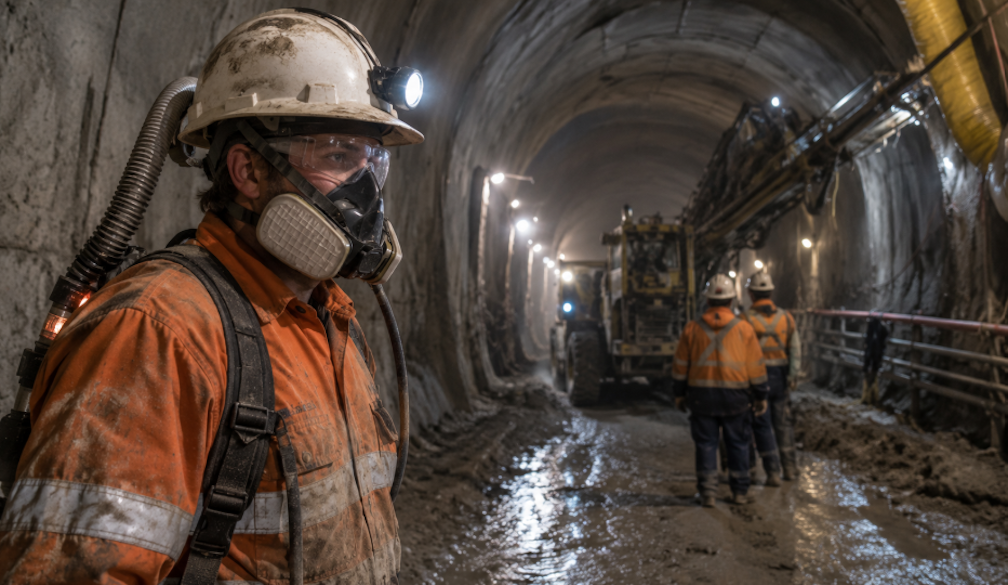
Australia's infrastructure investment pipeline includes a significant volume of underground construction: metro rail tunnels in Melbourne, Sydney, and Brisbane, road tunnels under urban centres, water supply and drainage tunnels, and mining development headings that share many characteristics with civil construction tunnelling. The workforce engaged in this work, tunnel workers, miners, shotcrete operators, and the support trades that operate in underground environments, face a respiratory hazard profile that is among the most complex and challenging in Australian industry.
The underground environment creates specific conditions that amplify respiratory hazards compared to surface construction. Limited natural ventilation means that dust, diesel exhaust, and blasting fumes accumulate in the working atmosphere rather than dispersing. The confined space geometry concentrates worker exposure near the source of generation. And the continuous cycle of rock breaking, material removal, and surface treatment that characterises tunnel construction generates multiple simultaneous and sequential respiratory hazards that a surface construction worker rarely encounters in combination.
Understanding these hazards, the respirator types that address them, and the program management challenges of underground respiratory protection, is the focus of this article.
The Respiratory Hazard Profile of Underground Construction
The underground construction environment presents a combination of respiratory hazards that requires both careful characterisation and multi-hazard respirator selection.
Respirable crystalline silica from rock. The most significant and most regulated respiratory hazard in tunnelling is silica dust generated during rock breaking operations. Australian civil tunnel projects frequently pass through geology containing significant crystalline silica, including sandstone, quartzite, and granite. The respirable silica concentrations during mechanical excavation, drill and blast operations, and hand-held rock breaking can reach hundreds of times the Australian workplace exposure standard of 0.05 mg/m3.
Diesel particulate matter. The fleet of diesel-powered equipment operating in an underground environment, including tunnel boring machine (TBM) systems, dump trucks, shotcrete equipment, and utility vehicles, generates diesel exhaust that accumulates in the tunnel atmosphere. Diesel particulate matter (DPM) is classified as a Group 1 human carcinogen. The confined underground environment, even with engineered ventilation, produces DPM concentrations that are typically higher than surface construction environments with the same equipment density.
Shotcrete dust and cement alkalinity. Shotcrete (sprayed concrete) is the primary ground support method in most Australian tunnelling projects. The shotcrete application process generates significant alkaline dust from cement content and, in accelerator-type shotcrete systems, from the accelerator chemicals that activate the cement. Prolonged alkaline dust inhalation causes upper respiratory tract irritation and can progress to chemical pneumonitis in cases of high exposure.
Blasting fumes. Drill and blast operations generate blasting fumes including nitrogen dioxide and carbon monoxide that must dissipate before re-entry to the heading is permitted. Despite re-entry time requirements based on fume monitoring, workers may encounter residual blast fumes during the early re-entry period.
Groundwater infiltration and biological contaminants. Some underground environments have significant groundwater infiltration that may carry bacterial contamination. Workers in environments with significant groundwater exposure may face Legionella and other waterborne pathogen risks in addition to mineral dust.
Why Standard Construction Site Respiratory Protection Is Insufficient Underground
The respiratory protection approaches used on surface construction sites, primarily P2 disposable respirators for short-duration dust tasks, are systematically inadequate for workers in underground construction for several interconnected reasons.
Continuous exposure versus episodic exposure. A surface construction worker who is cutting concrete for an hour has a one-hour silica exposure period on a day that includes many other tasks. A tunnel worker operating a jumbo drill for an eight-hour shift has a sustained eight-hour silica exposure period with no relief. The dose accumulated over a tunnel worker's shift is categorically different from what a surface construction worker experiences, requiring protection that maintains effective performance across the full shift period.
Simultaneous multi-hazard exposure. The underground worker faces silica, DPM, and potentially shotcrete dust, blasting fumes, or chemical vapours simultaneously rather than sequentially. A respirator specified for silica dust alone may not address the DPM component, which as a carcinogen also has no safe threshold. Protection that addresses both particulate and vapour components is often appropriate.
Physical demands and sustained wear requirements. Tunnelling is physically intensive work in a hot, humid environment. A P2 disposable respirator that becomes uncomfortable and is pulled down after two hours provides no protection for the remaining six hours of the shift. Comfort and wearability across a full underground shift is not a secondary consideration. It is a primary performance requirement for respiratory protection in this environment.
Respirator Selection for Underground Construction Workers
The multi-hazard profile of underground construction, the continuous exposure duration, and the physically demanding work environment combine to indicate respirator types that go beyond the minimum appropriate for surface construction work.
P2 disposable respirators are the entry level for incidental underground dust exposure during brief visits to underground environments or for short-duration tasks where exposure is limited. They are not adequate protection for workers who spend full shifts in underground construction environments with significant silica and DPM concentrations.
Half face respirators with P3 filter cartridges are the minimum appropriate protection for workers in underground environments with sustained silica and DPM exposure. The P3 filter efficiency of 99.95 percent addresses the carcinogenic fine particle fractions of both silica and DPM at a level appropriate for sustained exposure to materials with no safe threshold.
Half face respirators suitable for Australian underground construction must be selected for durability in the demanding underground environment, with consideration for the silicone or thermoplastic elastomer facepiece materials that resist the chemical and moisture exposure of the underground environment.
Full face respirators with P3 cartridges are appropriate for workers in the immediate working face environment where both fine particulate and eye and face protection against ground water spray and shotcrete overspray are simultaneously required.
PAPR systems with P3 filters are used increasingly in Australian tunnelling projects for workers with sustained high-exposure roles, including TBM operators who work in the immediate cutting face environment, shotcrete operators, and drilling crew. The comfort advantage of PAPR technology for sustained underground work in hot and humid conditions is significant, and the face seal independence of positive pressure delivery provides more reliable protection across a full underground shift than tight-fitting equipment whose seal quality may vary as the worker sweats, moves, and fatigues.
PAPR Maintenance Challenges in the Underground Environment
Powered air purifying respirators used in underground construction environments face specific maintenance challenges that differ from surface industrial applications.
Moisture and humidity. Underground environments are typically humid and may involve significant water infiltration or water spray from drilling and shotcrete operations. PAPR systems used in these environments require inspection and maintenance that addresses moisture ingress to the blower unit, filter housing, and battery compartment.
Battery performance in cold and hot environments. Underground tunnel temperatures vary with geology and season. In some Australian tunnel projects, particularly those at depth, ambient temperatures can be elevated. Battery performance in lithium battery-powered PAPR systems is temperature-sensitive, with capacity reduced at both extremes of temperature. Battery charge management and spare battery availability are operational requirements for underground PAPR use.
Filter loading rates. The high dust concentrations in some underground working environments load PAPR filters faster than the manufacturer's standard service life predictions, which are based on typical industrial ambient concentrations. Monitoring filter pressure drop and replacing filters when resistance increases, rather than on a fixed time schedule, is the appropriate approach for high-dust underground environments.
Quality PAPR accessories and replacement components from specialist Australian industrial safety suppliers for underground construction applications should include spare batteries, replacement filter elements rated for high-dust loading environments, and hood components that provide adequate coverage for the water spray conditions of active tunnel construction.
Program Management for Underground Respiratory Protection
Managing a respiratory protection program for an underground construction workforce presents specific challenges that surface construction programs do not face.
Air monitoring underground. Quantifying the respiratory hazard concentrations at different underground locations and during different activities is more complex than surface monitoring because the monitoring must be conducted underground, logistics are more demanding, and conditions change as the tunnel advances.
Wearability and compliance monitoring. Supervisors on surface construction sites can observe worker respirator use. Underground environments, with their multiple headings, complex layouts, and limited lighting, make direct observation more difficult. Program design that creates internal motivation for correct respirator use, through worker understanding of the specific hazards they face and the specific protection their equipment provides, is more effective underground than command-and-control compliance monitoring.
Equipment storage and maintenance in the underground environment. Clean storage for respirators and accessories in an underground environment requires specific provision, because the dusty, wet, and physically demanding conditions underground are not conducive to the clean storage that respiratory protective equipment requires between uses.
For Australian underground construction employers and contractors working with specialist industrial safety equipment suppliers to develop and supply respiratory protection programs for underground operations, the specialist knowledge of hazard profiles, equipment performance in demanding environments, and program design for sustained exposure scenarios is the most valuable component of the supplier relationship.
Conclusion
Underground construction in Australia presents a respiratory hazard profile that is more severe and more complex than surface construction, requiring respiratory protection at a higher specification level and managed within a program that addresses the specific challenges of continuous underground exposure, simultaneous multi-hazard environments, and the physically demanding conditions that affect wearability and compliance.
P3 filter efficiency is the appropriate baseline for sustained underground construction work. PAPR systems provide the best combination of protection and comfort for workers in full-shift underground roles. And program management that invests in worker understanding of the specific hazards and the specific protection their equipment provides is more effective in underground environments than compliance-focused supervision alone.
The workers who build Australia's underground infrastructure deserve respiratory protection that is matched to what they actually face below ground.