A majority Māori and Pacific All Blacks squad shows how far rugby’s ‘greatest rivalry’ has come
- Written by: Weekend Times
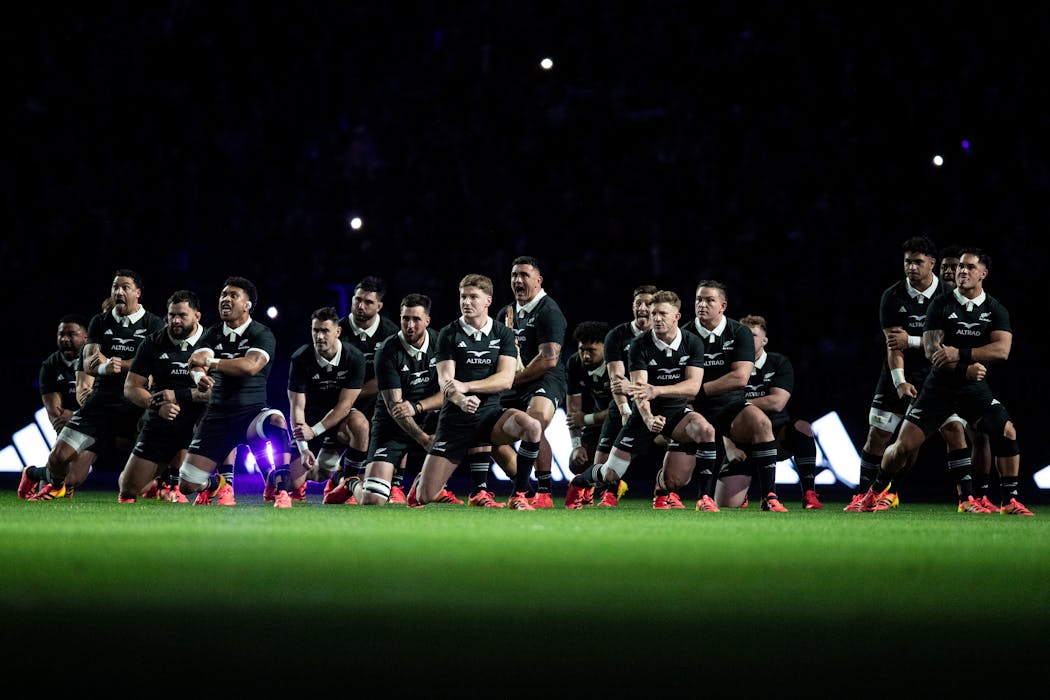
This weekend’s first test between the New Zealand All Blacks and South African Springboks will be played 105 years after the two nations first began
the “greatest rivalry” in rugby in 1921.
A great deal has changed in that time, including the composition of All Blacks teams and the players’ eligibility to tour the formerly apartheid republic.
In 2026, well over half the squad of 44 have Māori or Pacific ethnic backgrounds.
That would have been impossible 66 years ago when the 1960 All Blacks team toured South Africa. In fact, only 18 of the current squad would have been able to travel back then.
Under the old republic’s “colour bar”, a majority of today’s squad – including the most recently capped All Black, Semisi Ta'eiloa (who is of Tongan descent) – would not have been eligible.
But that was precisely what happened from 1928 until 1970, a period when New Zealand rugby administrators accepted the touring conditions set down by a racist state.
‘No Māoris – No Tour’
After the historic 1921 series played in New Zealand ended in a draw, the All Blacks toured Britain, Ireland and France in 1924–25. They won every match and were dubbed “the Invincibles”.
Anticipation for the All Blacks’ first tour of South Africa in 1928 was high, not least because of a new superstar of the game, fullback George Nepia, who had become the face of the Invincibles aged just 19.
Nepia was All Black #295 – nearly 1,000 All Black caps before Ta'eiloa at #1241 – and should have been part of the team to take on the Springboks. But, as his official All Blacks profile puts it:
Because he was of Māori ancestry he and another fine player, Jimmy Mill, were declared ineligible because of South Africa’s race prejudices.

This would create a significant gap in Nepia’s career record. Ultimately, as a leading anti-apartheid campaigner later wrote, it was because the then New Zealand Rugby Football Union “failed to confront South African racist political pressure”.
Despite growing unease and opposition, especially among Māori, the policy stayed in place for the All Blacks’ 1949 tour of South Africa (where they lost all four tests). By 1960, when the All Blacks were due to tour again, a genuine protest movement had emerged.
The Citizens’ All Black Tour Association raised one of the country’s largest ever petitions, collecting over 150,000 signatures under its banner of “No Māoris – No Tour”.
Regardless, and despite the Sharpeville massacre just two months earlier, the 1960 tour went ahead without any Māori players.
Progress and apology
South Africa was by now becoming a pariah state, and was banned from the Olympic Games from 1964 to 1988. The 1976 Olympics were boycotted by African countries in direct protest at the All Blacks tour of South Africa earlier that year, not long after the Soweto uprising that saw 176 protesting schoolchildren killed.
Things had shifted in New Zealand, too, albeit slowly. A proposed All Blacks tour of South Africa in 1967 had been abandoned because of the whites-only policy. A 1970 tour went ahead with brown players included – but only because they were exempted by South Africa as “honorary whites”.
Among the three non-white All Blacks was legendary winger Bryan Williams, the first player of Samoan heritage to tour South Africa. He toured again in 1976 – 50 years before Semisi Ta'eiloa followed in his bootsteps.
By 1981, however, playing rugby with apartheid South Africa had become deeply entwined in New Zealand’s domestic politics, culminating in protests and police action during the Springbok tour that tore the country apart.
Change and reconciliation was slow, but by the end of the next decade, Nelson Mandela had been released, apartheid had ended, and South Africa had hosted and won the 1995 Rugby World Cup.
In 2010, the New Zealand and South African rugby unions formally apologised for the exclusion of Māori players during the apartheid era. The New Zealand union also apologised more generally for the division rugby’s contact with South Africa had caused.

Equality and inclusion
With kickoff in the first test of the 2026 series approaching, the dominant narrative in New Zealand and South Africa has been one of anticipation and excitement after a 30-year gap since the last All Blacks tour in 1996.
At a sporting level, that’s understandable. Having lost the 1995 World Cup final to the Springboks, the All Blacks returned the next year and recorded their first ever series win on South African soil.
But there’s another narrative, too. Not only is this All Blacks squad filled with brown faces, Springboks captain Siya Kolisi is the first black player to hold that position. The story of how that happened is about more than rugby.
It’s important to remember that history, including the inconvenient truths that can all too often be glossed over with the passage of time.
And while we celebrate All Blacks past and present for their on-field endeavours, we can’t forget those who struggled off the field for equality and inclusion in sport and society – and who give rugby’s “greatest rivalry” even greater meaning.
The authors acknowledge the contribution to this article of Distinguished Professor Graham Hingangaroa Smith of Massey University.
Jeremy Hapeta receives funding from the Royal Society's Marsden Fund
Rochelle Stewart-Withers does not work for, consult, own shares in or receive funding from any company or organisation that would benefit from this article, and has disclosed no relevant affiliations beyond their academic appointment.