Why is the US so obsessed with controlling Cuba?
- Written by: Deborah Shnookal, Research fellow, Department of Spanish and Latin American Studies, The University of Melbourne
For months, US President Donald Trump has been fixated on Cuba. He’s issued threats[1] and imposed additional sanctions[2] on the island. The US military has conducted[3] dozens of intelligence-gathering flights off the coast in recent weeks, suggesting a prelude to an invasion.
The Cuban government has indicated a readiness to negotiate with the Trump administration on some issues, such as migration, drug trafficking and investment openings for Cuban-Americans. But Cuba’s sovereignty is not negotiable.
After interviewing Cuban President Miguel Díaz-Canel last month, US journalist Kristen Welker[4] seemed to catch on:
Nothing gets under [Cubans’] skin more than the notion that the United States can tell the Cuban government who should lead it or what it should be doing, how it should be governing, because that challenges the very idea of the sovereignty of the country.
This US obsession with controlling, influencing and coercing Cuba long predates Trump and even the Cold War. This is how President Theodore Roosevelt described[5] the island in 1906:
I am so angry with that infernal little Cuban republic that I would like to wipe its people off the face of the earth. All we have wanted from them was that they would behave themselves and be prosperous and happy so that we would not have to interfere. And now, lo and behold, they have started an utterly unjustifiable and pointless revolution.
Understanding the current impasse between the two adversarial neighbours requires looking at this full arc of history. While the 1823 Monroe Doctrine[6] sought to establish US predominance in the entire American continent, Cuba has always been a particular focus of Washington’s attention.
Read more: Cuba has survived 66 years of US-led embargoes. Will Trump’s blockade break it now?[7]
‘Americanisation’ of the island
From the moment the 13 American colonies declared independence from Britain, Americans assumed Cuba would become part of the union. Successive US administrations sought to purchase, annex or otherwise control Cuba, claiming this was inevitable by virtue of the laws of gravity and geography. It was also seen as part of a self-proclaimed “civilising mission[8]”.
When the Cubans eventually defeated their Spanish colonial masters in 1898, the United States stepped in and occupied the island to thwart its independence.
At the time, at least one third of Cubans[9] were former slaves or of mixed race. The US governor of Cuba, Leonard Wood, argued they were not ready for self-government.
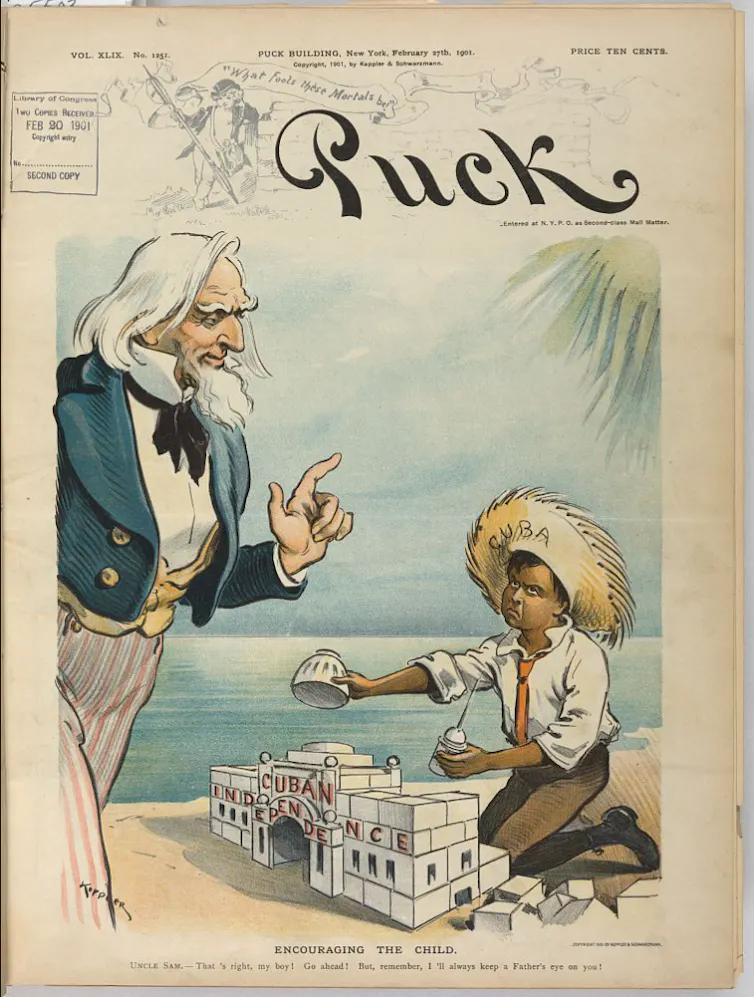
Certainly, the US – especially the Southern former slave holders – didn’t want another Haiti[10] in its neighbourhood. Haitian slaves had seized control of their island nation from the French in a violent rebellion in 1804, echoing the cries of the French revolution for liberty, fraternity and equality.
The US military occupation of Cuba ended in 1902 and Cuba formally declared independence – albeit with provisions[11]. These allowed for future US intervention whenever Washington thought the Cuban people needed a guiding hand (which turned out to be fairly often).
In the decades that followed, US business interests deeply penetrated every sector of Cuba’s economy and had complete sway over Cuban governments.
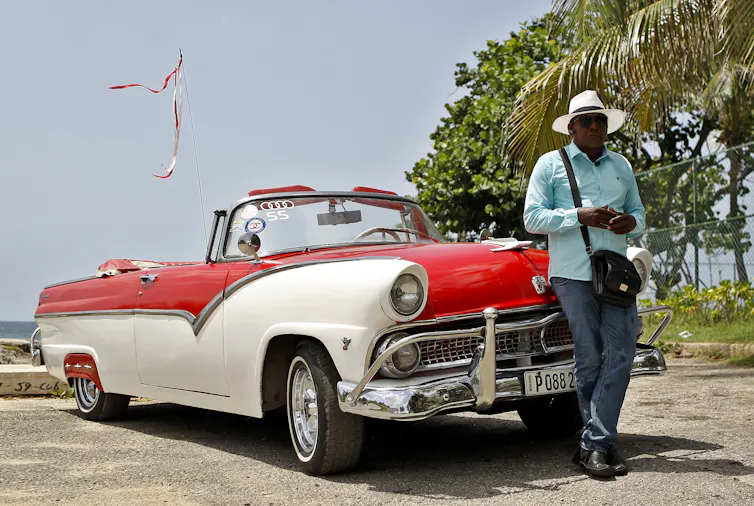
On a cultural level, Cuba rapidly became “Americanised” through a new US-style education system. Travel to the island picked up, too. The popular Terry’s Guide to Cuba reassured US visitors in the 1920s they would feel right at home because “thousands [of Cubans] act, think, talk and look like Americans”.
Castro’s mission
All of this changed with the rise of Fidel Castro.
During the Cuban Revolution[12], Castro announced in April 1959 that the revolutionary government would be “Cubanising Cuba”. This might seem “paradoxical”, he explained, but Cubans “undervalued” everything Cuban. They had become “imbued with a type of complex of self-doubt” in the face of the overwhelming US influence on the island’s culture, politics and economy.
US journalist Elizabeth Sutherland[13] similarly observed at the time that Cubans suffered from a “cultural inferiority complex typical of colonised peoples”.
For North Americans, however, Castro’s blunt statement seemed at best to reflect ingratitude, and at worst, an insult. As the US broadcaster Walter Cronkite recalled[14]:
The rise of Fidel Castro in Cuba was a terrible shock to the American people. This brought communism practically to our shores. Cuba was a resort land for Americans […] we considered it part of the United States.
At the heart of Cuba’s revolutionary project[15] has been an assertion of Cuba’s sovereignty, independence and national identity. The drive has been to create a new, united and socially just Cuban nation, as envisioned by its great national hero and poet, José Martí[16].
So, for Cubans it’s a matter of history. For North Americans, it’s a matter of self-image. They had “convinced themselves,” writes historian Louis A. Pérez[17], of the “beneficent purpose […] from which [the US] derived the moral authority to presume power over Cuba”.
When the Obama administration finally resumed relations[18] with Cuba in 2014, it felt like a historic shift was taking place. The US might finally respect Cuban sovereignty and engage with Cuba on equal terms.
As President Barack Obama said at the time:
It does not serve America’s interests, or the Cuban people, to try to push Cuba toward collapse. […] We can never erase the history between us, but we believe that you should be empowered to live with dignity and self-determination.
Trump has now reverted to Washington’s traditional neo-colonialist view of Cuba, proclaiming he can do what he likes with the island. Perhaps it is time to try a new approach. As the spectacular debacle of the US-backed Bay of Pigs invasion[19] showed 65 years ago, Cubans remain ready to defend their independence and their right to determine their own future.
References
- ^ issued threats (www.axios.com)
- ^ imposed additional sanctions (www.whitehouse.gov)
- ^ conducted (edition.cnn.com)
- ^ Kristen Welker (www.youtube.com)
- ^ described (doi.org)
- ^ the 1823 Monroe Doctrine (www.archives.gov)
- ^ Cuba has survived 66 years of US-led embargoes. Will Trump’s blockade break it now? (theconversation.com)
- ^ civilising mission (uncpress.org)
- ^ Cubans (uncpress.org)
- ^ Haiti (history.state.gov)
- ^ provisions (www.archives.gov)
- ^ Cuban Revolution (www.history.com)
- ^ Elizabeth Sutherland (archive.org)
- ^ recalled (uncpress.org)
- ^ Cuba’s revolutionary project (doi.org)
- ^ José Martí (www.ebsco.com)
- ^ Louis A. Pérez (uncpress.org)
- ^ resumed relations (obamawhitehouse.archives.gov)
- ^ Bay of Pigs invasion (www.jfklibrary.org)
Authors: Deborah Shnookal, Research fellow, Department of Spanish and Latin American Studies, The University of Melbourne
Read more https://theconversation.com/why-is-the-us-so-obsessed-with-controlling-cuba-280729