Can NZ’s new T20 cricket franchise attract the dollars, players and fans it will need?
- Written by: Chris McMillan, Professional Teaching Fellow in Sociology, University of Auckland, Waipapa Taumata Rau
New Zealand Cricket’s decision[1] to support “in principle” the development of a T20 franchise competition represents a major shift in governance and funding for the summer game. But it’s not clear whether the tensions behind that decision[2] have been resolved.
At the heart of the debate is a model that would see a new NZ20 competition replace the existing Super Smash, currently run by New Zealand Cricket. While crucial details are yet to be settled[3], this would likely see the league sold to a private owner.
In addition, a stake in existing teams could be sold, or new franchises established and owned or partly owned by private equity.
While the NZ20 competition ended up the preferred option[4] for players and domestic governing bodies, the immediate resignation of board member and former international Dion Nash[5] (following chief executive Scott Weenik’s departure[6] in December) shows how hotly contested this has been.
But it also reflects pressure across New Zealand sport in general, which is increasingly at the mercy of global commercial forces while also trying to improve domestic participation and performance.
As such, New Zealand Cricket opting for a franchise league funded by private equity raises questions about the future of the local game – and the ability of national sporting bodies to keep acting in the public interest.
To understand why, we need to appreciate how the cricketing landscape has shifted in recent years.
The changing face of cricket
The New Zealand summer was once defined by international cricket, especially during the school holidays. This summer, however, no men’s or women’s international cricket was scheduled from December 22 to February 25.
This is no anomaly. The southern hemisphere summer is now dominated by domestic franchise tournaments: Australia’s Big Bash League, the Bangladesh Premier League, South Africa’s SA20 and the United Arab Emirates International League T20.
On top of this, the Indian Premier League (IPL), just warming up now, is the second most valuable[7] sports tournament per match in the world. Combined, these franchise leagues have become the dominant commercial force in the game.
Notably, New Zealand is the only major cricket country without a franchise competition. Instead, the provincial “major associations” – most based on 19th-century colonial boundaries – play in the Super Smash.
It’s hardly a level playing field. The global franchise leagues – based in much larger media markets and backed by private capital (except in Australia) – offer salaries, status and glamour far beyond a provincial match in front of a smattering of fans.
As a result, many of New Zealand’s best players are rejecting contracts from New Zealand Cricket and playing in competing franchise leagues rather than the Super Smash.
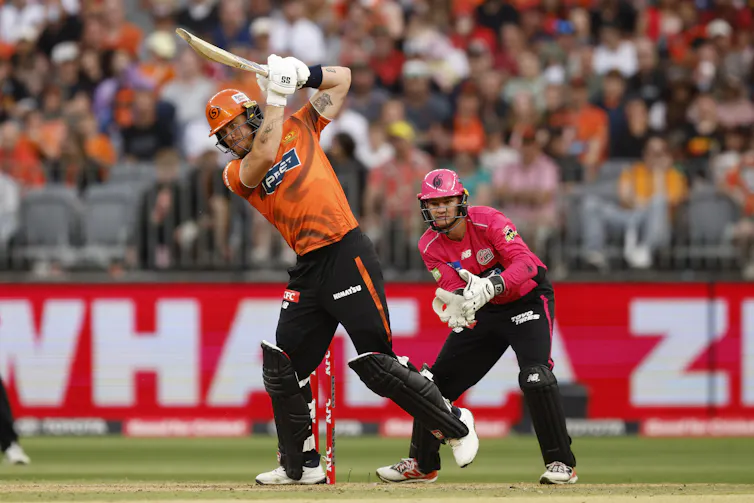
Kane Williamson, for example, played in the SA20 this summer, and Finn Allen turned out for the Perth Scorchers in the Big Bash League. There have been reports of a widespread exodus[9] of players next summer.
There was a feeling that something had to change, and the NZ20 initiative has been the result. Privatising the Super Smash and selling teams to private interests is likely to bring in cash and increase the status of a New Zealand competition.
And it’s hoped the NZ20 will retain the best players and revitalise fan interest, as well as generate income for New Zealand Cricket. But what might be lost?
The privatisation of the game means decisions once based on participation, player development and national representation will increasingly be subordinated to commercial imperatives.
National bodies are at least nominally responsible to members and the public; private investors are not.
Hypothetically, would a hedge fund owner prioritise broadening the game’s appeal in New Zealand over scheduling games to maximise the Indian market’s far larger broadcast audience? Would they be interested in increasing participation numbers or developing players for the national team?
The price of progress
It is no wonder New Zealand Cricket has been equivocal in its public statements[10], noting the decision was “not a final commitment” and “part of the process, not the end of it”.
In particular, concerns have been expressed[11] about support for the women’s game and regional representation. Whether private equity would share those concerns is yet to be seen.
Indeed, it seems these big questions of ownership, control and purpose are still to be worked through.
The game is changing, and New Zealand Cricket is being forced to make a decision in circumstances not of its choosing. But this is not a problem unique to cricket in an environment where broadcast deals are the primary source of income.
Given New Zealand’s small media market, any local competition will struggle to attract and retain the best players. That’s why teams such as the New Zealand Warriors in rugby league have attached themselves to Australian competitions, reducing local league to secondary importance.
NZ20 may provide financial stability and help retain talent. But it also embeds New Zealand more deeply in a system where commercial interests hold increasing power. Private equity comes at a cost, and it’s yet to be seen what cricket in New Zealand will have to pay.
References
- ^ decision (www.nzc.nz)
- ^ tensions behind that decision (www.rnz.co.nz)
- ^ yet to be settled (www.nzherald.co.nz)
- ^ the preferred option (www.nzherald.co.nz)
- ^ Dion Nash (www.rnz.co.nz)
- ^ Scott Weenik’s departure (www.rnz.co.nz)
- ^ second most valuable (www.espncricinfo.com)
- ^ James Worsfold/Cricket Australia via Getty Images (www.gettyimages.co.nz)
- ^ reports of a widespread exodus (www.nzherald.co.nz)
- ^ public statements (www.nzc.nz)
- ^ concerns have been expressed (www.rnz.co.nz)
Authors: Chris McMillan, Professional Teaching Fellow in Sociology, University of Auckland, Waipapa Taumata Rau