Colombia is producing more cocaine than ever – and more is reaching Australian shores
- Written by: Cesar Alvarez, Lecturer in Terrorism and Security Studies, Charles Sturt University
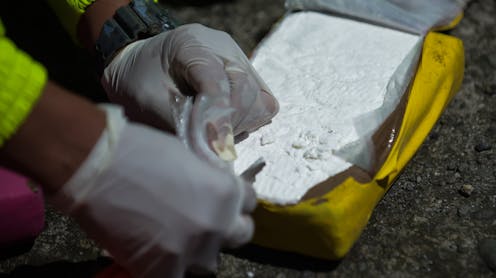
Imagine an area larger than the Australian Capital Territory, nearly twice the size of London and four times that of New York City covered in coca plantations.
That’s the scale of Colombia’s coca cultivation[1], according to an estimate from the United Nations Office of Drugs and Crime (UNODC).
Colombia produces an estimated 2,664 metric tonnes[2] of cocaine annually. That is enough to fill 20 Boeing 747 cargo planes per year.
Not even during the darkest days of Pablo Escobar’s infamous empire[3] did Colombia cultivate as much coca or produce as much cocaine as it does today.
In the past year alone, coca crops expanded by 10% and production capacity soared more than 50%[4].
So how did it come to this?
A worrying mix
Colombia did not arrive at this point overnight, nor by chance. A complex mix of radical and failed policy shifts, scientific innovation and global demand, among other factors, has shaped this trajectory.
For example, in 2015, Colombia’s Constitutional Court suspended aerial fumigation and banned the use of glyphosate[5]. Despite the herbicide’s effectiveness in killing coca plants, the court cited concerns over its health risks and environmental impact.
Aerial spraying had allowed the government to reduce the risk that manual eradication brigades were exposed to over large areas.
In 2016, then-president Juan Manuel Santos introduced a scheme to substitute coca with non-illicit plants. Incentives were offered to farmers. However, it ended up encouraging many peasants who had never grown coca before to begin cultivating it, simply to qualify for the new subsidies.
It is no surprise that during Santos’ second term (2014–18), Colombia’s coca crops nearly doubled[6], from 96,000 hectares to more than 170,000.
This was all in an effort to secure a peace deal[7] with the narco-terrorist group Revolutionary Armed Forces of Colombia[8] (FARC).
More recently, in 2022, President Gustavo Petro announced his Paz Total (Total Peace) policy. This was designed to bring trafficking organisations – including Colombia’s second largest narco-terrorist group, the National Liberation Army (ELN) – to the negotiation table[9].
Ironically, and paradoxically, Colombia is now producing more drugs than ever[10]. It is also experiencing a sharp increase in violence[11] by non-state armed groups.
The impact on Australia
What happens in Colombia matters to Australia because criminal innovation is fuelling greater cocaine volumes and higher purity. This means more is flowing towards Australian shores[12].
Colombia’s coca production is being reshaped by enhanced cultivation techniques, more secure and autonomous smuggling methods, and an increasingly fragmented criminal landscape.
Production is now more efficient and profitable than ever. Growers are planting improved coca leaf varieties and achieve more harvest cycles per year with higher alkaloid yields per kilo.
Smuggling methods have also evolved.
Semi-submersibles or narco-submarines[13] are increasing in storage capacity. Recent seizures show manned vessels with four to five tonnes of capacity are now the rule[14] rather than the exception.
Some networks are also transitioning from manned to unmanned operations.
Also, the growing presence and operational influence of Mexican cartels in Colombia has amplified the scope and scale of alliances between transnational organised crime groups across Europe, Asia and Oceania. International police investigations are even more complex.
Like much of the world, there is a growing demand for and increasing use of[15] cocaine in Australia.
Despite record-high seizure numbers[16] and total volumes intercepted, Australia is still among the most attractive destination markets for drug trafficking organisations because of the high price users pay for the drugs.
Unless something radically changes in Colombia, Australia continues to face growing risks from maritime trafficking routes. There is also an increased threat of being used as a transit and money laundering hub in the global drug economy.
Some possible solutions
Even if conditions in Colombia were to change swiftly and drastically, supply-focused strategies alone are insufficient to mitigate the risks facing Australia.
After all, Colombia cannot simply fumigate its way out of this cocaine crisis, just as Australia cannot arrest its way out of it.
However, continued collaboration between the Australian Federal Police and the National Police of Colombia remains essential to keep drugs at bay.
The appointment of Colombia’s first police attaché to Australia will be a welcome and meaningful step forward. (While not yet formally announced, the Colombian embassy in Australia has informed me and several other experts the country is appointing the attaché.)
Both countries must deepen this relationship and collectively engage meaningfully and frequently to help solve the problem.
References
- ^ scale of Colombia’s coca cultivation (www.unodc.org)
- ^ 2,664 metric tonnes (www.unodc.org)
- ^ Pablo Escobar’s infamous empire (www.ebsco.com)
- ^ soared more than 50% (css.unodc.org)
- ^ banned the use of glyphosate (www.theguardian.com)
- ^ nearly doubled (www.tni.org)
- ^ a peace deal (insightcrime.org)
- ^ Revolutionary Armed Forces of Colombia (www.dni.gov)
- ^ to the negotiation table (www.theguardian.com)
- ^ producing more drugs than ever (www.reuters.com)
- ^ a sharp increase in violence (www.theguardian.com)
- ^ more is flowing towards Australian shores (www.independent.co.uk)
- ^ Semi-submersibles or narco-submarines (strategicanalysis.org)
- ^ now the rule (www.wsj.com)
- ^ growing demand for and increasing use of (www.smh.com.au)
- ^ record-high seizure numbers (www.afp.gov.au)
Authors: Cesar Alvarez, Lecturer in Terrorism and Security Studies, Charles Sturt University