how the war is impacting young Ukrainians
- Written by: Ashley Humphrey, Lecturer in Social Sciences, Monash University
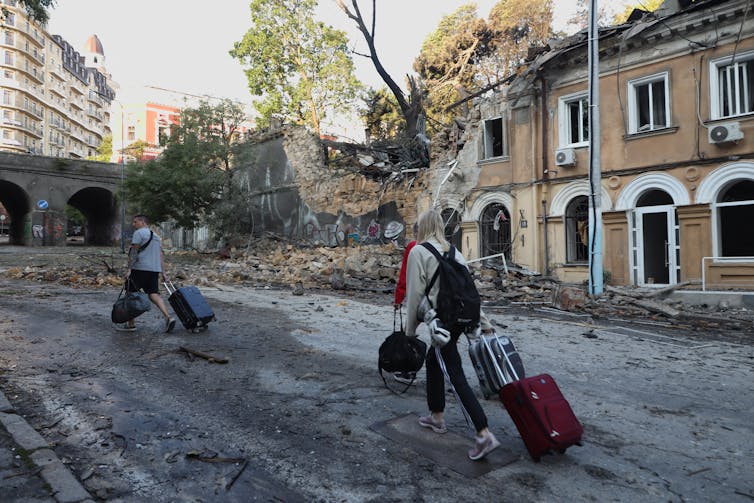
Now into its fourth year, the war that followed Russia’s invasion of Ukraine[1] has taken a devastating toll.
An estimated 60,000 to 100,0000 Ukrainian lives have been lost[2] and more than 10 million citizens displaced[3], and entire cities have been devastated.
Daily life in Ukraine is disrupted by frequent power outages, significant interruptions to school and work routines and the recurrent warnings of air raid sirens.
We sought to understand the war’s impact on young Ukrainians by interviewing those still in, and outside of Ukraine.
Stolen youth
Young adults (aged 18-35) tend to be in a transitional phase of life, working towards establishing a career, starting a family and making future plans.
For many young Ukrainians, these developmental processes have been severely impeded during the war.
Our work provides insights into how young Ukrainians have navigated the severe intrusion to their development, as well as how they have coped psychologically during this time.
Our research[4] drew on in-depth interviews with young Ukrainians who had lived in Ukraine for either the entirety or part of the war.
Conducted both in person in Ukraine as well as online, these interviews looked specifically at how the ongoing war has affected young people’s employment or study situation, their aspirations for the future and mental health, while also seeking to understand what support they need.
Responses from the participants varied.
Those who were working were now exclusively engaged in work centred on assisting the war effort, including in some cases having joined the armed forces.
Those who were studying had shifted to online mediums. The COVID pandemic ensured online learning platforms were largely already in place, allowing some to continue their studies from locations outside of Ukraine.
While perhaps an alluring prospect to some, this flexibility while studying was also accompanied by chaos and disorientation, with short-term visas forcing young Ukrainians to move from one country to another.
As one student explained:
We went to Ukraine for two weeks and then we moved to Georgia for three months. Now we’re in Thailand for one month, and now we’re going to be in Australia for two or three months. Then we’re probably going to go to Japan for a year maybe.

Depression, stress and surprising optimisim
Despite enduring the horrors of the war, the participants generally spoke of their futures with admirable optimism.
Remarkably, many commented on the way the war had redefined their goals toward helping their country in some way. One respondent told us:
When you are starting a new project, when you are applying for a job, you are having a constant filter: how does this affect Ukraine? Am I helping Ukraine? Am I helping Ukraine enough? What else can I do?’
Another shared:
I know we are fighting for our future. And I want to be a part of Ukraine and be a part of its reconstruction. Because I am like this bright future – I am the youth that will be reconstructing Ukraine because of their knowledge and money and everything else.
Unsurprisingly, some were also apathetic or dismissive of their futures, commenting on broken dreams and stating it was not a time for making future plans. They felt let down by the United Nations and the “international global order”.
Participants commented on the ways the war has affected their mental health.
Symptoms of PTSD, elevated stress, depression, constant anxiety as well as existential dread were raised, with one young Ukrainian telling us:
Every time when I hear alerts […] you’re thinking, maybe this is the last minutes you are living because the bomb can strike your flat.
The fear of loud noises, the harrowing plight of their country and the associated stress were emergent themes.
Yet, some indicated they had become resilient to this stress:
I think I became quite resistant to the stress as well, because I think I faced the scariest moments of my life, where I can die, and I understand that when you cannot control the situation and what’s going on, I cannot control whether a missile is going to be in my house.
This notion of resilience was both surprising and inspiring and this finding corroborated with past studies[6] on war-affected Ukrainians.
As one participant explained:
If there was no war, I wouldn’t be who I am right now. It has really changed me. It has given me strength, this optimistic outlook.
A need for greater support
There is much to learn from these inspiring young people. But more pressingly, they need help.
As the relentless shelling of Ukrainian cities continues, the participants call for greater access to mental health and counselling services, ongoing investment in online learning tools and job opportunities and basic resources to support their wellbeing.
References
- ^ Russia’s invasion of Ukraine (www.cfr.org)
- ^ Ukrainian lives have been lost (www.csis.org)
- ^ 10 million citizens displaced (www.iom.int)
- ^ Our research (psycnet.apa.org)
- ^ OLEKSANDR GIMANOV/AFP via Getty Images (www.gettyimages.com.au)
- ^ past studies (www.emerald.com)
Authors: Ashley Humphrey, Lecturer in Social Sciences, Monash University