

Trump’s worldview is causing a global shift of alliances – what does this mean for nations in the middle?
- Written by: Dilnoza Ubaydullaeva, Lecturer in Government - National Security College, Australian National University
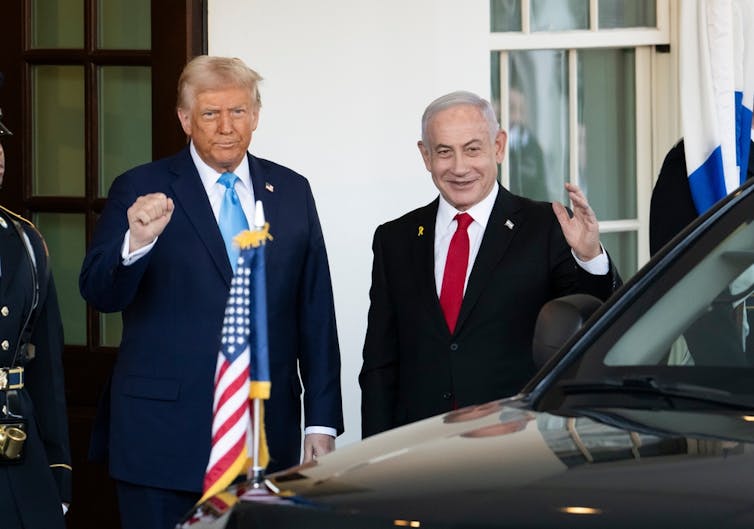
Since US President Donald Trump took office this year, one theme has come up time and again: his rule is a threat to the US-led international order.
As the US political scientist John Mearsheimer famously argued[1], the liberal international order
was destined to fail from the start, as it contained the seeds of its own destruction.
This perspective has gained traction in recent years. And now, Trump’s actions have caused many to question whether a new world order is emerging.
Trump has expressed a desire for a new international order[2] defined by multiple spheres of influence — one in which powers like the US, China and Russia each exert dominance over distinct regions.
This vision aligns with the idea of a “multipolar” world, where no single state holds overarching global dominance. Instead, influence is distributed among several great powers, each maintaining its own regional sphere.
This architecture contrasts sharply with earlier periods – the bipolar world of the Cold War, dominated by the US and the Soviet Union; and the unipolar period that followed, dominated by the US.
What does this mean for the world order moving forward?
Shifting US spheres of influence
We’ve seen this shift taking place in recent months. For example, Trump has backed away from his pledge to end the war between Russia and Ukraine and now appears to be leaving it[3] to the main protagonists, and Europe, to find a solution.
Europe, which once largely spoke in a unified voice with the US, is also showing signs of policy-making which is more independent. Rather than framing its actions as protecting “Western democratic principles”, Europe is increasingly focused on defining its own security interests.
In the Middle East, the US will likely maintain its sphere of influence. It will continue its unequivocal support for Israel under Trump.

The US will also involve itself in the region’s politics when its interests are at stake, as we witnessed in its recent strikes on Iranian nuclear facilities.
This, along with increasing economic ties between the US and Gulf states, suggests US allies in the region will remain the dominant voices shaping regional dynamics, particularly now with Iran weakened.
Yet it’s clear Trump is reshaping US dynamics in the region by signaling a desire for reduced military and political involvement, and criticising the nation building efforts of previous administrations.
The Trump administration now appears to want to maintain its sphere of influence primarily through strong economic ties.
Russia and China poles emerging elsewhere
Meanwhile, other poles are emerging in the Global South. Russia and China have deepened their cooperation, positioning themselves as defenders against what they frame as Western hegemonic bullying[5].
Trump’s trade policies and sanctions against many nations in the Global South have fuelled narratives (spread by China and Russia) that the US does not consistently adhere to the rules it imposes on others.
Trump’s decision to slash funding to USAID has also opened the door to China, in particular, to become the main development partner for nations in Africa and other parts of the world.
And on the security front, Russia has become more involved[6] in many African and Middle Eastern countries, which have become less trustful and reliant on Western powers.

In the Indo-Pacific, much attention has been given to the rise of China and its increasingly assertive posture. Many of Washington’s traditional allies are nervous about its continued engagement in the region and ability to counter China’s rise.
Chinese leader Xi Jinping has sought to take advantage of the current environment, embarking[8] on a Vietnam, Malaysia and Cambodia push earlier this year. But many nations continue to be wary of China’s increasing influence, in particular the Philippines, which has clashed with China over the South China Sea.
Strategic hedging
Not all countries, however, are aligning themselves neatly with one pole or another.
For small states caught between great powers, navigating this multipolar environment is both a risk and an opportunity.
Ukraine is a case in point. As a sovereign state, Ukraine should have the freedom to decide its own alignments. Yet, it finds itself ensnared in great power politics, with devastating consequences.
Other small states are playing a different game — pivoting from one power to another based on their immediate interests.
Slovakia, for instance, is both a NATO and EU member, yet its leader, Robert Fico, attended[9] Russia’s Victory Day Parade in May and told President Vladimir Putin he wanted to maintain “normal relations” with Russia[10].
Then there is Central Asia, which is the centre of a renewed “great game,” with Russia, China and Europe vying for influence and economic partnerships.
Yet if any Central Asian countries were to be invaded by Putin, would other powers intervene? It’s a difficult question to answer. Major powers are reluctant to engage in direct conflict unless their core interests or borders are directly threatened.
As a result, Central Asian states are hedging their bets, seeking to maintain relations with multiple poles[11], despite their conflicting agendas.
A future defined by regional power blocs?
While it is still early to draw definitive conclusions, the events of the past few months underscore a growing trend. Smaller countries are expressing solidarity with one power, but pragmatic cooperation with another, when it suits their national interests.
For this reason, regional power blocs seem to be of increasing interest to countries in the Global South.
For instance, the China-led Shanghai Cooperation Organisation[12] has become a stronger and larger grouping of nations across Eurasia in recent years.
Trump’s focus on making “America Great Again,” has taken the load off the US carrying liberal order leadership. A multipolar world may not be the end of the liberal international order, but it may be a reshaped version of liberal governance.
How “liberal” it can be will likely depend on what each regional power, or pole, will make of it.
References
- ^ argued (direct.mit.edu)
- ^ international order (theconversation.com)
- ^ leaving it (www.nytimes.com)
- ^ noamgalai/Shutterstock (www.shutterstock.com)
- ^ hegemonic bullying (www.themoscowtimes.com)
- ^ more involved (www.cfr.org)
- ^ plavi011/Shutterstock (www.shutterstock.com)
- ^ embarking (carnegieendowment.org)
- ^ attended (www.theguardian.com)
- ^ “normal relations” with Russia (www.youtube.com)
- ^ seeking to maintain relations with multiple poles (theconversation.com)
- ^ Shanghai Cooperation Organisation (eng.sectsco.org)
Authors: Dilnoza Ubaydullaeva, Lecturer in Government - National Security College, Australian National University