how Formula 1 drivers memorise race tracks before even stepping foot on them
- Written by: Dan van den Hoek, Senior Lecturer, Clinical Exercise Physiology, University of the Sunshine Coast
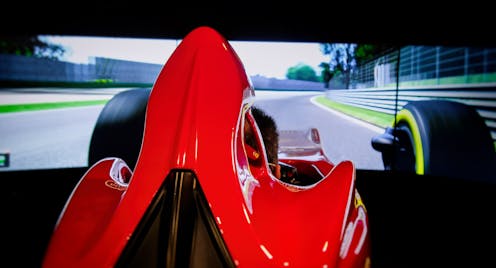
The Albert Park circuit for the Australian Formula 1 Grand Prix has 14 turns over 5.278 kilometres[1]. F1 drivers can tell you the braking points, cornering speeds and preferred line for every one of those corners without actually being there.
How?
A demanding profession
Formula 1 drivers are unique athletes[2]: typically, they are fitter, stronger, shorter and have lower body fat percentages[3] than drivers in other racing sports.
In the early years, drivers were bigger and stronger so they could wrestle cars without power steering. Now, they are shorter, leaner and incredibly fit to deal with the increased G-forces from higher cornering speeds in modern cars.
Beyond the physical demands of F1 racing[4] – like cornering G-forces in excess of 5Gs[5], the 600 newton forces needed to operate the brake pedal and cockpit temperatures that can exceed 50°C – drivers are subjected to high cognitive demands.
These include synthesising information about the track conditions, opponents and their environment, to help them to anticipate and execute precision driving[6].
In the past, F1 teams had unlimited opportunities to test cars and athletes on the track: some drivers accrued more than 100,000 km of testing[7] across their careers.
But since 2009, F1 drivers and teams have been limited[8] in the number of testing days and kilometres.
In 2025, drivers will only be allowed to take part in four test days, and they will be restricted to a total of 1,000 km[9].
The advancement of technology
Following these changes, teams have focused on technology to train drivers and test cars.
Simulators provide drivers and teams with additional testing not otherwise available under current rules.
Drivers typically have access to “factory” simulators owned by their team. These provide an experience as close to actually driving an F1 as you can get without being in the car[10].
They allow teams and drivers to change almost every aspect of the environment – car setup, tyre wear and even track temperature and humidity.
Drivers will also have a “home” simulator made up of multiple monitors, a steering wheel with force feedback and pedals.
These are used mostly for learning tracks and identifying racing lines, rather than for testing specific car setups.
The benefits of this technology
Arguably, the greatest benefit is safety: crashing a car in an F1 simulator won’t hurt the driver or damage an actual car[11].
Modern methods and mathematics allow teams to simulate damage without the costs associated with traditional crash testing.
Advanced racing simulators are expensive, costing up to £8M[12] ($A15.9 million). But by eliminating the need for fuel, tyres and track hire, they significantly reduce expenses.
Drivers can also refine their skills, familiarise themselves with circuits and practise high-risk manoeuvres in a risk-free environment.
Simulators enable drivers to hone their overtaking and defensive manoeuvres by adjusting variables such as track conditions, the number of AI-cars on track, AI-car aggression and proximity.
This controlled yet dynamic training enhances problem-solving, sharpens reaction times and strengthens strategic decision-making.
These are all crucial for real-world racing.
At a track, it may take upwards of 20 minutes to make a single change to the settings on a car. In a simulator, changes can be made in seconds.
This allows teams to take a car to the race track with a tested set-up, ready for practice sessions where they can experiment with strategies including engine maps, fuel strategies and pit-stop timing.
Post-race, teams use simulators to analyse performance data, identify potential improvements and gain insights for future races and car development.
What might the future hold?
Electronic racing (e-racing) is a virtual form of motorsport where competitors drive a computer-generated car on a virtual track.
There are three typical sub-types of e-racing[13]:
- sim racing (using realistic physics, tyre wear, fuel consumption and damage)
- simcade (incorporating some realistic elements but with reduced complexity)
- arcade racing (using simpler controls and physics like Mario Kart).
These online and electronic variants have surged in popularity[14], bridging the gap between virtual and real-world motorsport.
This is showcased in the movie Gran Turismo. It tells the true story of Jann Mardenborough, who transitioned from simulator racing to professional motorsport after winning a competition in 2011[15].
However, while simulators provide a controlled environment for skill development, they lack factors such as psychological and emotional stress, g-forces, thermal strain, and the unpredictable elements that exist in real-world competition.
Despite these differences, e-racing has gained credibility, with several F1 drivers regularly competing in virtual events.
Four-time F1 world champion Max Verstappen, for example, is also one of the best simulator racers in the world. He uses virtual racing to sharpen his skills and remain competitive between real-world races[16].
As e-racing continues to evolve, the role of simulators remains a key area of exploration.
Advancements in simulator technology — including enhanced motion feedback, physiological stress replication and AI-driven race dynamics – may further bridge the gap between virtual and real-world racing.
The question is no longer whether simulators can aid driver development but how they can be refined to better replicate the demands of on-track competition, ultimately shaping the future of motorsport training and performance.
References
- ^ 14 turns over 5.278 kilometres (www.formula1.com)
- ^ unique athletes (www.mclaren.com)
- ^ fitter, stronger, shorter and have lower body fat percentages (www.researchgate.net)
- ^ physical demands of F1 racing (theconversation.com)
- ^ G-forces in excess of 5Gs (www.mercedesamgf1.com)
- ^ execute precision driving (bjsm.bmj.com)
- ^ more than 100,000 km of testing (www.mclaren.com)
- ^ have been limited (www.fia.com)
- ^ they will be restricted to a total of 1,000 km (www.formula1.com)
- ^ without being in the car (www.redbull.com)
- ^ or damage an actual car (scholar.archive.org)
- ^ up to £8M (www.youtube.com)
- ^ three typical sub-types of e-racing (www.youtube.com)
- ^ surged in popularity (repository.uantwerpen.be)
- ^ winning a competition in 2011 (www.youtube.com)
- ^ real-world races (www.motorsport.com)
Authors: Dan van den Hoek, Senior Lecturer, Clinical Exercise Physiology, University of the Sunshine Coast