Trump wants the US to ‘take over’ Gaza and relocate the people. Is this legal?
- Written by: Tamer Morris, Senior lecturer, international law, University of Sydney
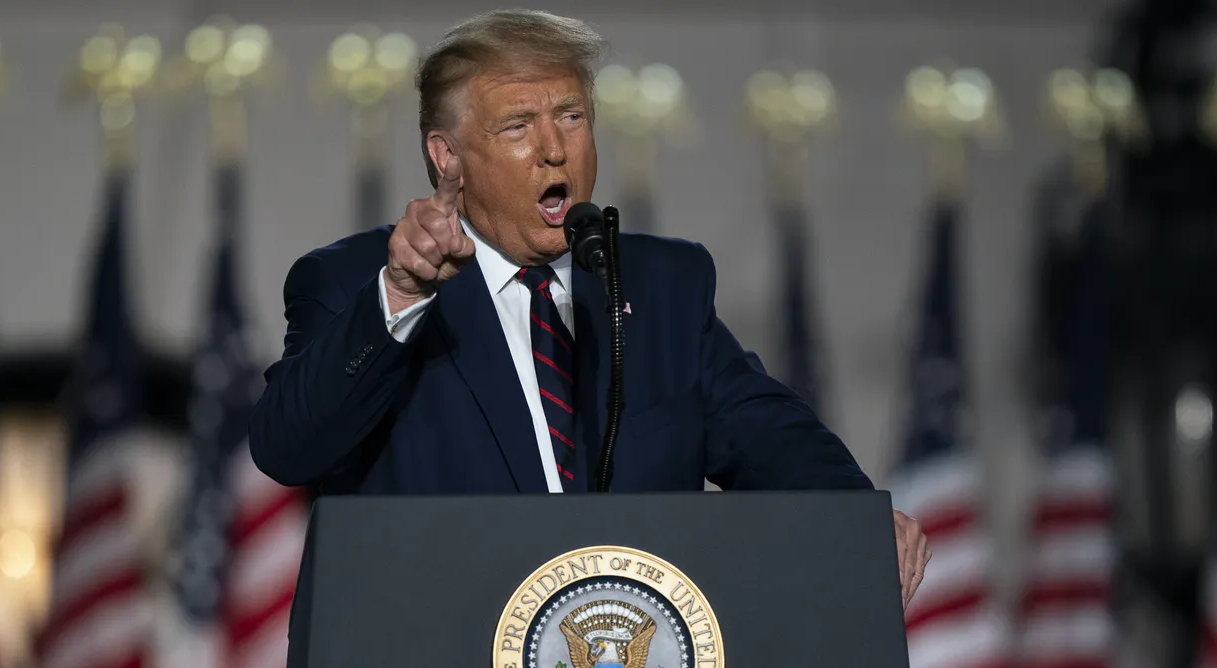
In an astonishing news conference in Washington, US President Donald Trump proposed[1] the United States “take over” the Gaza Strip and permanently relocate the nearly two million Palestinians living there to neighbouring countries.
Trump has previously called[2] on Egypt and Jordan to resettle Palestinians from Gaza, which both countries firmly rejected[3].
His new comments – and the possibility of a US takeover of a sovereign territory – were immediately met with criticism[4] and questions about the legality of such a move.
When asked what authority would allow the US to do this, Trump did not have an answer. He only noted it would be a “long-term ownership position”. He also did not rule out[5] using US troops.
So, what does international law say about this idea?
Can the US take over a sovereign territory?
The quick answer is no – Trump can’t just take over someone else’s territory.
Since the end of the second world war in 1945, the use of force has been prohibited in international law. This is one of the foundations of international law since the creation of the United Nations.
The US could only take control of Gaza with the consent of the sovereign authority of the territory. Israel can’t cede Gaza to the US. The International Court of Justice has ruled[6] that Gaza is an occupied territory – and that this occupation is illegal under international law.
So, for this to happen legally, Trump would require the consent of Palestine and the Palestinian people to take control of Gaza.
And what about removing a population?
One of the biggest obligations of an occupying power comes under Article 49 of the Geneva Conventions[7]. This prohibits an occupying power from forcibly transferring or removing people from a territory.
All other states also have an obligation not to assist an occupying power in violating international humanitarian law. So that means if the US wanted to move the population of Gaza by force, Israel could not assist in this action. And likewise, the US cannot assist Israel in violating the rules.
Occupying powers are allowed to remove a population for the reason of safety.
Trump and his Middle East envoy who visited Gaza last week have repeatedly referenced[8] how dangerous it is. Trump questioned how people could “want to stay” there, saying they have “no alternative” but to leave.
However, removing people for this reason has to only be temporary. Once it’s fine for someone to return, they must be returned.
What if people voluntarily leave?
Transferring a population has to be consensual. But in this specific case, it would mean the consent of all Palestinians in Gaza. The US could not force anyone to move who does not want to.
Further to this, a government, such as the Palestinian Authority, cannot give this consent on behalf of a people. People have a right to self-determination – the right to determine their own future.
A perfect example is migration – if a person migrates from one state to another, that is their right. It’s not displacement. But forcefully displacing them is not permitted.
And using what sounds like a threat would arguably not be consensual, either. This could be saying, for instance, “If you stay, you’ll die because there’s only going to be more war. But if you leave, there’s peace.” This is the threat of force.
Would forcing people to leave be ethnic cleansing?
Ethnic cleansing has not been defined in any treaty or convention.
However, most international law experts rely on the definition in the Commission of Experts report on the former state of Yugoslavia to the UN Security Council in 1994. It defined[9] ethnic cleansing as:
rendering an area ethnically homogeneous by using force or intimidation to remove persons of given groups from the area.
So, under that definition, what is being suggested by Trump could be classified as ethnic cleansing – removing the Palestinian people from a certain geographical area through force or intimidation.
What can be done if Trump follows through?
If Trump follows through with this plan, it would be a violation of what is known as jus cogens, or the paramount, foundational rules that underpin international law.
And international law dictates that no country is allowed to cooperate with another in violating these rules and all countries must try to stop or prevent any potential violations. This could include placing sanctions on a country or not providing support to that country, for example, by selling it weapons.
A perfect example of this is when Russia illegally annexed Crimea in 2014, very few countries recognised the move. Russia’s full-scale invasion of Ukraine in 2022 was then followed by sanctions and the freezing of Russian assets[10], among other actions.
If Trump pursued this course of action, he too could be personally liable under international criminal law if he’s the one instigating the forcible transfer of a population.
The International Criminal Court has already issued arrest warrants[11] for Israeli Prime Minister Benjamin Netanyahu, the former Israeli defence minister and a Hamas commander in relation to the conflict.
The risk of this kind of language
One of the dangers of this kind of rhetoric is the potential to dehumanise the enemy, or the other side.
Trump does this through statements[12] such as, “You look over the decades, it’s all death in Gaza”, and resettling people in “nice homes where they can be happy” instead of being “knifed to death[13]”. This language implies the situation in Gaza is due to the “uncivilised” nature of the population.
The risk at the moment, even if Trump doesn’t do what he says, is that the mere vocalisation of his proposal is dehumanising to the Palestinian people. And this, in turn, could lead to more violations of the rules of war and international humanitarian law.
The nonchalant way Trump is discussing things such as taking over a territory and moving a population gives the impression these rules can easily be broken, even if he doesn’t break them himself.
References
- ^ proposed (www.nytimes.com)
- ^ previously called (www.theguardian.com)
- ^ rejected (www.bbc.com)
- ^ criticism (www.nytimes.com)
- ^ did not rule out (edition.cnn.com)
- ^ ruled (www.bbc.com)
- ^ Article 49 of the Geneva Conventions (ihl-databases.icrc.org)
- ^ repeatedly referenced (www.nytimes.com)
- ^ defined (www.icty.org)
- ^ freezing of Russian assets (enlargement.ec.europa.eu)
- ^ has already issued arrest warrants (news.un.org)
- ^ statements (nationalpost.com)
- ^ knifed to death (news.sky.com)
Authors: Tamer Morris, Senior lecturer, international law, University of Sydney