what voters really wanted, and why the coalition’s mandate could be fragile
- Written by: Mona Krewel, Senior Lecturer in Comparative Politics, Te Herenga Waka — Victoria University of Wellington
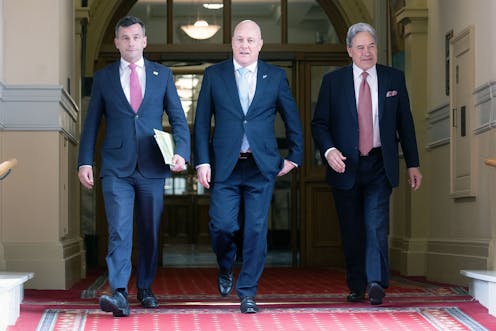
After winning the 2023 election, the National-led coalition government quickly embarked on a wide range of policy changes, often reversing the policies of its Labour predecessor.
A year on, despite continuing economic troubles, the three government parties have remained ahead in the polls – although sometimes only marginally.
The National-Act-NZ First coalition’s continued support suggests voters think it is delivering on its mandate – the promises and outcomes people had in mind when they voted for the coalition parties. Which raises the question, what exactly did people want when they voted in 2023?
The New Zealand Election Study[1] helps us understand why people voted the way they did. After the election, the study surveyed a random sample of people registered to vote, receiving just under 2,000 responses. We use this data to try to understand the new government’s mandate.
Economy and cost of living dominated
When asked to choose who they would prefer to lead the next government, about 48% wanted a National-led coalition, compared with 38% who preferred Labour to lead.
Nearly half of all voters wanted a new government after the election, suggesting this was a “change” election.
The issues that mattered for voters provide insights into why voters wanted change in 2023. The Election Study asks people what the most important issue was for them when voting.
A word cloud (see below) of the most important issues shows two responses stood out: the economy and the cost of living.
However, unlike 2020 – when COVID dominated[2] – in 2023 there was a range of issues people cared about, including health, climate change, and law and order: 73% wanted tougher sentencing laws. National’s strong stance on law and order was therefore also part of its mandate.
Moreover, there are clear differences between the two connected issues of the economy and cost of living.
Voters who said “the economy” was their most important issue tended to feel National was the party best equipped to address this problem. Voters who answered “cost of living” (and other related terms, such as poverty) were more likely to say Labour would be the best party to deal with those problems.

Some good news for Labour
While economic issues were front-of-mind for many people, and people wanted change, levels of satisfaction with the previous government’s performance were still surprisingly high.
Some 54% said the Labour government did a “very” or “fairly” good job – strong support for a government dismissed at the election. And 64% of respondents also continued to approve of the previous government’s COVID response, suggesting Labour was still getting credit for its management of the pandemic.
The previous Labour government were therefore not widely considered to be incompetent, as National and its partners perhaps hoped it would be.
Indeed, Labour’s Chris Hipkins was slightly more liked by voters on average than National’s Christopher Luxon (5.3 versus 4.7 out of 10). Hipkins was also seen as a marginally more competent leader than Luxon, overall.
However, the infamous slogan from Bill Clinton’s 1992 US presidential campaign – “it’s the economy, stupid!” – was central in the 2023 election.
Almost 75% of people thought the economy had got worse over the year prior to the election, and two-thirds of voters believed the economy or inflation had affected their voting decision.
The state of the economy and inflation rate were clearly on people’s minds. Economic evaluations mattered more than memories of the COVID crisis, the likeability or perceived competence of party leaders, or long-term views about parties.
A fragile mandate
In the year since the election, inflation has fallen, just as it has in other countries. But unemployment has increased, the economy has moved into recession, and a recent 1News Verian poll[3] showed more voters think New Zealand is in worse shape than better shape since the election.
Nonetheless, the coalition government remained ahead in the polls, despite criticism of many of its policies. The Election Study can also shed light on where some of these criticisms of the government come from.
Only 30% of New Zealanders wanted the restoration of interest deductibility for landlords, whereas 46% wanted landlords to pay tax on this income.
Half of the electorate wanted stronger measures to reduce carbon emissions, while just 23% did not want them. Voters also wanted more health and education expenditure.
Our results suggest the National-led coalition government has a mandate from voters to reduce inflation and to manage the economy towards growth and improved living standards.
Voters also want to see a reduction in crime, and better government services, especially healthcare.
If the coalition fails to deliver on this challenging set of expectations, National and its partners are likely to feel the wrath of voters at New Zealand’s next election – particularly considering people retained relatively favourable attitudes about the outgoing Labour government.
References
- ^ New Zealand Election Study (www.nzes.net)
- ^ when COVID dominated (theconversation.com)
- ^ 1News Verian poll (www.1news.co.nz)
Authors: Mona Krewel, Senior Lecturer in Comparative Politics, Te Herenga Waka — Victoria University of Wellington