5 key health priorities for future disaster response
- Written by: Holly Thorpe, Professor in Sociology of Sport and Gender, University of Waikato
“The climate crisis is a health crisis.” So says[1] World Health Organization Director-General Tedros Ghebreyesus.
The World Economic Forum[2] agrees. Its report this year highlighted how climate change is taking a toll on global health due to increasingly frequent extreme weather events.
These issues are on the official agenda here too, especially since severe tropical cyclone Gabrielle caused extensive damage in the South-west Pacific and northern New Zealand in early 2023.
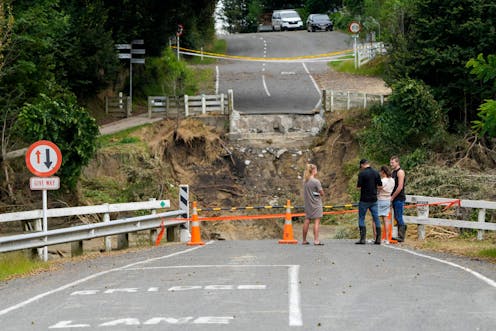
Between February 13 and 14 it slammed into Te Tairāwhiti/East Coast[3] and Te Matau a Māui/Hawkes Bay, with disastrous results for the land and its inhabitants. Communities were displaced, homes destroyed, power and telecommunications cut, water systems compromised, and many roads and bridges badly damaged.
Shortly after Gabrielle hit, Manatū Hauora/Ministry of Health commissioned us to investigate the impacts of adverse weather events on health systems and community health and wellbeing.
Our community research teams interviewed 143 residents in the two affected regions. They included first responders, heath workers, council staff and members of the public. Their stories were emotional, powerful and insightful.
Our recently published report[4] amplifies these community voices and local knowledge, and offers recommendations about planning for future, inevitable events. Here we offer five key messages.
1. Prioritise vulnerable people
Many older people and those with disabilities or existing health conditions were deprioritised or simply forgotten during evacuations and in the days and weeks after the cyclone. As one community responder in Tairāwhiti recalled:
Some of them couldn’t move out because they were so old and frail. The water was so powerful, they couldn’t move anywhere. Some just stayed in their room until somebody turned up. For instance, there was a lady [who] was stuck in her wheelchair, and by the time people found her, the water was at her neck.
Our report identified the need for health and social services to work more closely to ensure at-risk, vulnerable older people and those with disabilities or complex needs[5] are prioritised during evacuations, so their medical and physical needs are met during and after an extreme weather event.
2. Invest in mental health support and trauma recovery
Those in the most affected communities had high levels of stress, grief and trauma during and after emergencies and evacuations.
Staff and volunteers in front-line roles during the state of emergency experienced similar mental health effects. Many felt mental health support was not there when they needed it most.
Almost everyone we spoke to had some negative mental health impacts. These included sleep disruption, rain anxiety and stress from road closures, insurance claims and land instability.
Māori participants also told of their grief over environmental damage and destruction, highlighting the links between whenua (land) and hauora (health). They described drawing on cultural practices to support whānau recovery. For example, a leader of local volunteer efforts spoke about the personal impact of the cyclone:
I was not good […] it was seeing the impact on how it was for your own community whānau. I think it hit me quite a bit later on. I fell into depression […] It just built up over time. I’m still in healing therapy for the last probably six to seven months since Gabrielle, just trying to get my wairua [spirit] and my tinana [body] and everything back in place.
Overall, the research shows a need for greater awareness and investment in weather-related trauma recovery and mental health support.
3. Ensure medical supplies can reach remote areas
Rural and isolated communities had heightened health challenges, particularly due to road and communication failures.
Transporting medical staff into these communities often required creative solutions (driving, using helicopters or hiking through bush and across farmland when roads were damaged, for example).
Access to medicines was a major concern. It took co-ordinated effort to get pharmaceuticals to such communities. Helicopters were crucial in getting supplies and patients in and out of remote areas. Not everyone who needed attention received it, however.
The most effective responses involved organisations (such as the NZ Police and Civil Defence) working together with communities. As one police officer told us:
Our whānau up the coast needed medicine, prescriptions. Getting access from the helicopter to the home was a challenge. So, the police leant in and helped out. We used [an all-terrain vehicle] to get to places and spaces to get medicine in.
4. Resource and co-ordinate local support networks
Fiscally challenged health systems were stretched during the emergency and struggled with power and telecommunications outages. But we heard of many health workers going “above and beyond” to care for patients and communities.
Many continued working even when their own families, homes and communities were directly under threat. Anticipating this and supporting these workers will be important as adverse weather becomes more frequent with climate change.
We also found marae, schools, local social services and non-profit organisations played key roles after the cyclone, but were often outside the direct ambit of the health system.
Often the people working in these organisations have strong community relationships and knowledge that is essential to supporting emergency and recovery processes. These connections should be mapped and integrated for future events.
5. Shift resources and build common will
Local communities are full of knowledge. Many have learnt from recent events to better prepare their families, workplaces and organisations.
Whānau told us about the importance of having cash in case of power outages and telecommunications failure. Others identified battery-powered radio as a critical source of information when systems were down. Pharmacists and doctors told of the importance of hard-copy evidence of prescriptions, to be able to dispense when electronic systems are out.
Checking in on neighbours, sharing resources and making time for a cup of tea were all important for people in the recovery and rebuilding phases. A key lesson is to harness the power of community connections, trust and relationships in climate change resilience and recovery.
Although knowledge, experience and wisdom lie in the hands of communities, our research highlights how financial resources mostly sit with central government. The challenge is to shift resources and build common will for climate action, before the inevitable next event.
The report is receiving attention in parliament[6]. We hope local experience can be central to planning around the health impacts of climate change and decision-making at all levels.
We acknowledge the important contributions of our wider research team and community partners, particularly Manu Caddie (Te Weu Charitable Trust), Josie McClutchie (project lead), Dayna Chaffey, Haley Maxwell and Hiria Philip-Barbara (community researchers) in Tairāwhiti, and Emma Horgan and John Bell (Sustainable HB Centre for Climate & Resilience) in Hawkes Bay.
References
- ^ So says (www.who.int)
- ^ World Economic Forum (www.weforum.org)
- ^ Te Tairāwhiti/East Coast (teweu.nz)
- ^ recently published report (www.health.govt.nz)
- ^ disabilities or complex needs (www.rnz.co.nz)
- ^ receiving attention in parliament (www.parliament.nz)
Authors: Holly Thorpe, Professor in Sociology of Sport and Gender, University of Waikato