why anti-patch policies backfire – and what would actually work
- Written by: Antje Deckert, Associate Professor (Criminology), Auckland University of Technology
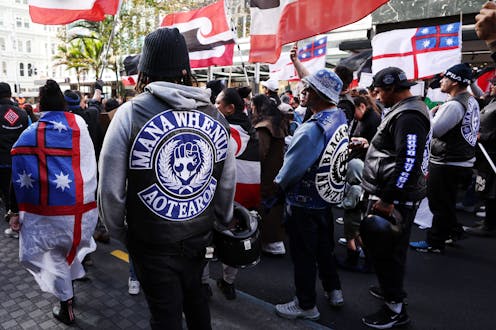
Despite the connection between institutional harm and gang membership made clear in this week’s mammoth royal commission abuse-in care report[1], the government seems unlikely to soften its “get tough on crime” policies.
Since taking office last year, the coalition has moved quickly to make good on its election promises. As well as reintroducing boot camps[2] and bringing back the three-strikes sentencing policy[3], its crackdown on gangs[4] is well underway.
The Gangs Legislation Amendment Bill[5] seeks to make gang membership an aggravating factor in sentencing, ban gang patches from public spaces, and restrict gang members’ right to congregate in public or communicate with each other. A specialised National Gang Unit[6] will focus on enforcing those policies.
All of this will cost money. When a new offence (such as violating the patch ban or a non-consorting order) is added to the Crimes Act[7], more must be spent on policing, courts and prisons.
Taxpayers may approve of such additional government spending if the policies work. But the research evidence suggests these costly anti-gang measures may well have the opposite of the desired effect.
How anti-gang policies backfire
The government promises[8] banning gang patches and giving police more dispersal powers will “restore law and order” and reduce crime. But there is no research evidence to support these claims.
As Australian gang law expert Mark Lauchs has noted, there is no conclusive data[9] that “gang-busting” legislation reduces gang-related crime. Some suggest such measures may simply push criminal activity further underground.
It seems counterintuitive, but there is also evidence of anti-gang policies actually increasing offending, due to the increased contact between police, gang members and their whānau (extended family).
As one Norwegian study[10] recently found, “criminal justice involvement increases rather than decreases criminal behaviour”. The study surveyed individuals at high risk of offending over a period of 30 years. One group was exposed to frequent police contact, while the other was not. The former group reported committing more crimes than the latter.
The researchers concluded contact with police “labels” individuals as criminals, who then act according to the label. Simply put, frequent police contact can mean more crimes being committed. More crimes also mean more people being victimised.
The risk in New Zealand extends to increased police contact not only with patched gang members but also with innocent young Māori[11] caught up in surveillance operations or investigations.
In 2021, police were found to have illegally obtained tens of thousands of photographs of young Māori, including “non-voluntary” pictures (taken without consent or knowledge) during gang investigations[12]. The police then missed the mandated deadline[13] to delete the images.
In sum, the research evidence suggests the current government approach may in fact perpetuate the “gang problem” it seeks to solve. On the other hand, there is considerable evidence and expert knowledge – both academic and “grassroots” – that could inform better policy.
What expert knowledge can offer
Gang members, their whānau, and organisations that provide social support for so-called hard-to-reach communities have extensive experience with previous government gang policies.
These non-academic experts know what works, fails and backfires. But their vast institutional knowledge continues to be ignored or dismissed by policymakers.
In our recently published special issue[14] of the Decolonization of Criminology and Justice journal[15], we showcase the more nuanced understandings these expert voices have to offer.
Among them are Harry Tam, Angie Wilkinson and Joanna Wilkinson from H2R Research and Consulting[16], a social support provider focused on community-led solutions. They explain[17] how gangs originally formed in response to structural racism in postwar New Zealand, as outlined in this week’s royal commission abuse-in-care report.
Successive governments met the rapid urban migration of Māori with policies that left them disadvantaged in all aspects of life: housing, education, employment and social support. Thousands of Māori children were uplifted and systematically abused in state care[18].
The survivors, deprived of whānau and cultural connections, naturally formed support groups – later to become the Mongrel Mob and Black Power gangs. The members of these organisations behaved, unsurprisingly, in ways that reflected the multifaceted harms inflicted on them.
Instead of addressing the causes, governments focused on the symptoms. They labelled survivors “gang members” and sought to monitor, suppress and criminalise gang activity.
But this response – central to the current government’s approach – failed to arrest the growth in gang membership or offending by those involved.
Evidence as the basis of policy
Also in our journal edition, authors Sonny Fatupaito, Paula Ormsby and Steve Elers provide insights[19] into the whakapapa (genealogy) and meaning of the gang “patch” or insignia.
They explain how the patch evolved from a stylised symbol of aggression and confrontation to a “korowai[20]” (cloak) symbolising a transition from problematic past behaviours such as violence and drug offending toward rehabilitation and positive community engagement.
The authors offer a counter to perceptions of the patch as intimidating. Misrepresenting or ignoring this cultural shift, they argue, effectively obscures significant changes in gang identity and culture over the past 20 years.
The lack of engagement with this kind of expert knowledge has enabled governments to dominate public commentary on gangs and sideline scholars and practitioners who work with gang whānau.
We argue the current anti-gang policies will not reduce crime, but are likely to further alienate hard-to-reach communities.
Policies informed by evidence and expert knowledge would not only result in better understanding of gangs and the patch, they would also be more effective in protecting the interests of the public in general.
References
- ^ abuse-in care report (www.abuseincare.org.nz)
- ^ boot camps (newsroom.co.nz)
- ^ three-strikes sentencing policy (www.rnz.co.nz)
- ^ crackdown on gangs (theconversation.com)
- ^ Gangs Legislation Amendment Bill (www.legislation.govt.nz)
- ^ National Gang Unit (www.1news.co.nz)
- ^ Crimes Act (www.legislation.govt.nz)
- ^ promises (www.tiktok.com)
- ^ no conclusive data (ojs.aut.ac.nz)
- ^ Norwegian study (academic.oup.com)
- ^ innocent young Māori (www.stuff.co.nz)
- ^ during gang investigations (www.rnz.co.nz)
- ^ missed the mandated deadline (www.rnz.co.nz)
- ^ special issue (ojs.aut.ac.nz)
- ^ journal (ojs.aut.ac.nz)
- ^ H2R Research and Consulting (www.hard2reach.co.nz)
- ^ explain (ojs.aut.ac.nz)
- ^ systematically abused in state care (theconversation.com)
- ^ provide insights (ojs.aut.ac.nz)
- ^ korowai (teara.govt.nz)
Authors: Antje Deckert, Associate Professor (Criminology), Auckland University of Technology