can it select the right boardroom players for the modern game?
- Written by: Tracy Molloy, Senior Lecturer in Sport Governance, Law & Ethics, Auckland University of Technology
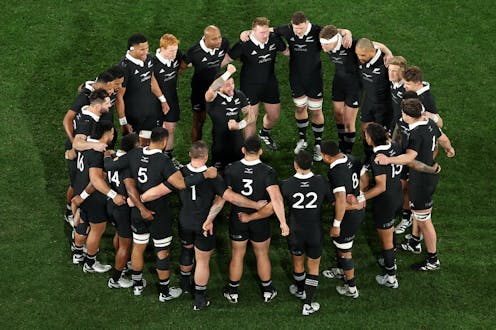
As the All Blacks’ bruising first encounter with England last weekend showed, rugby is not a game for the faint-hearted. The same can apply off the field as well.
At the end of May, a special general meeting of NZ Rugby[1], the game’s national organisation, decided on a future governance structure. It marked the culmination of an arm wrestle between the national board and key provincial unions, with the latter prevailing.
Media coverage captured the depth of feeling attached to the outcome: NZ Rugby chair, Dame Patsy Ready, was reportedly prepared to resign[2], and the Players Association threatened a breakaway organisation for the professional game.
Behind the substantive issues of funding and board appointment models, deeper forces were at work.
Since the game went professional in 1995, there has been a longstanding tension between two institutional “logics”. One is corporate, about commercialisation, professionalisation and efficiency. The other is community oriented, about the “grassroots” voice and member representation.
Making that dual remit workable now falls to NZ Rugby and the provincial unions to progress at tomorrow’s annual general meeting. Some commentators are suggesting[3] the future stability of the game is at stake.
Finding common ground
The challenges to the game are commonly accepted: static or declining participation rates, the financial sustainability of the professional game in a small domestic market, disrupted spectator engagement, low Māori and Pasifika presence in leadership, and questions about maximising opportunities for the women’s game.
What is contested is how the game should be funded, and how NZ Rugby should be structured to address these challenges.
The tensions that came to head in May were sparked by the investment agreement[4] NZ Rugby made with US private equity firm Silver Lake in 2022.
Part of the deal involved NZ Rugby commissioning and publishing an independent governance review[5]. This resulted in the Pilkington Report (named after the review panel chair David Pilkington). Published last year, the report found the NZ Rugby model no longer “fit for purpose”:
The structure it sits within was not designed for a business of this size and complexity.
The report contained two key recommendations: the selection of independent board members through an independent process, and the creation of a “stakeholder council” to ensure broad representation.
Two proposals were presented at the special general meeting. The first, supported by the NZ Rugby Board, the Māori Rugby Board and the Players Association, was rejected in favour of the second, backed by key provincial unions.
Competing proposals
At the core of the debate is a complex disagreement over achieving “independence” of board members. NZ Rugby wanted to move away from an “independence of office” model, which risked undue influence by provincial union interests, to a more corporate “independence of thought” model.
Under the previous NZ Rugby model, board members could not also sit on the board of a provincial union or similar rugby organisation (“independence of office”).
In practice, the board selection process saw candidates campaigning for nomination by provincial unions. The fear was that they may then feel obliged to promote those unions’ interests, potentially influencing an elected board member’s decisions.
However, the new Incorporated Societies Act[6] requires board members to “act in good faith” and in the “best interests” of the organisation as a whole (“independence of thought”).
Both proposals presented at the special general meeting allow for an “open” application process, meaning candidates no longer need to be nominated by a provincial union. Both proposals also include a stakeholder council and an appointments panel in the board selection process.
However, the provincial union proposal requires three of the nine board members to have previously been on a provincial union board. This potentially narrows the candidate pool, and could see pro-provincial union members back on the board.
Given there would still be six other board members, this may not be a problem. More telling, perhaps, would be the provincial union proposal effectively giving the stakeholder council more power over the board appointments panel than recommended in the Pilkington report.
Importantly, this would give the stakeholder council the power to “sign off” on some board selection criteria and processes.
But the stakeholder council (now called a governance advisory panel) is a broad church. It provides for representation of the Māori Rugby Board, Pasifika Advisory Group, NZ Super Rugby clubs and the Players Association. Combined with an independent chair and three provincial union representatives, it can represent a range of community and professional perspectives.
All on the same team
Our research[7] shows appointment panels have been used by New Zealand sports organisations for over 25 years. The NZ Rugby model, with a mix of independent and stakeholder perspectives on the appointments panel, is not new.
The research also suggests[8] the two competing logics within NZ Rugby – professional/elite and amateur/grassroots – can be resolved. Both coexist in various forms within other New Zealand sporting codes.
As NZ Rugby prepares for tomorrow’s AGM and the staged implementation of the provincial union proposal, all involved will need to act in the best interests of the whole game and the NZ Rugby organisation.
Ultimately, the game’s top administration needs well-chosen representatives who can bring their individual experience and perspective to the table, but be capable of thinking and acting independently, without favouring any particular interests.
Rugby has been described[9] as a “game for everybody and every body”. The same applies to the NZ Rugby board, the stakeholder council and the appointments panel. They’re all on the same team, contributing their respective skill sets.
Now they just need to get the ball over the line at the AGM, and then convert it between the goal posts of good governance.
References
- ^ NZ Rugby (www.nzrugby.co.nz)
- ^ reportedly prepared to resign (www.stuff.co.nz)
- ^ commentators are suggesting (www.nzherald.co.nz)
- ^ investment agreement (www.rnz.co.nz)
- ^ governance review (www.nzrugby.co.nz)
- ^ Incorporated Societies Act (www.legislation.govt.nz)
- ^ research (www.tandfonline.com)
- ^ also suggests (openrepository.aut.ac.nz)
- ^ described (w-rugby.com)
Authors: Tracy Molloy, Senior Lecturer in Sport Governance, Law & Ethics, Auckland University of Technology