NZ’s commercial rocket industry is taking off, but national space law needs a boost
- Written by: Alexander Gillespie, Professor of Law, University of Waikato
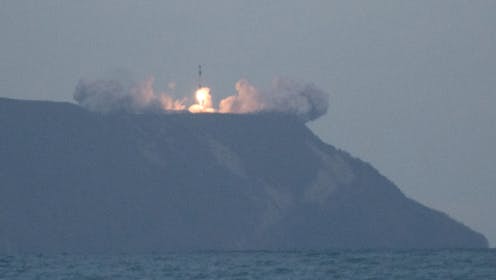
News of a potential new rocket launch site[1] in Canterbury has largely been enthusiastically received. Boosts to the regional and national economies, and to New Zealand’s competitiveness in a crowded sector, have been welcomed.
But it also shines a light on the rapidly growing military-industrial use of space, and the pressing need for both national and international law to keep up.
The establishment of a National Space Agency[2] in 2016 and appointment of the first minister for space (Judith Collins) last year are a start. But the challenges are significant in such a fast-moving area.
If and when the new launch site is operational, it will join Rocket Lab’s “spaceport[3]” on the Mahia Peninsula in the North Island, which opened in 2016. Rocket Lab signed a major deal[4] in June to launch ten rockets for Japanese satellite data company Synspective.
While Rocket Lab says it does not carry military payloads, critics have argued[5] its vehicles have the capacity, and there are no real legal or regulatory safeguards to prevent such uses.
Furthermore, Rocket Lab’s main base is now the US, where it is quickly advancing as an important supplier[6] to the American military. It also launched[7] an experimental communications satellite for the New Zealand Defence Force (NZDF) in April.
At the same time, New Zealand is now a partner[8] (along with Five Eyes allies Britain, Australia and Canada, as well as France and Germany) with Space Force[9], part of the overall US Armed Forces.
What the partnership involves remains unclear[10]. But if New Zealand were to join pillar two of the AUKUS security pact[11], its role could well expand. Either way, it will need fit-for-purpose rules and regulations for this new space age.
Old rules in a new world
The international rules governing outer space[12] and its peaceful use – astronaut rescue[13], accident liability[14] and the registration of objects[15] sent above the atmosphere – reflect understandings now nearly five decades old.
This is largely also reflected in New Zealand’s Outer Space and High-altitude Activities Act 2017[16], which covers the local space industry and compliance with existing international law.
The current regime gives considerable latitude[17] to the minister, who has a “broad discretion” is deciding what is in the national interest when authorising payload deliveries. A prohibition on military hardware, and the goal of demilitarisation of space, are not listed objectives.
To its credit, New Zealand is advocating[18] at the United Nations for enhanced “norms, rules and principles of responsible behaviours in space”. These include ensuring space activities are for peaceful purposes and in the interest of maintaining international peace and security.
The previous foreign minister, Nanaia Mahuta, also spoke out[19] against destructive ground-launched anti-satellite missile tests and supported related efforts at the UN, despite objections from Russia and China.
Crowded space
As of last year, an estimated 7,560 satellites[20] operated in various orbits around Earth. The lion’s share belonged to the United States (5,184), followed by China (628) and Russia (181).
Of the US satellites, most (4,741) are commercial. But the division between categories is not always tight, with commercial operators often doing work for the military.
According to the NZDF[21], space-based systems and technologies are a “critical enabler of more than 90% of military capability”. They provide all forms of intelligence, from early warning and global positioning systems to missile guidance.
If any country loses control of this information in space, the risk of losing a war on Earth is high. Defence of its military and intelligence-gathering satellites is a high priority for the US[22] and other nations.
The same applies to sites or infrastructure associated with defence data collection, communication links and launch pads. The threat of a “Space Pearl Harbour” is taken very seriously.
Non-military targets
These fears escalate with each new iteration of anti-satellite missiles, which America, China[23], India and Russia [24] have all tested.
Given some firms operate in grey zones of dual-use military and non-military technologies (Starlink’s connection to the war in Ukraine[25], for example), the risk of commercial infrastructure becoming a target[26] remains real.
But while establishing new rules for a new world is essential, it is not an end in itself. Rather, it should be part of the overall goal of meaningfully expanding the peaceful use of space: seeking demilitarisation where possible and the prevention of an orbital arms race.
It will also require addressing the currently blurred lines between developing and deploying weapons for offensive and defensive purposes, and between military and commercial operators.
Those commercial operators provide a vast amount of essential satellite information for peaceful purposes. Protecting them from any future conflict is in the national interest.
While there are clear benefits available in this new space age, there needs to be wider discussion of the potential risks. New Zealand’s remote and unique geographic position allows satellite observation and communication not possible from other places. This makes the country both valuable and vulnerable in any large-scale conflict.
National sovereignty should govern policy-making, and cross-party political co‑operation will help. Above all, New Zealanders should be aware of the potential implications, so decisions are made with their full and informed consent.
References
- ^ new rocket launch site (www.rnz.co.nz)
- ^ National Space Agency (www.mbie.govt.nz)
- ^ spaceport (www.rocketlabusa.com)
- ^ major deal (www.newshub.co.nz)
- ^ critics have argued (www.rnz.co.nz)
- ^ important supplier (www.defenseone.com)
- ^ launched (www.nzherald.co.nz)
- ^ now a partner (www.spaceforce.mil)
- ^ Space Force (www.spaceforce.mil)
- ^ remains unclear (www.rnz.co.nz)
- ^ pillar two of the AUKUS security pact (www.defence.govt.nz)
- ^ outer space (www.unoosa.org)
- ^ astronaut rescue (www.unoosa.org)
- ^ accident liability (www.unoosa.org)
- ^ registration of objects (www.unoosa.org)
- ^ Outer Space and High-altitude Activities Act 2017 (www.legislation.govt.nz)
- ^ considerable latitude (www.mbie.govt.nz)
- ^ advocating (front.un-arm.org)
- ^ spoke out (www.beehive.govt.nz)
- ^ 7,560 satellites (blog.ucsusa.org)
- ^ According to the NZDF (www.nzdf.mil.nz)
- ^ high priority for the US (breakingdefense.com)
- ^ China (www.space.com)
- ^ Russia (www.space.com)
- ^ connection to the war in Ukraine (www.belfercenter.org)
- ^ becoming a target (time.com)
Authors: Alexander Gillespie, Professor of Law, University of Waikato