5 reasons why the government should slow down on raising speed limits
- Written by: Simon Kingham, Professor of Human Geography, University of Canterbury
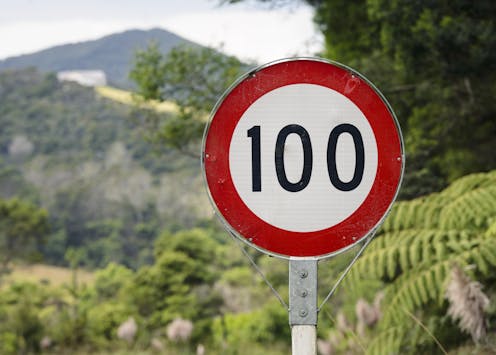
Only last year, all the talk was about lowering speed limits[1] to save lives as part of the previous Labour government’s Road to Zero[2] policy.
Even motoring advocacy group the Automobile Association was calling for continued reductions[3] in speed limits.
But a year on, the coalition government has announced[4] it will reverse the blanket speed limit reductions put in place after January 1, 2020. Submissions on this policy shift[5] close on July 11.
It is worthwhile considering, then, why the government is increasing speed limits despite extensive research highlighting the benefits of slower speeds – including fuel savings, reduction in injuries and deaths, environmental benefits and community wellbeing.
1. Time savings and productivity
Supporters of higher speed limits argue slowing traffic costs time and money. But a 10% increase in speed limit doesn’t lead to a 10% increase in time savings. Much of a journey involves slowing in traffic and stopping at junctions and traffic lights[6].
The evidence[7] suggests lower speeds usually result in very small increases in travel time, especially in urban areas. There are also questions about how travel time savings would be used.
Typically, time savings are multiplied by the number of vehicles on the road to produce the total time saved. For example, 5,000 vehicles on a stretch of road each day, saving an average of 30 seconds per vehicle, gives 2,500 minutes of time saved. At NZ$30 per hour, this would equal $75,000 of “saved time” each day.
That sounds like a significant number. But, of course, this is based on the assumption people use time savings to be more productive. Research[8] suggests they often don’t.
In fact, making it easier to travel further and faster encourages people to travel longer distances. This is called induced demand[9] and ultimately it adds to our traffic woes[10].
This is because, in the short term, people who had previously been discouraged from using congested roads start to use them. And in the longer term, people move further away from city centres to take advantage of new roads that allow them to travel further faster.
In addition, time savings associated with higher speed limits could be worth less than the fuel savings associated with lower speed limits. This is especially the case on state highways where more fuel is used at speeds above 80 kilometres per hour.
2. Crashes, deaths and injuries
Speed is a contributing factor in a third of fatal crashes[11] on our roads and over 50% in crashes that kill 15-29 year olds[12]. By comparison, potholes contribute to 1% of crashes leading to deaths or serious injuries.
The research clearly shows deaths and serious injuries are much higher at increased speeds, primarily as stopping distances[13] become longer. The chances of a pedestrian surviving a crash are around 90% at 30km/h[14], compared to around 10% at 50km/h, for example.
Recent research in New Zealand[15] has found notable reductions in these sorts of deaths and serious injuries on roads where speed limits have been reduced.
In countries such as the United Kingdom[16], where urban speed limits have been reduced, there have been significant reductions in road casualties. In Wales[17], reducing the speed limit on residential roads to 20 miles per hour (30km/h) has been estimated to save around $200 million annually.
3. Environmental pollution
Lower speed limits are also better for the environment. As well as producing greenhouse gas emissions, motor vehicles fuels emit air pollution – something that causes over 2,000 New Zealand deaths each year[18].
Research shows the speed at which vehicles travel affects the amount of pollutants released. Vehicles driven at very high or very low speeds emit more pollutants[19], with the lowest emissions from vehicles travelling at 60-80km/h.
Braking and accelerating increase emissions[20], so driving at a consistent speed is better. Research[21] has shown the optimum speed limit to minimise emissions in urban areas is between 20 km/h and 30km/h.
Lower speeds also reduce noise, which has been identified as the second biggest environmental[22] stressor on public health after air pollution. Even small decreases in speeds[23] create significantly quieter roads.
4. Health, wellbeing, community and equity
Further research shows[24] communities with slower traffic have better health and wellbeing.
Oxford University’s Danny Dorling has argued[25] urban speed limits of 20 miles-per-hour (30km/h) are the “most effective thing a local authority can do to reduce health inequalities”.
This is particularly important in New Zealand. Rates of injury and death on the roads disproportionately affect[26] Māori, younger people and those in low-income communities.
It has also been suggested there are multiple additional benefits[27] from slower urban speed limits, including economic, health and social gains.
5. Global trends
Around the world, numerous cities are adopting lower urban speed limits, typically 30 km/h. For example, Wales has legislated a national speed limit of 20m/h (30km/h) on residential streets, and Scotland has committed to doing this by 2025.
Nearly 30 million people in the UK have speed limits of 20mph[28] (30km/h) in the places where they live or work. There are similar examples[29] across continental Europe.
In 2020, road safety experts and government ministers from 130 countries adopted the “Stockholm Declaration[30]”. This advocates for 30km/h limits in urban areas where “vulnerable road users and vehicles mix in a frequent and planned manner”.
It’s not just Europe. Lower speed limits are being implemented across many other regions, including the United States[31] and South America[32].
The case for lower speed limits is compelling. Lives are saved, pollution reduced, health improved and communities enhanced. The question is, why is New Zealand’s government seeking to buck the trend and go against what science shows is good policy, when the rest of the world accepts lower speed limits make sense.
References
- ^ lowering speed limits (www.stuff.co.nz)
- ^ Road to Zero (www.stuff.co.nz)
- ^ continued reductions (www.newshub.co.nz)
- ^ has announced (www.stuff.co.nz)
- ^ Submissions on this policy shift (consult.transport.govt.nz)
- ^ stopping at junctions and traffic lights (videos.futuretransport.info)
- ^ evidence (viastrada.nz)
- ^ Research (www.greaterauckland.org.nz)
- ^ induced demand (www.wired.com)
- ^ traffic woes (theconversation.com)
- ^ third of fatal crashes (www.transport.govt.nz)
- ^ 50% in crashes that kill 15-29 year olds (www.transport.govt.nz)
- ^ stopping distances (futuretransport.info)
- ^ 90% at 30km/h (futuretransport.info)
- ^ research in New Zealand (viastrada.nz)
- ^ United Kingdom (www.bmj.com)
- ^ Wales (media.service.gov.wales)
- ^ 2,000 New Zealand deaths each year (www.stuff.co.nz)
- ^ emit more pollutants (at.govt.nz)
- ^ increase emissions (www.fueleconomy.gov)
- ^ Research (futuretransport.info)
- ^ second biggest environmental (pubmed.ncbi.nlm.nih.gov)
- ^ small decreases in speeds (cfile240.uf.daum.net)
- ^ research shows (hria.org)
- ^ has argued (www.thebritishacademy.ac.uk)
- ^ disproportionately affect (www.ehinz.ac.nz)
- ^ multiple additional benefits (theconversation.com)
- ^ speed limits of 20mph (www.20splenty.org)
- ^ similar examples (en.30kmh.eu)
- ^ Stockholm Declaration (www.roadsafetysweden.com)
- ^ United States (hria.org)
- ^ South America (www.roadsafetyngos.org)
Authors: Simon Kingham, Professor of Human Geography, University of Canterbury