My own prison ordeal gave me a taste of what Assange may be feeling. He’s out – but the chilling effect on press freedom remains
- Written by: Peter Greste, Professor of Journalism and Communications, Macquarie University
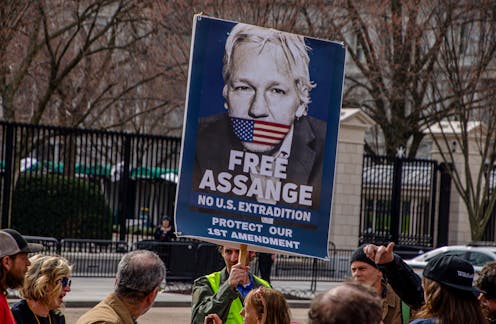
Julian Assange is out of prison, after agreeing to plead guilty to violating the US Espionage Act. He is expected to be freed[1] after appearing in a US courtroom[2] on the Northern Mariana Islands this week.
It is worth pausing for a moment to consider all that Assange has been through, and to pop a bottle of champagne to celebrate his release.
He spent 1,901 days in a small cell in Britain’s notorious Belmarsh Prison and, according[3] to WikiLeaks, was “isolated 23 hours a day”.
I know – from first-hand experience – what imprisonment feels like. Make no mistake. Assange might not have been beaten up or had his fingernails ripped out, but extended confinement with an uncertain future is its own particular kind of excruciating torture.
The crushing burden of incarceration
Belmarsh came after Assange had already spent almost seven years[4] seeking asylum in the Ecuadorian embassy in London.
He went there to evade extradition to Sweden as part of a rape investigation he said was trumped up, and included the possibility of being sent on to the United States to face allegations of espionage.
When Ecuador eventually rescinded his asylum claim in 2019[5], he was dragged out of the embassy and arrested by UK police for absconding from bail.
The US wanted to extradite him for alleged conspiracy to commit computer intrusion, and then 17 counts of espionage. Those charges, his supporters said[6], included the possibility of life behind bars.
My own ordeal in Egypt, where I was imprisoned on terrorism charges in 2014–15, was nothing compared to Assange’s, but it was more than enough to understand the crushing mental and physical burden that incarceration imposes on inmates.
And I also understand the weird blend of elation, confusion and disorientation that sudden release brings. Assange’s journey home will be much longer than his flight back to Australia.

A serious chilling effect on public-interest journalism
But Assange’s release does not end the questions this whole saga raised in the first place.
It began when his company, WikiLeaks, published a series of documents exposing evidence of war crimes and abuses by the US government in Iraq and Afghanistan.
WikiLeaks was doing what the First Amendment to the US Constitution was designed to achieve.
It guarantees freedom of speech and press freedom, and in the process it grants people the right to speak out against abuses of government authority.
That is a vitally important check on the awesome power that governments wield, and WikiLeaks should be celebrated for what it exposed.
Like many others, I believe Julian Assange should never have been charged with espionage.
The Obama administration was among the most aggressive in US history[8] in going after journalists’ sources who leaked embarrassing government information.
Yet in 2013, Obama’s justice department decided against prosecuting Assange[9]. Justice officials realised they couldn’t do it without setting a precedent that would force them to also go after established news organisations like the New York Times and Washington Post.
This case has undeniably had a serious chilling effect on public-interest journalism, and sends a terrifying message to any sources sitting on evidence of abuses by the government and its agencies.
While it is impossible to quantify the number of stories not told, it is hard to imagine it hasn’t frightened off potential whistleblowers and reporters.
It also leaves open the question of precedent. It is still not clear whether future governments might be able to use Assange’s guilty plea as a way of using the Espionage Act to go after uncomfortable journalism.
As we have seen in the past, leaders with an authoritarian streak tend to use every lever available to control the flow of information, and that must surely worry anyone who believes in the corrective power of a free press.
 Activists have always argued the Assange case could have a chilling effect on press freedom.
E Ozcan/Shutterstock[10]
Activists have always argued the Assange case could have a chilling effect on press freedom.
E Ozcan/Shutterstock[10]
Questions about journalism
Assange has been hailed by his supporters as a “Walkley Award-winning journalist”. His gong is certainly prestigious and worth celebrating, but it is also important to recognise the award was for his “Outstanding Contribution to Journalism[11]”.
I got the same award in 2014. I am very proud of that. I got it not for my journalism, but for my stand on press freedom while I was imprisoned. Assange rightly got his for the role WikiLeaks played in supplying journalists with a steady stream of incredibly valuable documents.
The distinction is important because of the particular role journalism plays in our democracy, elevating it beyond freedom of speech. Journalism comes with the responsibility to process and present information in line with a set of ethical and professional standards.
I don’t believe WikiLeaks met that standard; in releasing raw, unredacted and unprocessed information online, it posed enormous risks for people in the field, including sources[12].
This is not to diminish the importance or value of what WikiLeaks exposed. Australia’s union for journalists, the Media Entertainment and Arts Alliance, has rightly described this case as “one of the darkest periods in the history of media freedom”.
And it will undoubtedly cast a long shadow across public-interest journalism. But for now, we should all celebrate the release of a man who has suffered enormously for exposing the truth of abuses of power.
References
- ^ expected to be freed (theconversation.com)
- ^ US courtroom (www.cbsnews.com)
- ^ according (www.theguardian.com)
- ^ seven years (www.bbc.com)
- ^ rescinded his asylum claim in 2019 (www.washingtonpost.com)
- ^ said (www.aljazeera.com)
- ^ EPA/Mourad Balti Touati (photos.aap.com.au)
- ^ aggressive in US history (www.cato.org)
- ^ against prosecuting Assange (www.washingtonpost.com)
- ^ E Ozcan/Shutterstock (www.shutterstock.com)
- ^ Outstanding Contribution to Journalism (www.walkleys.com)
- ^ including sources (www.aljazeera.com)
Authors: Peter Greste, Professor of Journalism and Communications, Macquarie University