The defence force is allowing foreign recruits. Will soldiers be willing to die for a country they’ve only lived in for a year?
- Written by: Ned Dobos, Senior Lecturer in International Ethics, UNSW Sydney
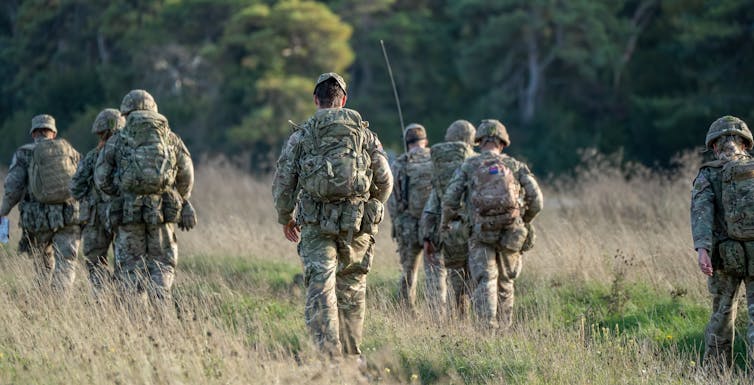
From July this year, New Zealand nationals will be eligible[1] to serve in the Australian Defence Force. From January 2025, so will Americans, Canadians and Brits. This raises a number of political and ethical issues that will need to be addressed in due course, but some of the early misgivings are unfounded.
Under the new rules, a foreign national from any of these countries need only live in Australia for one year before applying for admission. One might wonder whether this is enough time for any individual to become sufficiently socially bonded to Australia.
So, will these new recruits identify with the civilian population they are entrusted to protect? Maybe not. But why assume other members of the force are any different in this respect?
Us and them
In countries that rely on professional volunteers to populate their armed forces, the military and civilian worlds tend to drift apart and develop distinct (and often conflicting) sets of values, ideologies and attitudes.
Journalist Arthur Hadley once called[2] this “The Great Divorce”. Sociologists today usually call it the “civil-military gap[3]”. It tends to give rise to what I have elsewhere called[4] “warrior-class consciousness”. This is where soldiers come to think of themselves as a distinct caste, rather than a sample of the general population from which they are drawn.
Over time, this feeling of being separate from one’s parent society can mutate into feelings of contempt and even hostility toward the civilian “other”.
US journalist Thomas Ricks found evidence of this among US Marines in the 1990s. At the time, he described it as their “private loathing for public America[5]”. Even after a relatively short period of time in the service, Ricks noticed that Marines started looking at old non-military friends and colleagues with a certain disdain, to the point of avoiding social encounters with them as much as possible.
Eminent military historian Hew Strachan finds[6] much the same among the UK armed forces. Its members are said to see British civilians “as mentally soft and physically feeble”. Military writer Carl Forsling coined the term “veteran superiority complex[7]” to describe this phenomenon.
Should the US and UK expunge from their armed forces any member who is revealed to be insufficiently socially bonded to the civilian population? Would we do that? Unlikely.
But then it is not clear why we should be so bothered by the prospect of a foreign national joining the Australian Defence Force without yet feeling like “one of us”. Any professional soldier that spends enough time sequestered away from his or her parent society is liable to feel alienated from it to some degree.
Risk-averse recruits?
A related worry is that foreign nationals without deep-seated communal bonds will not be prepared to make the sacrifices necessary for effective military service.
A unique feature of the military profession is that it is governed by an “unlimited liability covenant”, so-called because there is no limit to the sacrifice a soldier can legitimately be asked to make.
Soldiers are bound by[8] an “obligation to die”, in the words of philosopher Cheyney Ryan, or at least a duty of obedience unto death[9].

An explanatory note[11] on the Work Health and Safety Act, issued by the Chief of the Australian Defence Force, stated explicitly that (unlike civilian workers), force members “do not have the right to cease work where they are concerned about […] an immediate or imminent exposure to a hazard”.
Existing defence force personnel, most of whom are born and bred on our shores, may be willing to accept this “unlimited liability” for the sake of their homeland, but can we really expect a foreigner to knowingly give up their life for a country they hardly know?
The problem with this argument is that it makes a dubious assumption[12] about why military personnel are willing to make the personal sacrifices they do.
When asked whether the soldiers who have died in Australia’s past wars should be thought of as “making a glorious sacrifice for their country”, General Sir Peter John Cosgrove had this to say[13]:
It wasn’t like that […] at all. They were scared. When they got hit, they were calling for Mum. They were calling out in agony. They died horribly. And not a lot of them would have said, ‘I do this for Australia’. They were doing it because of that bonding moment between human beings, where they said, ‘Bill’s going over the top, and Tom’s going. I’ve got to go. I can’t have them thinking I’m weak’.
In other words, when soldiers sacrifice their lives or their limbs, they do it, usually, for their fellows-in-arms, not for their institution or their flag or for the people back home.
This explains why even members of profit-driven mercenary groups, or “private military contractors”, are often just as willing to make the ultimate sacrifice as national servicemen and women.
Consider the case of Executive Outcomes, a private firm whose activities in Sierra Leone helped to stabilise[14] the country after years of civil war. Its employees are said[15] to have “never shirked from combat”.
International relations researcher Scott Fitzsimmons describes one situation in which an Executive Outcomes contractor “charged through the hail of bullets and RPG rounds to drag their beleaguered colleagues to safety”.
This should allay any doubts we might have about the willingness of foreign nationals recruited into the Australian Defence Force to face danger with the same bravery as their native-born or already naturalised counterparts.
None of this is to suggest the defence force’s decision to open its doors to outsiders is entirely unproblematic. But if what we are worried about is our defence force admitting members who do not strongly identify with Australian society, or who are unwilling to make the sacrifices demanded by their role, we needn’t be.
References
- ^ will be eligible (www.bbc.com)
- ^ once called (cir.nii.ac.jp)
- ^ civil-military gap (journals.sagepub.com)
- ^ elsewhere called (global.oup.com)
- ^ private loathing for public America (www.theatlantic.com)
- ^ finds (www.tandfonline.com)
- ^ veteran superiority complex (taskandpurpose.com)
- ^ are bound by (onlinelibrary.wiley.com)
- ^ a duty of obedience unto death (onlinelibrary.wiley.com)
- ^ Shutterstock (www.shutterstock.com)
- ^ explanatory note (www.legislation.gov.au)
- ^ dubious assumption (onlinelibrary.wiley.com)
- ^ had this to say (www.smh.com.au)
- ^ helped to stabilise (securityanddefence.pl)
- ^ are said (cpsa-acsp.ca)
Authors: Ned Dobos, Senior Lecturer in International Ethics, UNSW Sydney