Is Australia doing enough to respond to Papua New Guinea’s catastrophic landslide?
- Written by: Jonathan Ritchie, Senior Lecturer in History, Deakin University
The total number of people killed in the landslide in Papua New Guinea’s remote and mountainous Enga Province will probably never be known. Shortly after the entire hillside collapsed on Friday, it was speculated around 150 men, women and children had lost their lives. Such a death toll is tragic in itself, but as the days have passed, the numbers have continued to grow.
At the time of writing, the PNG government is reporting[1] the toll exceeds 2,000, making this one of the most catastrophic events in the history of the nation.
Of course, the number of lives lost is only one, crude way of measuring the impact of disasters. Behind each of these deaths are lost livelihoods, broken families and even more poverty. The effects will last for years, even decades.
A nation familiar with natural disasters
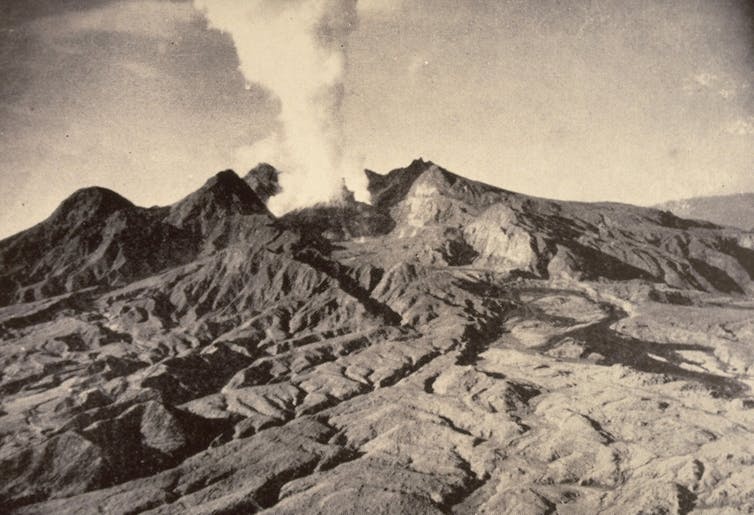
By this grisly measure, the Enga landslide is up there with the eruption of Mt Lamington[2] in January 1951. The eruption took the lives of at least 2,900 people. Many were killed by the superheated gases and volcanic material that spewed out of the mountain’s side.
It is also comparable to a more recent event, 1998’s Aitape tsunami[3], thought to have caused the deaths of up to 2,200 people on PNG’s northern coastline. At least 500 died from an eruption of the volcanoes surrounding Rabaul in 1937[4], and around 125 as a result of an earthquake that struck Hela Province[5], adjoining Enga, in 2018.
PNG’s tumultuous geology has long been the source of devastation and death for its people. At the same time, it has brought the promise of fabulous wealth from the copper, gold and hydrocarbons that have accompanied the instability – so much so that the country is sometimes described as “a mountain of gold floating in a sea of oil[6]”.
PNG’s export economy is driven by mining. But along with the economic benefits, mining has at times brought unplanned and unwelcome impacts[7].
PNG’s second-largest gold mine (and one of the top ten in the world) is located at Porgera, only 30 kilometres from the landslide. The mine has recently reopened[8] following four years of disputes and litigation. Porgera’s troubled past embodies much of the problematic nature of mining, especially in a nation that Australia’s Department of Foreign Affairs and Trade considers[9] “one of the most disaster-prone countries in the world”.
The region’s geology has also been a boon to its people. With so much rich volcanic soil in its well-watered valleys, PNG’s Highlands are considered to be[10] one of the first sites in the world where plants were domesticated, around 7,000 years ago.
This environment has long supported large populations. When the first outsiders ventured in, as recently as the 1920s and ’30s, they wondered[11] at the signs of prosperity, of settled communities previously unknown.
But, at times, over-population brought violence as groups competed for access to land. Increasingly, this fighting has come to characterise the Highlands generally, and more particularly Enga Province. Accounts of tribal fighting[12] have accompanied reports of the recovery efforts, compounding the challenges facing relief agencies at the landslide site.
While fears of being caught in a tribal fight are real and understandable, a more pressing reason preventing relief reaching the site is the near impossibility of transporting necessary equipment and supplies. What roads there are lie buried[13] under tens of metres of rocks and mud. Helicopters remain the only way of moving, and these can only operate when the low cloud cover allows.
The Enga landslide seems likely to rank among PNG’s worst natural disasters. However, a comparison to the devastation caused by the 1951 eruption of Mt Lamington – with a similar death toll – reveals much about the changing nature of Australia’s relations with Papua New Guinea.
The Mt Lamington eruption is by far the most costly in terms of lives lost[14] ever to have taken place on what was at the time Australian territory – a fact most Australians would now not know. What may be even more surprising is that the 3,000 Papuans who died were all Australian citizens, following the passing of the Citizenship Act of 1948.
In Australia, newspapers from the large metropolitan dailies to the smaller regional papers led with stories of the disaster and its aftermath. The devastation entered our historical consciousness, as the collection of photographs[15] in the National Library of Australia, taken by the first medical team to arrive, starkly demonstrates.
Is Australia doing enough?
Seven decades later, we are faced with a similar level of catastrophe. Now, however, the principal responsibility for bringing relief to the victims belongs to PNG’s national government.
This is entirely appropriate, because PNG has been an independent nation for nearly 50 years. But as Australian Prime Minister Anthony Albanese declared[16] in response to the disaster, “At this most tragic of times, I want the people of PNG to know Australia is there for them and always will be.”
Initial efforts to deliver rescue and recovery services have begun, with the promise of a substantially larger commitment.
Despite the two countries taking separate paths since PNG’s independence, Albanese recognises we share a deep history and a common bond expressed in both good and bad times. This may come as a surprise to many Australians for whom Papua New Guinea perhaps means little beyond the single word “Kokoda” – and not even that, for many.
How Australians have come to leave PNG out of our understanding of our history is a subject that is tackled in a just-published special issue of Australian Historical Studies[17], which we co-edited along with Deakin University Associate Professor Helen Gardner.
Many Australians were touched when, in the aftermath of the Black Summer bushfires of 2019-20, Papua New Guineans took it on themselves[18] to send assistance to affected communities. Now it is our turn. The challenge of getting services to the people of Enga needs more than responses from the PNG and Australian governments: where is the concern, the outrage and the determination to help our friends and neighbours?
References
- ^ the PNG government is reporting (apnews.com)
- ^ eruption of Mt Lamington (trove.nla.gov.au)
- ^ 1998’s Aitape tsunami (www.abc.net.au)
- ^ volcanoes surrounding Rabaul in 1937 (trove.nla.gov.au)
- ^ earthquake that struck Hela Province (www.who.int)
- ^ a mountain of gold floating in a sea of oil (www.abc.net.au)
- ^ unplanned and unwelcome impacts (oktedi.com)
- ^ recently reopened (www.abc.net.au)
- ^ considers (www.dfat.gov.au)
- ^ considered to be (www.abc.net.au)
- ^ they wondered (www.nfsa.gov.au)
- ^ Accounts of tribal fighting (www.theage.com.au)
- ^ lie buried (www.abc.net.au)
- ^ most costly in terms of lives lost (en.wikipedia.org)
- ^ collection of photographs (trove.nla.gov.au)
- ^ Anthony Albanese declared (www.canberratimes.com.au)
- ^ special issue of Australian Historical Studies (www.tandfonline.com)
- ^ Papua New Guineans took it on themselves (www.abc.net.au)
Authors: Jonathan Ritchie, Senior Lecturer in History, Deakin University