Google AI

Weekend Times


The Times

Business News

Like the famous budget tree, Chalmers can change the story to suit the season

  • Written by: Michelle Grattan, Professorial Fellow, University of Canberra
Like the famous budget tree, Chalmers can change the story to suit the season

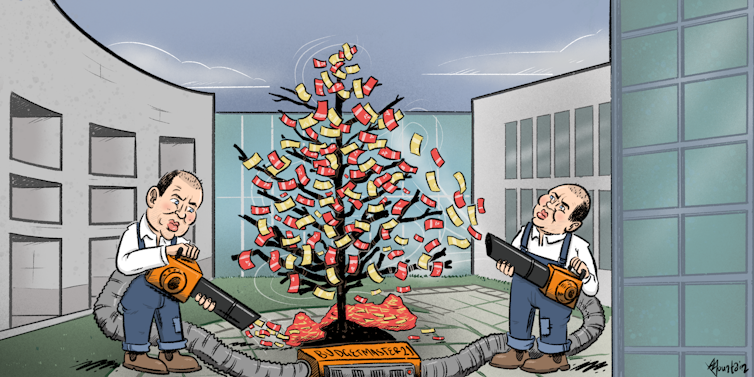
Many people who follow federal budgets know about the magnificent “budget tree” in a parliamentary courtyard, which turns a glorious red in time for the May event.

This week Treasurer Jim Chalmers posed by the tree for pre-budget photos. As the snappers looked for a new take on an old favourite shot, Chalmers kicked the leaves. The treasurer has an eye for angles; he understands the importance of presentation and narrative as well as content.

The budget tree has its own narrative; those in Parliament House have once again watched as the tree’s changes signal the coming date. In these weeks, and indeed in the months before, Chalmers has been weaving his budget story.

Over this time, as international and Australian economic conditions have altered, so have some aspects of his preparatory narrative. No matter: when necessary he starts a fresh chapter. On the whole, Chalmers is a “no surprises” politician – his approach is to prepare the public for what’s on the cards.

As is the modern way, the government is putting out to the media ahead of time figures and announcements from the budget, in embargoed “drops”. That way, these get a clear run in the morning media, ahead of comments and criticisms from pesky stakeholders or sceptical experts. Maximum control has been achieved over the government’s pre-budget publicity. There are few genuine “leaks” of measures these days.

Among the “drops”, we’ve seen the change to the HELP indexation of student debt, and a new payment for students on teaching, nursing and social work placements. Also “dropped” has been the smaller-than-before revenue upgrade that will be in the budget. That came with Chalmers’ warning not to expect a cash splash.

Lukas Coch/AAP Once we get to Tuesday night, things will be harder for the treasurer to control. He will hope his narrative holds, but critics will spring up from all directions, especially with a budget like this year’s, which has to juggle sharply different demands in difficult circumstances. Chalmers referred this week to charting “a responsible middle course between those who want us to slash and burn in the budget and those who think that it should be some kind of free-for-all of spending”. The hardliners in the media will thunder it’s all too loose, with excessive spending and not enough of the revenue windfalls banked. The welfare lobby has the government’s own Economic Inclusion Advisory Committee’s total wish list to refer to, which inevitably the government isn’t able to fulfil. Chalmers has already told us that, in the short term, the budget – which delivers Labor’s second consecutive surplus – will emphasise the continuing fight against inflation. In the longer term, the emphasis will switch to promoting growth. Reserve Bank Governor Michele Bullock said this week: “Jim Chalmers says publicly, and he says to me in private, that he does have inflation in his mind while he is thinking about the budget”. In a clear and repeated message, Bullock also warned: “We don’t think we [the bank] necessarily have to tighten [rates] again. But we can’t rule it out. If we have to, we will.” Politically, the government needs an interest rate cut before the election, due in a year. A rise would be a political disaster. With the inflation dragon wounded but not slain and a rate cut (the most likely next move) already pushed out months, budget spending has to be restrained. But at the same time, extra spending on cost-of-living relief is required, beyond the expensive (rejigged) income tax cuts. We can expect there’ll be targeted help on energy costs and rental assistance, among other things. Apart from the cost-of-living relief they bring, the energy and rental measures have a second benefit: in the immediate term they subtract from, rather than add to, inflation. Households squeezed by living costs, however, and eyeing that short term surplus, may see various budget measures as not coming their way or as inadequate. Of course all taxpayers will get a tax cut, but one problem is people have factored that in (even though it doesn’t come until July 1). Chalmers is caught between “back-end loading” some of the budget’s new spending while trying to minimise the structural challenges in the later years, when the budget is already under pressure from the National Disability Insurance Scheme, the costs of an ageing population and the defence program.
The budget tree has long been used to illustrate budgets and how treasurers go about preparing for them. Wes Mountain, CC BY-NC[1]

A centrepiece of the budget will be the government’s controversial Future Made in Australia interventionist policy. We won’t see the umbrella legislation for this, but there will be more details about its framework. Importantly, the budget will contain tax incentives as part of the government’s effort to attract investment from overseas.

Observers will be focused on what more is said about the guardrails around Future Made in Australia, which has seen (among other initiatives) $1 billion committed to the manufacture of solar panels, which critics argue would be much better imported. We’d also expect information about the parts of the program that will be on and off budget, and about the economic rationale for the government incentivising private investment in particular sectors.

To some eyes, Future Made in Australia has a blokey feel about it – because of the nature of the projects – when the government is very sensitive to gender issues.

This sensitivity has been heightened by the recent publicity around the domestic violence crisis. More generally, the government is very attuned, in political terms, to women. In high-profile appointments, it has made clear its active search for women candidates. It has to take into account in the budget that many female voters will have even more of a gender lens on it than usual.

This is only Chalmers’ third budget but he’s been around for a lot more: as a staffer he worked on five of former treasurer Wayne Swan’s six budgets. Treasurers receive a leather-bound book of their budget papers. When Swan retired, he gave Chalmers the copy of his second budget book (2009-2010). The accompanying inscription read: “When challenges arise in your future ministerial service keep this Hansard nearby as a reminder of the cause we represent and the people we serve”.

Chalmers has fulfilled Swan’s prediction of a ministerial career. And many are presently rating him as the government’s best performer. All that attention to detail counts. But each budget presents a fresh test over the latest hurdles. And, of course, opportunities to kick some new goals.

References

  1. ^ CC BY-NC (creativecommons.org)

Authors: Michelle Grattan, Professorial Fellow, University of Canberra

Read more https://theconversation.com/grattan-on-friday-like-the-famous-budget-tree-chalmers-can-change-the-story-to-suit-the-season-229711

The Weekend Times Magazine

Experienced Accident Lawyers Brisbane and Accident Compensation Claims

When a serious accident disrupts your life it can feel like everything changes overnight. Injuries often mean hospital visits ongoing medical treatment and weeks or even months off work. On...

Rodent Control: Effective Strategies to Protect Your Home and Health

Rodent control is an essential part of maintaining a safe and healthy environment in both residential and commercial properties. Rodents, including rats and mice, are not only a nuisance but...

Parrtjima opens in Australia’s Red Centre

Free event in Alice Springs will lift spirits every night until 20 September Parrtjima – A Festival in Light launched last night with an incredible display of lighting installations and interactive...

Why Removalists Melbourne Are the Smartest Choice for an Easy and Organised Move

Relocating from one home or office to another can feel overwhelming, especially when you’re trying to balance packing, sorting, transporting, and managing deadlines all at once. Choosing experienced removalists Melbourne is...

Alcohol and your brain: study finds even moderate drinking is damaging

It’s a well-known fact that drinking too much alcohol can have a serious impact on your health, including damaging your liver. But how much is too much? For conditions such...

Effective Pest Control Solutions in Ballarat: What You Need to Know

Living in Ballarat means enjoying a beautiful regional lifestyle, but it also comes with its share of challenges—one of which is managing pests. From termites threatening your home’s structure to...

Why External Blinds and Awnings Are Essential for Comfortable and Protected Outdoor Spaces

Creating outdoor areas that remain functional, comfortable, and visually appealing throughout the year requires effective protection from sun, wind, and changing weather. Installing external blinds and awnings provides a practical solution...

Out of 500 Nominations, My Guardian Breaks into Top 3 at Australia’s Prestigious 2025 ACE Awards

Sydney, 22 July 2025 – From humble beginnings to national recognition, My Guardian is celebrating a milestone achievement - being selected as one of the top three finalists in the...

Top Applications of Sandstone Crazy Pavers

Crazy paving may not seem like an expensive flooring option, but it is well worth your attention and thought. It refers to the ‘crazed’ appearance of a completed area and...