Sexual assault victims give evidence in court, but alleged perpetrators don’t have to. Bruce Lehrmann’s defamation case shows why that needs to change
- Written by Kelly Saunders, PhD Candidate, University of Canberra
There has been much analysis and praise of Justice Michael Lee’s recent judgement in Bruce Lehrmann’s defamation case against Channel Ten. Many people were openly relieved to read Lee’s “forensic” and “nuanced” application of law and good sense. Journalist Annabel Crabb wrote[1] the judgement was a “lesson in shades of grey”.
What is not said, however, is that a significant factor in this case is that Lehrmann gave evidence. This is a major difference from the aborted criminal prosecution[2] in 2022, in which Lehrmann relied on his right to silence at trial.
Lee’s decision in this defamation case is a clarion call. It compels us to think more creatively about approaches to prosecuting sex crimes, acknowledging a stark reality: in an “adversarial” legal system, a fair trial in these cases is rarely achieved by providing one of usually only two parties with a right to silence.
Read more: Judge finds Bruce Lehrmann raped Brittany Higgins and dismisses Network 10 defamation case. How did it play out?[3]
Wars of words
In essence, the right to silence[4] is the right for an accused person not to incriminate themself through their own testimony. In Australia, it is mostly seen as a central part of the presumption of innocence for serious crimes. It is widely used.
At first glance, this seems fair enough. The prosecution should have to prove its case beyond reasonable doubt to avoid wrongful conviction. The right to silence can protect against abuses of process by the state against the individual.
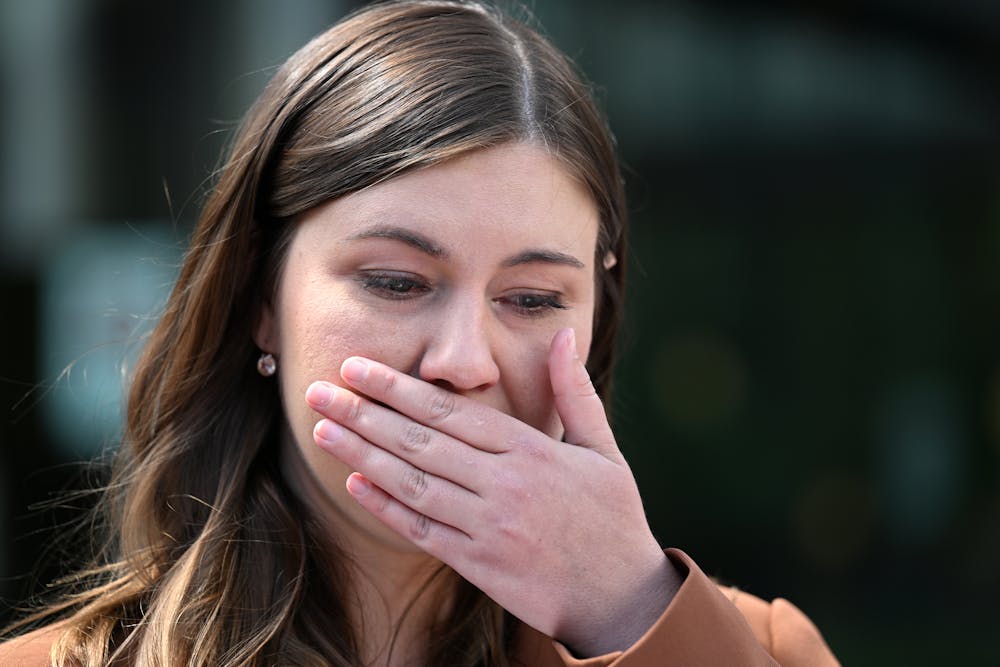
Yet, like many sexual assault and child sexual abuse cases, this trial boiled down to an accusation and a denial: one person’s word against another. It was key to Channel Ten’s legal case, seeking to defend the claims it reported as true.
Given the nature of sex crimes, which mostly happen in private, there is often no hard evidence[5]. There is no CCTV footage or “third party” witness. There is often no paper trail[6] or easy basis for DNA testing where the accused is known or the case is about consent.
Read more: How the Lehrmann v Channel 10 defamation case shone an unflattering light on commercial news gathering[7]
There are also reasons why victims of a sex crime might not have the perpetrator’s skin under their fingernails, for example, and why they don’t rush to a police station for immediate forensic testing. There can be a significant power imbalance between the people involved.
So, cases like Lehrmann’s come down to the credibility of the people involved and whatever can be gleaned from the broader circumstances.
Time for a rethink
What ultimately brought Lehrmann undone in this civil trial was that he chose to give evidence in defence of his reputation. He likely chose to testify because under New South Wales defamation law, the person alleging they’ve been defamed has the onus of proving the statements were, in fact, defamatory. For five days[8], the open court heard and felt the quality of his evidence and character.
This case was a rare chance to see what happens when everyone tells their story about an alleged rape. The decision is a basis from which legal reformers and academics should be seriously questioning the role of the right to silence in sex crime cases.
Despite ongoing reforms[9] to improve things, victim-survivors of sex crimes still regularly face abuses of process in the current system.
This includes a culture[10] of defence barristers using rape myths to destroy a victim’s credit as a witness. It also includes women being silenced[11] by the law from talking about their experience and trauma.
Lee’s masterclass in sorting the evidentiary wheat from the chaff shows how judges with solid understandings of trauma and sexual assault are perhaps better suited than juries to navigate complex legal concepts such as “probative” and “prejudicial” evidence and witness “credit”, as they apply to sex cases.
Read more: Does Australia need dedicated sexual assault courts?[12]
An inquisitorial process may also work better, whereby judges can make reasonable inquiries of all parties throughout an investigation and trial, bound by rules of evidence, but active in getting to the truth of the matter. Such judges could balance the rights of both the accused and the alleged victim.
This kind of change is obviously big and structural but not unprecedented in Australia. Coronial hearings routinely exercise inquisitorial powers.
While we ultimately don’t know what the jury would have found in Lehrmann’s criminal case, the deeply flawed approach to sex crimes in Australia today means it’s time for a rethink.
Hopefully, Lee’s competent treatment of this complex case is not an aberration but the cultural moment when we start to think about what’s possible.
References
- ^ wrote (www.abc.net.au)
- ^ aborted criminal prosecution (www.news.com.au)
- ^ Judge finds Bruce Lehrmann raped Brittany Higgins and dismisses Network 10 defamation case. How did it play out? (theconversation.com)
- ^ right to silence (www.alrc.gov.au)
- ^ hard evidence (www.aihw.gov.au)
- ^ no paper trail (www.abc.net.au)
- ^ How the Lehrmann v Channel 10 defamation case shone an unflattering light on commercial news gathering (theconversation.com)
- ^ five days (www.theguardian.com)
- ^ ongoing reforms (www.alrc.gov.au)
- ^ culture (www.aic.gov.au)
- ^ being silenced (www.google.com.au)
- ^ Does Australia need dedicated sexual assault courts? (theconversation.com)
Authors: Kelly Saunders, PhD Candidate, University of Canberra