who makes the words? Who decides what things like ‘trees’ and ‘shoes’ are called?
- Written by: Kate Burridge, Professor of Linguistics, Monash University
Who makes the words? Why are trees called trees and why are shoes called shoes and who makes the names? - Elliot, age 5, Eltham, Victoria

Good question Elliot!
Let’s start with the first part of the question: who makes words?
Well, there’s no official person or group that’s responsible for making words. New words are invented by all of us getting creative. Mostly, it’s a matter of reusing words, or parts of words, and transforming them into new products. Language is the ultimate recycler!
Read more: Curious Kids: what did people use before toothpaste was invented?[1]
Creating words out of ‘tree’ and ‘shoe’
There are five main ways of building new words.
One is to add things called “suffixes”, which are letters we add to the ends of words to change their meaning slightly. By adding a “-y” to “tree” and “shoe”, we can make “treey” (to describe something with lots of trees) and “shoey” (to describe people drinking from a shoe, an odd but old tradition[2]). There are also things called “prefixes”. These are letters that go at the front of a word. For example, the word “subtree” describes a kind of shrub, and “overshoes” are something worn over ordinary shoes.
It’s also possible to combine whole words to make new ones. We can even put “tree” and “shoe” together to create “shoe-tree”, which is a block of wood we put into shoes to keep their shape. These types of words are called “compound words” — they are often written as two words (“apple tree”), but sometimes one (“shoelace”). English has never sorted out the rules here.
A third process, and one that’s really popular these days, is “blending”. This is when we mix words together (sometimes they’re called “frankenwords”, itself a blend of “Frankenstein” and “word”). Here are two made-up blends based on “tree” and “shoe”. They don’t exist — yet (perhaps they’ll take off!).
Treerific (“tree” has been squished with “terrific” to convey something wonderful that is related to trees)
Shoenicorn (“shoe” has been squished with “unicorn” to mean an unicorn with magical shoes)
Words and parts of words can combine and recombine to create a never-ending number of new words. Out of blended “treerific”, I can build “treerifical”, “treerificalise”, “treerificalisation”, “treerificalisational” and so on. The number of words is endless. But of course we can’t invent too many of these because it’s difficult to keep track of all the “-als”, “-izes” and “-ations”!
English words are also flexible. For example, “trees” and “shoes” are objects (called “nouns”), but we can turn them into doing words (called “verbs”) too — “to tree” (plant with trees) and “to shoe” (put shoes on).
We can also build words from the first letters of other words. These are called “acronyms”. Each letter in the word “tree” could mean “tall rustling evergreen entity”. Of course, this isn’t true, it’s just an example. In fact, most acronyms are names (for example, your school might introduce something called “TREE”, short for Tactical Response Emergency Evacuation).
Finally, English is also a word pirate that steals words from other languages — more than 350 in fact. Words like “tree” and “shoe” weren’t stolen but thousands of others have been, like “forest” and “sandal” to give just two (about 700 years ago, we pinched “forest” from French and a little later “sandal” from Latin). This term for this is “borrowing” — curious, because English has no intention of ever giving these words back!
Read more: Who created the alphabet? A historian describes the millennia-long story of the ABCs[4]
Early examples of trees and shoes
Okay, so what about the second part of the question: why are trees called trees and why are shoes called shoes? This is a trickier puzzle, because both are among the oldest words in the English language.
Here’s a very early example of “tree” from an ancient poem[5] written more than a thousand years ago. In Modern English, the sentence is “I saw a wondrous tree” but as you can see, the English in this poem looks very different:
Iċ ġesāwe syllicre trēow
At this time, there were lots of words for trees and also for different types of shoes (including what we now know as “sock”, originally a kind of slipper). Many of these words didn’t survive, but “shoe” (originally “sco”) did, even though shoes look very different now than they did hundreds of years ago.
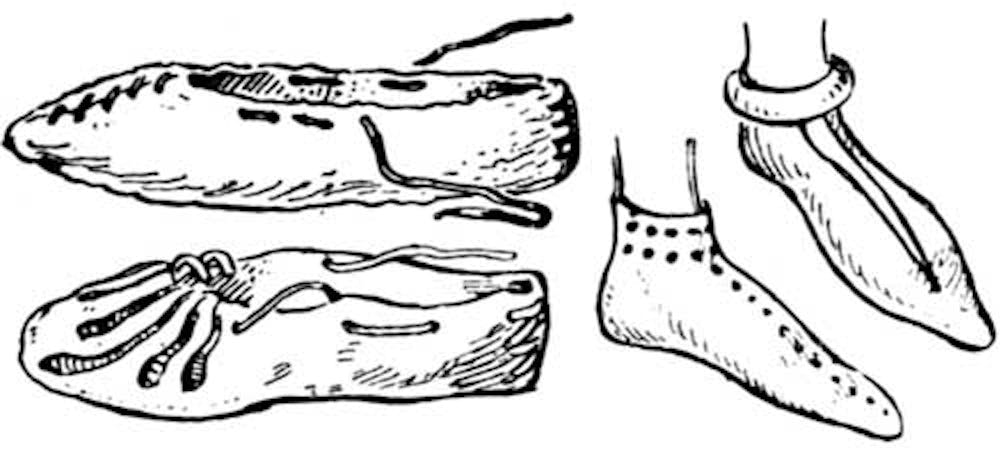 Shoes used to be called other things, like hemmings.
Florence Mary Gardiner/Project Gutenberg, CC BY-NC-ND[6][7]
Shoes used to be called other things, like hemmings.
Florence Mary Gardiner/Project Gutenberg, CC BY-NC-ND[6][7]
Both “tree” and “shoe” can be traced back to the parent language of English, called “Proto-Germanic”. This was spoken about 2,500 years ago, but unfortunately nothing survives of the language, or perhaps people weren’t into writing things down back then. Even so, we can do some detective work to recreate the ancient words they grew out of: “tree” comes from something like “trewo-” and “shoe” from “skōhw-”.
We can go even further back in time to the grandparent of English — a language called “Proto-Indo-European”. About 6,000 years ago, the word “tree” probably looked like “dōru-”.
Read more: Curious Kids: what came first, the chicken or the egg?[8]
The very beginning of trees and shoes
How language started is a big mystery.
For centuries, people have wondered how words like “tree” and “shoe” were invented. There are lots of ideas around, but we’ll never know for sure because people have been speaking for more than 30,000 years. That’s a very long time!
Only one thing is certain. Humans are the only animals that can create a never-ending number of new words. Remember what we could do earlier with just the two words “tree” and “shoe’!
Hello, Curious Kids! Do you have a question you’d like an expert to answer? Ask an adult to send your question to curiouskids@theconversation.edu.au
References
- ^ Curious Kids: what did people use before toothpaste was invented? (theconversation.com)
- ^ old tradition (reporter.anu.edu.au)
- ^ Shutterstock (www.shutterstock.com)
- ^ Who created the alphabet? A historian describes the millennia-long story of the ABCs (theconversation.com)
- ^ ancient poem (www.oldenglishaerobics.net)
- ^ Florence Mary Gardiner/Project Gutenberg (www.gutenberg.org)
- ^ CC BY-NC-ND (creativecommons.org)
- ^ Curious Kids: what came first, the chicken or the egg? (theconversation.com)
Authors: Kate Burridge, Professor of Linguistics, Monash University