What is pattern book development and how can it help ease the housing crisis?
- Written by: David Kroll, Senior Lecturer in Architecture, University of Adelaide
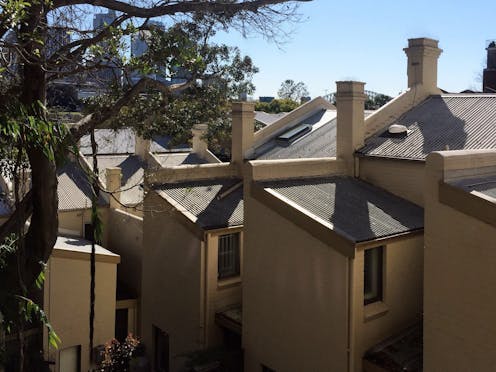
Australian cities are grappling with ways to increase housing supply and make it more affordable. One suggested solution is “pattern book” development. The idea made headlines[1] when proposed recently by Housing Now[2], an alliance of businesses and lobby groups in New South Wales.
The problem, they argue, is that housing projects take years to process, due to overly lengthy processes of design, planning and public consultation. The group aims to fast-track development by commissioning “a modern pattern book with a suite of approved designs by recognised architects developed in partnership with local neighbourhoods”.
These ready-made, pre-approved designs for townhouses, terraces and low-rise apartments could then be rolled out at a much faster pace. This, Housing Now claims, would clear the backlog and cut the time it takes to make housing happen. In the past, the alliance argues[3], “many of the world’s greatest cities were designed using pattern books”.
What then is pattern book development? Could it help ease the housing crisis?
Read more: The housing and homelessness crisis in NSW explained in 9 charts[4]
What are architectural pattern books?
The term “pattern book” originally referred to books with design templates for textiles, wallpapers, sewing or knitting. For housing, the term is applied to books illustrating a range of architectural designs that could be copied or used as inspiration.
Since the early Renaissance, pattern books allowed architects, builders and clients to share and advertise designs to a wider audience. An example in Victorian Britain was The Builder’s Practical Director[5] (1855), which contains a range of house designs with plans and facades. Architect and surveyor E.L. Tarbuck wrote this book as a reference guide for anyone wanting to build a house.
Were cities designed with pattern books?
Certainly, there are houses resembling designs from pattern books across the Western world, including cities such as London and Dublin.
However, the idea that most houses were simply direct copies of designs from such books is unlikely to be historically correct. Until the mid-20th century at least, pattern books were more often used as inspiration for designers[6], rather than being merely copied without any deviations.
The growth of many cities in the 19th and early 20th centuries was certainly based on formulaic housing patterns. The rapid urbanisation that came with the Industrial Revolution produced a wide range of terraced, detached and semi-detached houses or apartment blocks with similarities and repetition in their layout and planning.
These repeating patterns were the result of a combination of drivers.
In Britain and Ireland, the leasehold development system played an important role, as small land parcels were laid out in repetitive patterns (often by estate surveyors) and then leased to different builders[7]. These “masterplans” created a kind of template with approved housing types on which builders could base their designs.
The designs were often based on tried and tested precedents, which had evolved slowly over time. For example, the first houses to emerge in Dublin’s early 19th-century suburbs[8] were based on the terraced house, a familiar housing typology since medieval times.
Read more: Englishman's castle, slum, or cultural icon? The fall and rise of the terraced house[9]
In London, another driver was that houses were codified into so-called classes or “rates” in the Building Act of 1774[10]. This seems to have further reinforced patterns of similar housing types.
Could pattern books ease the housing crisis?
Housing Now’s proposal of pre-approved design templates and development patterns could indeed help speed up planning approvals for new housing and support planned increases in urban densities. We would still need to consider carefully how this could work in detail, of course.
This housing would need to align with urban design and planning strategies, such as the regional and district plans in NSW[11]. The proposed typologies would also need to suit the context of their specific settings such as established suburbs, former industrial areas or alongside major highways.
Read more: Planning laws protect people. A poorly regulated rush to boost housing supply will cost us all[12]
A risk is that these pattern book templates will be too monotonous and too prescriptive for people’s needs. Some flexibility in the design and choice would seem sensible.
Pre-approved pattern book templates could set the overall building form and type while still allowing for different designs. Such an approach has historical precedents.
One example is the 19th-century Hobrecht Plan for Berlin[13], which determined the building heights and their outline.
A more recent example (from 1993-2000) of an area developed within an overall master plan of housing types and forms is Borneo-Sporenburg in Amsterdam[14]. Within their set terrace-house typology and massing, this development achieved fairly high densities while allowing each house to be custom-designed.
A similar approach could be used to plan increases in density of established neighbourhoods through pre-approved, pattern book housing forms.
Proactive and innovative proposals that help speed up planning approvals and construction of housing are very welcome and urgently needed. One question that remains, however, is how to ensure this new housing will be affordable to those in need.
Read more: How do we get urban density 'just right'? The Goldilocks quest for the 'missing middle'[15]
References
- ^ made headlines (www.theguardian.com)
- ^ Housing Now (www.housingnow.com.au)
- ^ argues (static1.squarespace.com)
- ^ The housing and homelessness crisis in NSW explained in 9 charts (theconversation.com)
- ^ The Builder’s Practical Director (openlibrary.org)
- ^ inspiration for designers (www.tandfonline.com)
- ^ leased to different builders (books.google.com.au)
- ^ Dublin’s early 19th-century suburbs (www.routledge.com)
- ^ Englishman's castle, slum, or cultural icon? The fall and rise of the terraced house (theconversation.com)
- ^ Building Act of 1774 (en.wikipedia.org)
- ^ regional and district plans in NSW (www.planning.nsw.gov.au)
- ^ Planning laws protect people. A poorly regulated rush to boost housing supply will cost us all (theconversation.com)
- ^ Hobrecht Plan for Berlin (en.wikipedia.org)
- ^ Borneo-Sporenburg in Amsterdam (archello.com)
- ^ How do we get urban density 'just right'? The Goldilocks quest for the 'missing middle' (theconversation.com)
Authors: David Kroll, Senior Lecturer in Architecture, University of Adelaide