Henry Kissinger has died. The titan of US foreign policy changed the world, for better or worse
- Written by: Lester Munson, Non-resident fellow, United States Studies Centre, University of Sydney
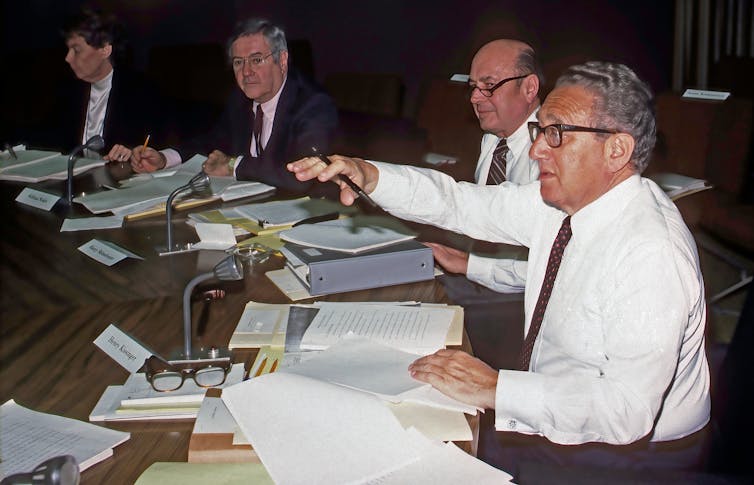
Henry Kissinger was the ultimate champion of the United States’ foreign policy battles.
The former US secretary of state died[1] on November 29 2023 after living for a century.
The magnitude of his influence on the geopolitics of the free world cannot be overstated.
From world war two, when he was an enlisted soldier in the US Army, to the end of the cold war, and even into the 21st century, he had a significant, sustained impact on global affairs.
Read more: Kissinger at 100: his legacy might be mixed but his importance has been enormous[2]
From Germany to the US and back again
Born in Germany in 1923, he came to the United States at age 15 as a refugee. He learned English as a teenager and his heavy German accent stayed with him until his death.
He attended George Washington High School in New York City before being drafted into the army and serving in his native Germany. Working in the intelligence corps, he identified Gestapo officers and worked to rid the country of Nazis. He won a Bronze Star[3].
Kissinger returned to the US and studied at Harvard before joining the university’s faculty. He advised moderate Republican New York Governor Nelson Rockefeller – a presidential aspirant – and became a world authority on nuclear weapons strategy.
When Rockefeller’s chief rival Richard Nixon prevailed in the 1968 primaries, Kissinger quickly switched to Nixon’s team.
A powerful role in the White House
In the Nixon White House, he became national security advisor and later simultaneously held the office of secretary of state. No one has held both roles at the same time since.
For Nixon, Kissinger’s diplomacy arranged the end of the Vietnam war[4] and the pivot to China: two related and crucial events in the resolution of the cold war.
He won the 1973 Nobel Peace Prize[5] for his Vietnam diplomacy, but was also condemned by the left as a war criminal for perceived US excesses during the conflict, including the bombing campaign in Cambodia[6], which likely killed hundreds of thousands of people.
That criticism survives him[7].
The pivot to China[8] not only rearranged the global chessboard, but it also almost immediately changed the global conversation from the US defeat in Vietnam to a reinvigorated anti-Soviet alliance.
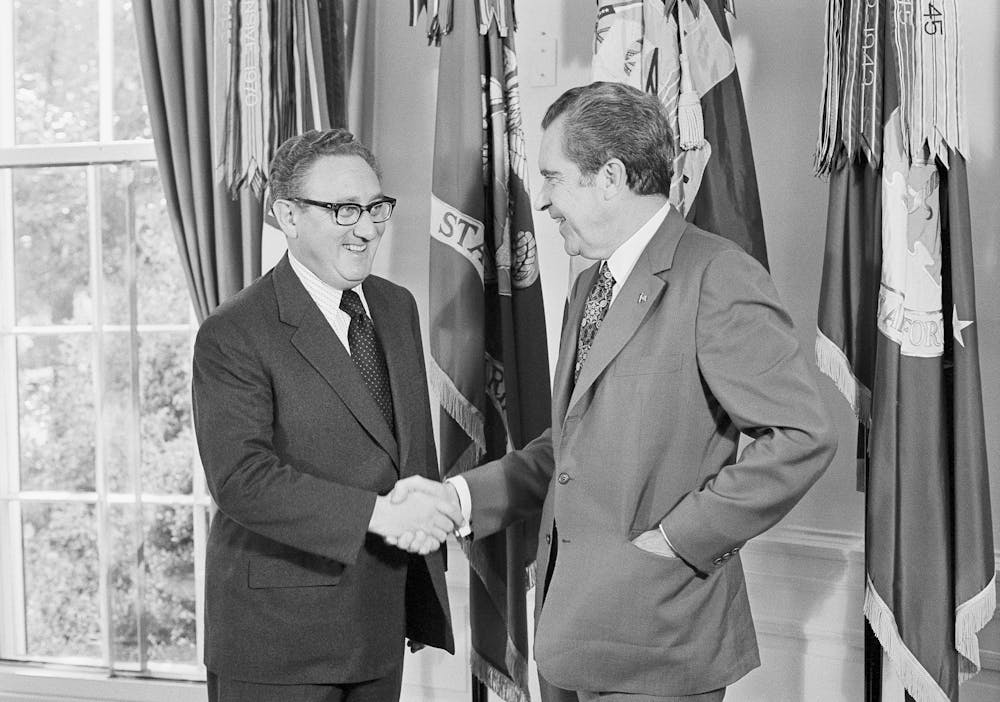
After Nixon was compelled to resign by the Watergate scandal, Kissinger served as secretary of state under Nixon’s successor, Gerald Ford.
During that brief, two-year administration, Kissinger’s stature and experience overshadowed the beleaguered Ford. Ford gladly handed over US foreign policy to Kissinger so he could focus on politics and running for election to the office for which the people had never selected him.
During the turbulent 1970s, Kissinger also achieved a kind of cult status.
Not classically attractive, his comfort with global power gave him a charisma that was noticed by Hollywood actresses and other celebrities. His romantic life was the topic of many gossip columns[9]. He’s even quoted[10] as saying “power is the ultimate aphrodisiac”.
His legacy in US foreign policy continued to grow after the Ford administration. He advised corporations, politicians and many other global leaders, often behind closed doors but also in public, testifying before congress well into his 90s.
Read more: The Nobel Peace Prize offers no guarantee its winners actually create peace, or make it last[11]
Criticism and condemnation
Criticism of Kissinger was and is harsh. Rolling Stone magazine’s obituary of Kissinger[12] is headlined “War Criminal Beloved by America’s Ruling Class, Finally Dies”.
His association with US foreign policy during the divisive Vietnam years is a near-obsession for some critics, who cannot forgive his role in what they see as a corrupt Nixon administration carrying out terrible acts of war against the innocent people of Vietnam.
Kissinger’s critics see him as the ultimate personification of US realpolitik[13] – willing to do anything for personal power or to advance his country’s goals on the world stage.
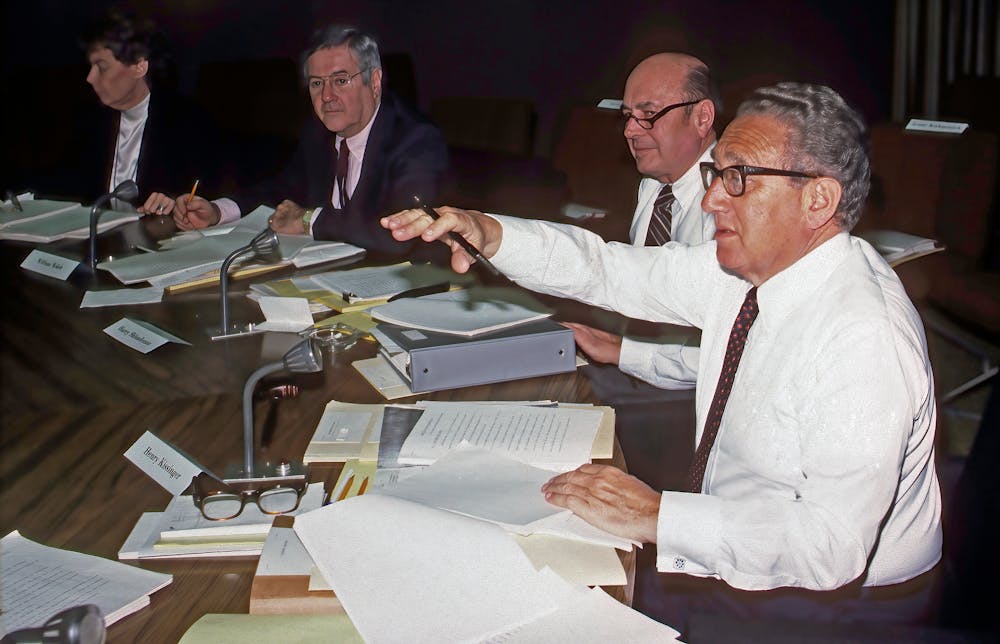 Former US Secretary of State, Henry Kissinger, leaves behind a controversial legacy.
Shutterstock[14]
Former US Secretary of State, Henry Kissinger, leaves behind a controversial legacy.
Shutterstock[14]
But in my opinion, this interpretation is wrong.
Niall Ferguson’s 2011 biography[15], Kissinger, tells a very different story. In more than 1,000 pages, Ferguson details the impact that world war two had on the young Kissinger.
First fleeing from, then returning to fight against, an immoral regime showed the future US secretary of state that global power must be well-managed and ultimately used to advance the causes of democracy and individual freedom.
Whether he was advising Nixon on Vietnam war policy to set up plausible peace negotiations, or arranging the details of the opening to China to put the Soviet Union in checkmate, Kissinger’s eye was always on preserving and advancing the liberal humanitarian values of the West – and against the forces of totalitarianism and hatred.
The way he saw it, the only way to do this was to work for the primacy of the United States and its allies.
No one did more to advance this goal than Henry Kissinger. For that he will be both lionised and condemned.
Read more: A tortured and deadly legacy: Kissinger and realpolitik in US foreign policy[16]
References
- ^ died (www.abc.net.au)
- ^ Kissinger at 100: his legacy might be mixed but his importance has been enormous (theconversation.com)
- ^ Bronze Star (www.aljazeera.com)
- ^ end of the Vietnam war (www.history.com)
- ^ 1973 Nobel Peace Prize (www.nobelprize.org)
- ^ bombing campaign in Cambodia (theconversation.com)
- ^ survives him (www.huffpost.com)
- ^ pivot to China (theconversation.com)
- ^ gossip columns (www.theguardian.com)
- ^ quoted (www.washingtonpost.com)
- ^ The Nobel Peace Prize offers no guarantee its winners actually create peace, or make it last (theconversation.com)
- ^ obituary of Kissinger (www.rollingstone.com)
- ^ US realpolitik (theconversation.com)
- ^ Shutterstock (www.shutterstock.com)
- ^ 2011 biography (books.google.com.au)
- ^ A tortured and deadly legacy: Kissinger and realpolitik in US foreign policy (theconversation.com)
Authors: Lester Munson, Non-resident fellow, United States Studies Centre, University of Sydney