Urban planning has long ignored women's experiences. Here are 5 ways we can make our cities safer
- Written by: Nicole Kalms, Director, XYX Lab, and Associate Professor, Faculty of Art, Design and Architecture, Monash University
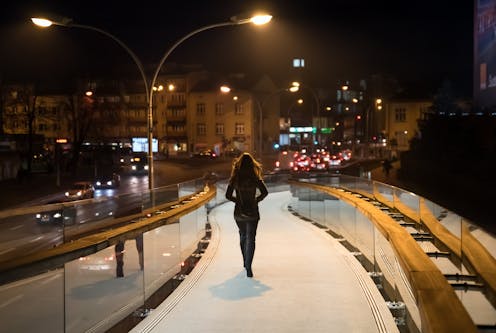
Women consistently raise concerns about their safety[1] when moving through their cities and communities.
Women often experience harassment[2] in the street, which can lead them to avoid areas and adjust their lifestyles to feel safe.
Based on our research, here are five ways we can make cities safer for women.
Read more: More lighting alone does not create safer cities. Look at what research with young women tells us[3]
1. Don’t just invest in lighting and surveillance
Underlying the desire for lighting and surveillance is women’s concern about the inappropriate (real or anticipated) behaviour of men[4] and young people in public places.
Yet emerging studies[5] reveal that strategies solely concerned with improved lighting or surveillance are not the only pathways to reducing worry or fear for women.
In fact, the public investment in CCTV with regard to women’s safety may do more harm than good[6].
The women we surveyed recognised that young people have a right to use public places, but they also said antisocial behaviour from young men, particularly in groups, created significant apprehension, fear and avoidance of places, especially at night.
One participant told us:
I think it’s mainly that drug-affected type of people. And they hang around in a bunch. And people who are affected by alcohol […] they’ll be boisterous.

While CCTV can reduce property crime, it does not appear effective in addressing women’s safety or for preventing violence and assault.
It may also further exclude some members of the communtiy[8] – particularly women from diverse backgrounds.
Instead, studies suggest[9] that improving safety for women requires a shift in overall strategy, moving away from short-term hardware fixes such as installing CCTV and more lighting.
2. Consider the role of technology
Women are keen to see digital interventions across both day and night-time.
They see real-time information for public transport[10] as vital for their confidence in public spaces.
When combined with well-designed wayfinding[11] – such as lighting, footpaths, landscaping and signage – women said they would feel safer.
Increasingly, lighting and digital interactivity are being combined in public placemaking[12] to enhance women’s safety.
Read more: We should create cities for slowing down[13]
3. Design spaces with women, for women
Women have been denied a say in their own communities for too long.
A co-design workshop[14] is an approach that aims to engage stakeholders with the people that will benefit from the design outcomes. In this case, it’s women.
Most often a co-design workshop will include high-level decision-makers, planners, designers and various user groups.
If done from the outset, co-design ensures the lived experiences of community members and with the issues faced by communities are factored in.
It’s also an inclusive, collaborative and creative method.
One of our survey participants said:
My favourite experience in the workshop was just being able to meet all the different women who I probably wouldn’t have met without the workshop. I think just having a space like – creating a space like that is one of the first steps so that women can gather and meet.
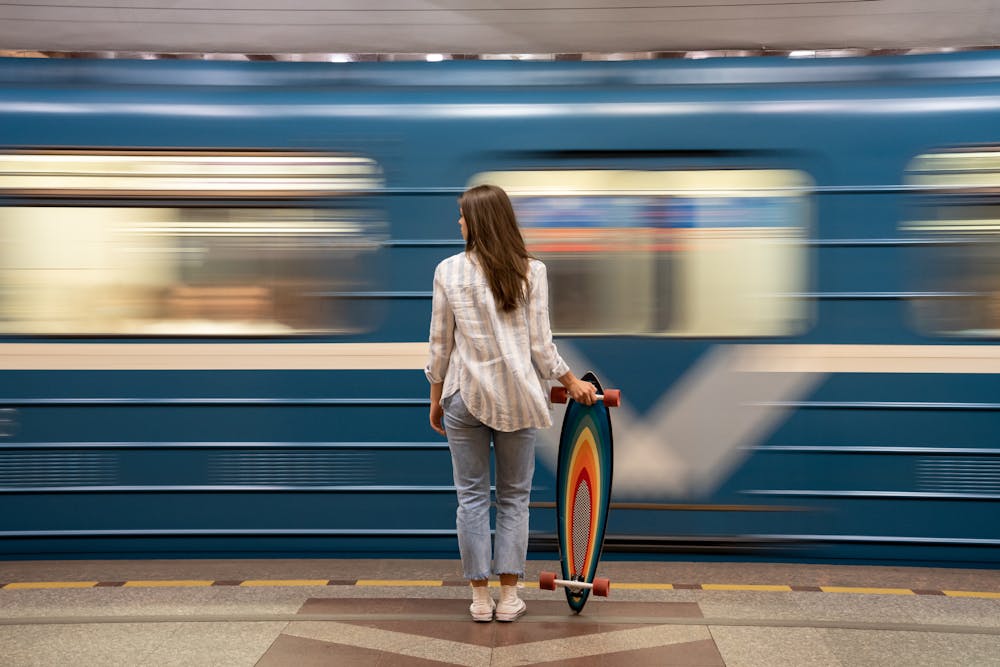 Women value live tracking of public transport to make them feel safer.
Shutterstock[15]
Women value live tracking of public transport to make them feel safer.
Shutterstock[15]
4. Use ‘walking interviews’
A walking interview, as opposed to a regular sit-down interview or focus group, can help communities understand what makes women feel safe.
This helps us develop an understanding not only of the physical nature of public places evoking concern, but also of the ways in which different women, and indeed different user groups, engage with each other in a physical place.
The development of place-based strategies[16] – collaborative design to help build a sense of place – can encourage inclusion and safety for women from different ethnicities and cultural backgrounds, life stages and abilities.
By accompanying women on foot and discussing specific locations, we get a holistic understanding about how women move through these public places, or avoid them, and why.
Read more: There's $1.3 billion for women's safety in the budget and it's nowhere near enough[17]
5. Survey the right people, with the right questions
Understanding the way women perceive their communities is key to creating safer spaces.
Community safety surveys are particularly useful for understanding the prevalence of attitudes, sentiments and feelings at one point in time. They can then be repeated each year to track changes over time.
If designed well, community safety surveys can be an effective tool to understand perceptions and experiences of safety and inclusion for women from all backgrounds.
But the survey must be diverse and inclusive.
Our research, the Safe Spaces Project[18], set out to do just that. We surveyed more than 200 women from a variety of backgrounds.
By figuring out the best ways to engage with women in the research process, we can then empower councils and other community organisations to do the same.
We’ve done that in the form of toolkits[19].
In the past couple of weeks we have had more than 400 registrations at the launch and more than 1000 downloads of the toolkits from across urban, regional and rural councils in Australia, North America, the United Kingdom, Italy and New Zealand.
This research[20] has identified effective ways to engage with a diverse range of women.
To make our cities safer, we just have to listen to them.
References
- ^ concerns about their safety (research-repository.griffith.edu.au)
- ^ often experience harassment (www.standup-international.com)
- ^ More lighting alone does not create safer cities. Look at what research with young women tells us (theconversation.com)
- ^ behaviour of men (theconversation.com)
- ^ emerging studies (theconversation.com)
- ^ more harm than good (theconversation.com)
- ^ Shutterstock (www.shutterstock.com)
- ^ further exclude some members of the communtiy (theconversation.com)
- ^ studies suggest (www.monash.edu)
- ^ real-time information for public transport (theconversation.com)
- ^ wayfinding (wayfoundvictoria.vic.gov.au)
- ^ combined in public placemaking (www.bloomberg.com)
- ^ We should create cities for slowing down (theconversation.com)
- ^ co-design workshop (www.monash.edu)
- ^ Shutterstock (www.shutterstock.com)
- ^ place-based strategies (theconversation.com)
- ^ There's $1.3 billion for women's safety in the budget and it's nowhere near enough (theconversation.com)
- ^ Safe Spaces Project (www.monash.edu)
- ^ toolkits (research-repository.griffith.edu.au)
- ^ This research (research-repository.griffith.edu.au)
Authors: Nicole Kalms, Director, XYX Lab, and Associate Professor, Faculty of Art, Design and Architecture, Monash University