Google AI

Weekend Times


The Times

Business News

Today's Measuring What Matters statement is just a first step – now we have to turn goals into action

  • Written by: Warwick Smith, Research economist, The University of Melbourne
Today's Measuring What Matters statement is just a first step – now we have to turn goals into action

Today’s release of the Commonwealth Treasury’s Measuring What Matters[1] statement is an important step towards better government decision-making and a shared vision for the Australia we want, but it’s only the first step.

Treasurer Jim Chalmers has long talked about broadening[2] our measures of success beyond the traditional ones of Gross Domestic Product (GDP), inflation and unemployment.

The wellbeing framework[3] announced today is an attempt to bring those ideas into being. The need for different economic thinking is demonstrated in many ways, including the current housing crisis, worsening climate change, the loss of biodiversity and increases in financial stress and mental illness.

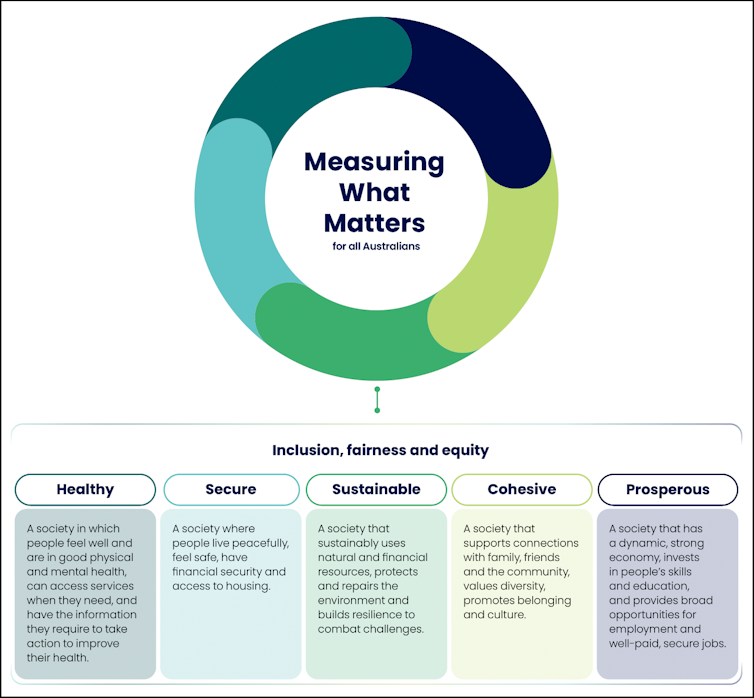
The new framework consists of a dashboard of 50 indicators, grouped under five themes, which seek to broaden our collective ambition beyond things such as GDP.
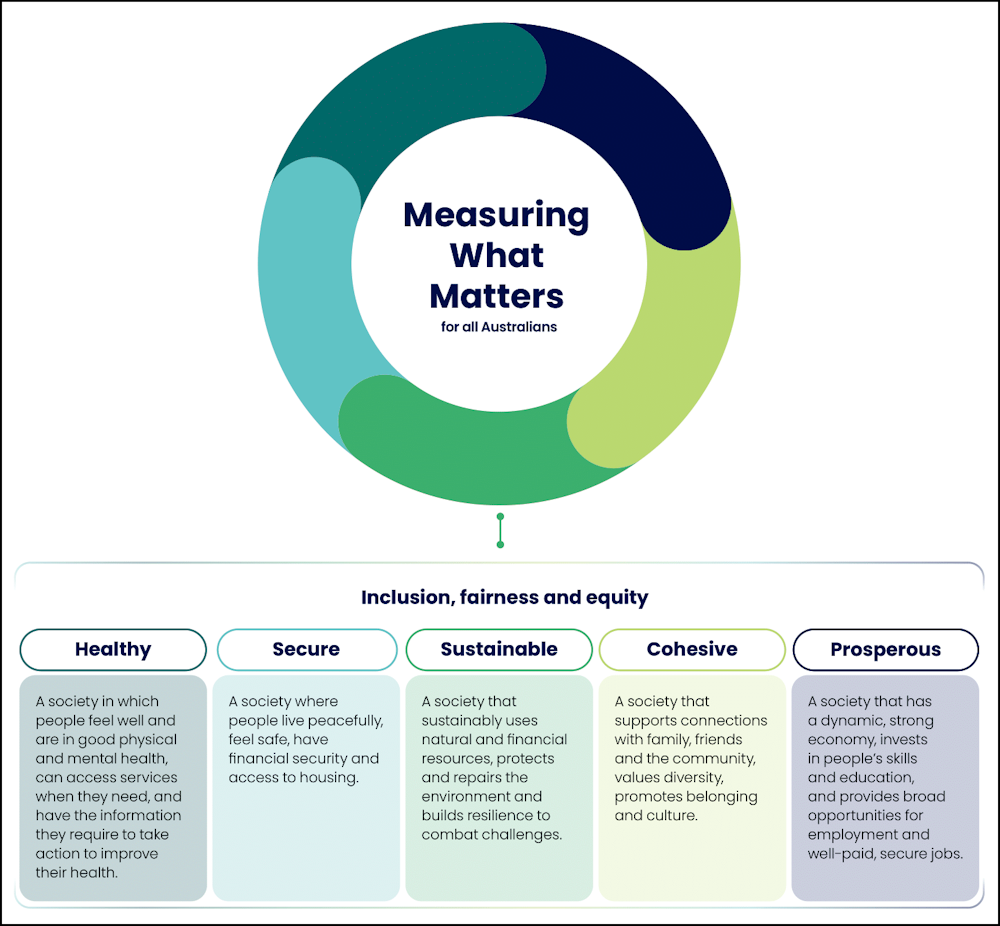
Measuring What Matters, Commonwealth Treasury[4] Developing a wellbeing framework brings Australia into line with many forward-thinking democracies, including the five members of the Wellbeing Economy[5] government partnership: Finland, Iceland, New Zealand, Scotland and Wales. But creating such an economy requires more than a dashboard. The Wellbeing Economy Alliance[6], a global collaboration of people and organisations working for a wellbeing economy, has developed five “tests” of a genuine wellbeing economy: Does the economy provide everyone with what is needed to live a life of dignity and purpose? Does the economy restore, protect, and cherish the natural environment and is the economy guided by the principles of interconnection and indivisibility of human, animal, plant, and environmental health? Does the economy value activities and behaviours by their contribution to social and ecological wellbeing? Is the economy designed to ensure a just distribution of income, wealth, power, and time? Is the shape and form of the economy locally rooted and determined by people’s active voices? From metrics to meaningful change Encouragingly, the statement says measurement is only the beginning[7]. It says the next step will be integrating the framework into decision making. Consistent with our international counterparts, we will be looking for opportunities to embed the Framework into government decision-making. This will involve guidance for agencies to inform policy development and evaluation. This won’t be easy. While the metrics in the framework will be useful for tracking progress and sparking action aimed at reversing negative trends and building on successes, international examples[8] tell us it’s hard to use a framework built from 50 different metrics to work out what to do. It can turn compliance into a box-ticking exercise, when what’s really needed is a paradigm shift. Read more: Beyond GDP: Chalmers' historic moment to build wellbeing[9] Learning from others’ failures and successes Wales found a way around this through a national conversation that eventually led to the Wellbeing of Future Generations (Wales) Act 2015[10]. That act requires public bodies to use sustainable development as guiding principle and to work to achieve seven goals that reflect the values and aspirations of the Welsh people. Those goals include prosperity, resilience, health, equality, global responsibility, cultural vibrancy and connection – not dissimilar to the themes in Measuring What Matters. Where the Welsh goals differ from those in Australia’s Measuring What Matters statement is that they have a democratic mandate, and all Welsh public authorities are legally obligated to work towards achieving all of them. Inaugural Welsh Future Generations Commissioner Sophie Howe.Realising the potential of Measuring What Matters will require the support and vigilance of the Australian people. Australians, and the government, will need to be willing to experiment and sometimes fail. It took Wales three attempts at developing a wellbeing framework before it landed on the Wellbeing of Future Generations Act. Read more: 'Wellbeing’ will give future budgets more rigour than any before[11] It is encouraging that treasury and the treasurer are openly saying that what was released on Friday is only the start of a conversation about measures of progress. Measuring what matters, when the people have been robustly engaged in defining what matters, is a vital precondition for the economic system change Australia needs. Read more: Australians' national wellbeing shows a glass half full: Measuring What Matters report[12] References^ Measuring What Matters (treasury.gov.au)^ broadening (theconversation.com)^ wellbeing framework (treasury.gov.au)^ Measuring What Matters, Commonwealth Treasury (treasury.gov.au)^ Wellbeing Economy (wellbeingeconomy.org)^ Wellbeing Economy Alliance (weall.org)^ only the beginning (treasury.gov.au)^ international examples (cpd.org.au)^ Beyond GDP: Chalmers' historic moment to build wellbeing (theconversation.com)^ Wellbeing of Future Generations (Wales) Act 2015 (www.gov.wales)^ 'Wellbeing’ will give future budgets more rigour than any before (theconversation.com)^ Australians' national wellbeing shows a glass half full: Measuring What Matters report (theconversation.com)Authors: Warwick Smith, Research economist, The University of Melbourne

Read more https://theconversation.com/todays-measuring-what-matters-statement-is-just-a-first-step-now-we-have-to-turn-goals-into-action-209879

The Weekend Times Magazine

A Fantastic Trip To Melbourne, Australia With Minimal Spending? Here’s How?

Famed for the iconic Melbourne cup horse race, Melbourne, Australia ranks as one of the best travel destinations worldwide. It offers tourists an escape from the hustle and bustle of...

Australia’s top economists oppose the next increases in compulsory super: new poll

The five consecutive consecutive hikes in compulsory super contributions due to start next July should be deferred or abandoned in the view of the overwhelming majority of the leading Australian...

Weekend Escapes Closer to Home: Making the Most of Every Litre

Rising fuel prices are changing more than household budgets—they are changing the way Australians holiday. For many families, a weekend away has traditionally meant filling the car and heading several hundred...

Republicans have used a ‘law and order’ message to win elections before. This is why Trump could do it again

In 1991, Donald Trump’s mother, Mary, was mugged on a New York street. As Trump’s niece recounts in her new book, the young assailant slammed Mary’s head into her Rolls...

How Much Should a Small Business Actually Budget for a Website in 2026?

Three quotes land in the same inbox. One says $890. One says $4,600. One says $11,000. All three are for a five-page website for the same Sydney plumbing business. All three...

How TPD Solicitors Unlock Your Super Insurance Payout Fast

Up to 70% of Australians don't realize they have TPD insurance through their super, potentially missing out on life-changing payouts when they need them most. This staggering statistic reveals a...

Men’s style: where to buy it and how to build it

Most men are not taught style. They are taught how to work, drive, earn money and solve problems. Fashion and presentation are often treated as secondary concerns, something instinctive that men...

Lady Elliot Island Tours

Uncover Island Bliss With a Luxury Vacay Exploring W Brisbane and Lady Elliot Island Who needs Bora Bora when you have one of the world's most pristine islands on your doorstep...

Aussies get budget savvy with surge in deferred payment of bills

Deferit co-founders Mat Blas and Jonty Hirsowitz Deferit, a payment platform exclusively focused on helping people pay their bills on time, has released new data on the huge uptake of its...