What this year's El Niño means for wheat and global food supply
- Written by: David Ubilava, Associate Professor of Economics, University of Sydney
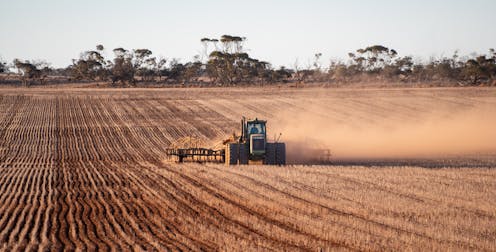
The World Meteorological Organization has declared the onset of the first El Niño event in seven years. It estimates 90% probability the climatic phenomenon, involving an unusual warming of the Pacific Ocean, will develop through 2023, and be of moderate strength[1].
El Niño events bring hotter, drier weather to places such as Brazil, Australia[2] and Indonesia, increasing the risk of wildfires and drought. Elsewhere, such as Peru and Ecuador, it increases rain, leading to floods.
The effects are sometimes described as a preview of “the new normal” in the wake of human-forced climate change[3]. Of particular concern is the effect on agricultural production, and thereby the price of food – particularly “breadbasket” staples such as wheat, maize and rice.
El Niño’s global impacts are complex and multifaceted. It can potentially impact the lives of the majority of the world’s population. This is especially true for poor and rural households, whose fates are intrinsically linked with climate and farming.
The global supply and prices of most food is unlikely to move that much[4]. The evidence from the ten El Niño events in the past five decades[5] suggests relatively modest, and to some extent ambiguous, global price impacts. While reducing crop yield on average, these events have not resulted in a “perfect storm” of the scale to induce global “breadbasket yield shocks[6]”.
But local effects could be severe. Even a “moderate” El Niño may significantly affect crops grown in geographically concentrated regions — for example palm oil, which primarily comes from Indonesia and Malaysia.
In some places El Niño-induced food availability and affordability issues may well lead to serious social consequences, such as conflict and hunger[7].
Read more: Global temperature rises in steps -- here's why we can expect a steep climb this year and next[8]
Impact on global food prices
The following graph shows the correlation between El Niño events and global food prices, as measured by the United Nations’ Food Price Index[9]. This index tracks monthly changes in international prices of a basket of food commodities.
Despite the general inflationary pattern, there have rarely been big swings in El Niño years. Indeed, it shows prices decreasing during the two strongest El Niño episodes of the past three decades[10].
Other human-caused factors were at play – notably the Asian Financial Crisis in 1997, and the Global Financial Crisis in 2007-2008. In 2015, prices decreased due to stronger (than expected) supply and weaker demand, when the El Niño event did not turn out to be as bad as feared.
This all suggests that El Niño does not usually play the lead role in global commodity price movements.
Impacts on wheat supply
Why? Because El Niño does induce crop failures, but for food grown around the world the losses tend to be offset by positive changes in production across other key producing regions.
For example, it can bring favourable weather to the conflict-ridden and famine-prone Horn of Africa (Djibouti, Ethiopia, Eritrea and Somalia).
A good example is wheat.
The following chart shows how El Nino has affect Australian wheat production since 1980. In six out of nine El Niño events of at least moderate strength, production has dropped significantly – in four cases, at least 30% below the “trend line” (representing the long-term average).
Australia is one of the world’s top three wheat exporters[11], accounting for about 13% of global exports. So its production does affect on global wheat prices. But in terms of total wheat grown it’s less signicant – about 3.5% of world production[12]. And El Niño-induced crop failures tend to be offset by production in other key wheat-producing regions.
The next graph compare changes in Australia’s wheat production with other significant wheat exporters in El Niño years. Dips in Australia’s production tend tend to be offset by changes elsewhere.
In 1994, for example, Australian wheat production dropped nearly 50% but barely changed elsewhere. In 1982, when Australian production dropped 30%, Argentina’s production was 50% higher. Such balancing patterns tends to be present across most El Niño years.
But some will bear the cost
That said, there will be at least some negative effects. Even if crop failures in one region are fully offset by rich harvests in others, some people are going to bear the costs of El Niño’s direct impact.
Australian farmers, for example, will be worse off if local wheat yields drop while global prices remain relatively stable.
Moreover, because most countries are connected via trade, El Niño will have wider economic impacts[13]. It could still lead to deeper societal issues in some region, such as famine and agro-pastoral conflicts[14].
Read more: Global warming to bring record hot year by 2028 – probably our first above 1.5°C limit[15]
These effects may also be nuanced. For example, poor harvests in Africa may mitigate seasonal violence linked with the appropriation of agricultural surpluses[16]. But considering other vulnerabilities around the world, the odds are that even a moderate El Niño will make already dire socio-economic conditions in some countries worse.
Most of the usual warnings about the caveats of climate change apply here. The difference, of course, is that all this is happening now.
References
- ^ of moderate strength (public.wmo.int)
- ^ Australia (theconversation.com)
- ^ in the wake of human-forced climate change (theconversation.com)
- ^ is unlikely to move that much (doi.org)
- ^ past five decades (ggweather.com)
- ^ breadbasket yield shocks (doi.org)
- ^ hunger (www.theguardian.com)
- ^ Global temperature rises in steps -- here's why we can expect a steep climb this year and next (theconversation.com)
- ^ Food Price Index (www.fao.org)
- ^ past three decades (ggweather.com)
- ^ top three wheat exporters (www.tridge.com)
- ^ 3.5% of world production (www.aegic.org.au)
- ^ economic impacts (www.sciencedirect.com)
- ^ agro-pastoral conflicts (www.nber.org)
- ^ Global warming to bring record hot year by 2028 – probably our first above 1.5°C limit (theconversation.com)
- ^ agricultural surpluses (doi.org)
Authors: David Ubilava, Associate Professor of Economics, University of Sydney
Read more https://theconversation.com/what-this-years-el-nino-means-for-wheat-and-global-food-supply-209386